AMOC Slowdown Impact On Indian Monsoon And Global Climate Systems
Source:Indian Express ↗
Why It Matters
The AMOC is a foundational concept in physical geography (ocean currents), and its connection to the Indian monsoon and El Nino forms a critical intersection of static geography and contemporary climate change. Understanding these linkages is essential for GS Paper 1 (Geography) and GS Paper 3 (Environment).
Summary
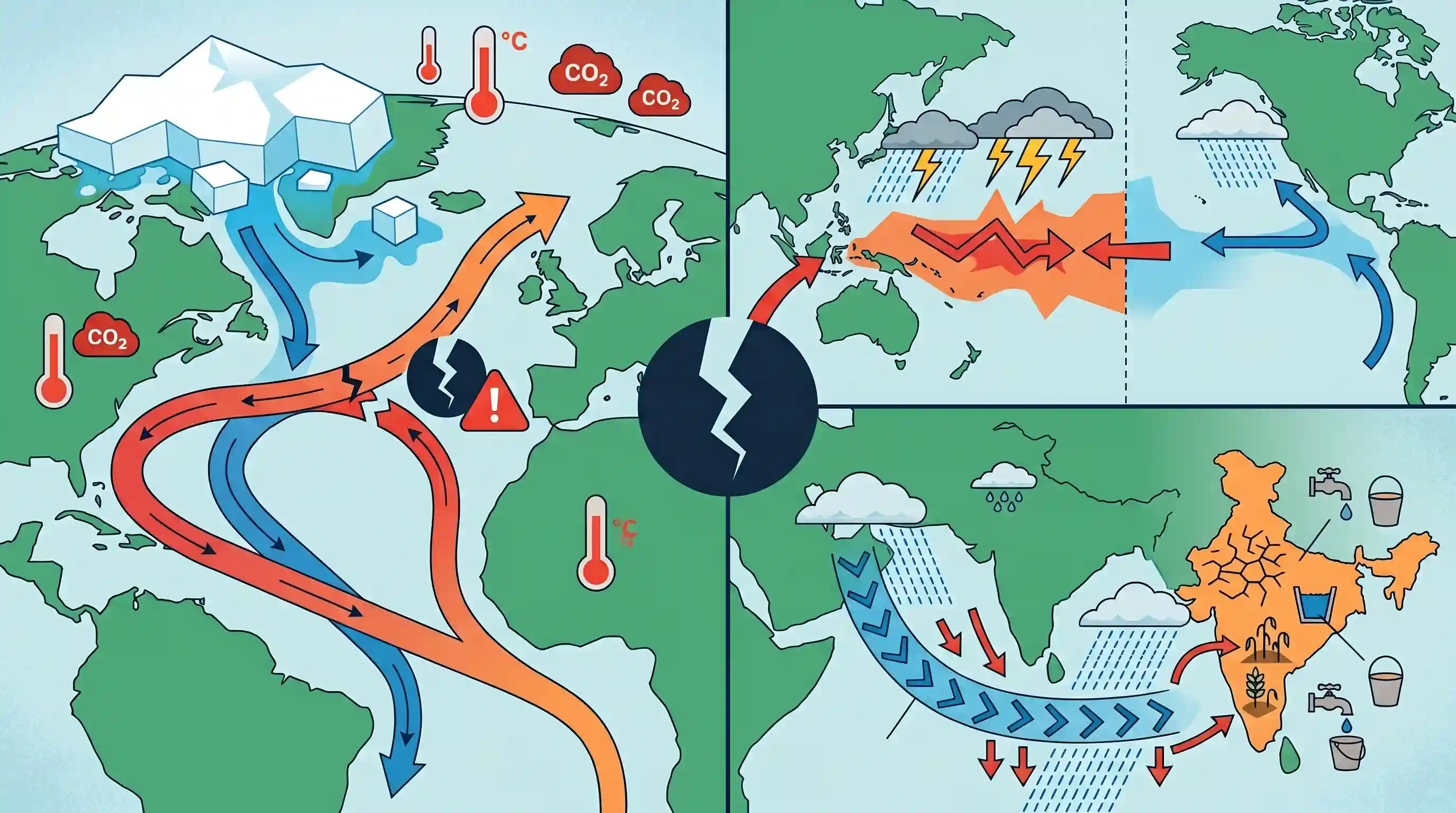
The article discusses the severe global and regional implications of the potential slowdown or collapse of the Atlantic Meridional Overturning Circulation (AMOC) due to climate change. The influx of freshwater from melting Arctic ice threatens to disrupt this critical system of ocean currents. A weakened AMOC acts as a climate tipping point, fundamentally altering phenomena like the El Nino Southern Oscillation (ENSO) by making El Nino events more intense and erratic. Crucially, for India, an AMOC collapse would push the tropical rain belt southward, significantly weakening the southwest monsoon, shortening the wet season, and causing prolonged dry spells, which poses severe threats to agriculture and water security.
Key Points
- The AMOC (Atlantic Meridional Overturning Circulation) is a vital system of ocean currents that acts as a global conveyor belt, driven by differences in temperature and salinity (thermohaline circulation).
- Global warming is accelerating the melting of Arctic ice, releasing freshwater that reduces ocean salinity and density, potentially leading to a tipping point where the AMOC slows down or collapses.
- A weakened AMOC disrupts global climate patterns, notably making the El Nino Southern Oscillation (ENSO) more unpredictable and leading to more extreme El Nino events.
- For India, an AMOC collapse would shift the tropical rain belt southwards, weakening the moisture-laden winds from the Arabian Sea and resulting in a shorter, more erratic southwest monsoon with longer dry spells.
Important Terms
Atlantic Meridional Overturning Circulation (AMOC)

A large-scale system of ocean currents that redistributes heat globally by transporting warm, salty tropical water northwards and returning cold, deep water southwards as a "conveyor belt."
UPSC context
GS Paper 1 (Geography) and Paper 3 (Environment); tests understanding of thermohaline circulation and global heat distribution mechanisms.
Climate Tipping Point
A critical threshold in the Earth's climate system beyond which small changes can trigger abrupt, large-scale, and often irreversible shifts in state (e.g., AMOC collapse or Amazon dieback).
UPSC context
GS Paper 3 (Environment); critical for analyzing non-linear climate risks and IPCC-defined mitigation strategies.
Intertropical Convergence Zone (ITCZ)
A low-pressure belt near the equator where northern and southern trade winds meet; its position dictates tropical rainfall and is critical for the Indian monsoon's onset.
UPSC context
GS Paper 1 (Physical Geography); fundamental concept for planetary winds, monsoons, and climate teleconnections.
El Niño-Southern Oscillation (ENSO)
A periodic fluctuation in sea surface temperatures (El Niño/La Niña) and air pressure (Southern Oscillation) in the tropical Pacific, influencing global weather and Indian monsoon variability.
UPSC context
GS Paper 1 (Geography); essential for understanding monsoon disruptions and agro-climatic forecasting in India.
Southwest Monsoon
India's primary rainfall system (June-September) driven by a pressure gradient between the Indian Ocean and the Asian landmass, providing over 70% of the country's annual precipitation.
UPSC context
GS Paper 1 & 3; vital for Indian agriculture, water security, and economic planning.
Potsdam Institute for Climate Impact Research (PIK)
A globally renowned German research institute specializing in climate change impacts, recognized for its pioneering research on planetary boundaries and climate tipping points.
UPSC context
Prelims (Institutions in News); relevant for sourcing major global climate reports and scientific frameworks like 'Planetary Boundaries.'
Prelims Trap
"Melting Arctic ice increases North Atlantic water density, causing the AMOC to accelerate."
Melting ice adds freshwater, which decreases salinity and density. Lighter water cannot sink, which slows down or halts the thermohaline circulation.
Static Concepts Connected
What drives the Thermohaline Circulation?
- Temperature and Salinity: Cold, salty water is denser, causing it to sink in polar regions like the North Atlantic, acting as the engine for global deep-ocean currents.
- Surface vs Deep: Unlike surface ocean currents which are primarily driven by planetary winds, thermohaline circulation is driven entirely by spatial differences in water density.
How does the ITCZ shift dictate the Indian Southwest Monsoon?
- Thermal Equator: The ITCZ tracks maximum solar heating. In summer, it shifts north over the Tibetan Plateau, creating an intense low-pressure trough.
- Moisture Draw: This northward shift pulls southeast trade winds across the equator, deflecting them into moisture-laden southwest monsoon winds from the Arabian Sea.
- Vulnerability to Cooling: If the Northern Hemisphere cools (e.g., via AMOC collapse), the ITCZ is pushed southward, causing the Indian monsoon to weaken or fail.
Cross-Topic Patterns
Arctic melt to Indian food inflation
AMOC collapse connects polar cryosphere melting directly to Indian agrarian distress via monsoon failure, linking global warming to domestic food security and inflation.
IPCC Climate Tipping Points
AMOC is a definitive 'tipping point'. UPSC often tests the cascading effects of such irreversible thresholds (like Amazon dieback or permafrost thaw) on global ocean-atmosphere coupling.

Expect a multi-statement question linking Arctic freshwater influx, ITCZ southward shifts, and ENSO anomalies via an AMOC slowdown.
Linked PYQs · 5
Linked PYQs · 5
- 2025MainsGS1
Discuss how the changes in shape and sizes of continents and ocean basins of the planet take place due to tectonic movements of the crustal masses.
- 2022MainsGS1
What are the forces that influence ocean currents? Describe their role in fishing industry of the world.
- 2014MainsGS1
Most of the unusual climatic happenings are explained as an outcome of the El-Nino effect. Do you agree?
- 2017MainsGS1
What characteristics can be assigned to monsoon climate that succeeds in feeding more than 50 percent of the world population residing in Monsoon Asia?
- 2025PrelimsGS1
Consider the following statements : Statement I: Scientific studies suggest that a shift is taking place in the Earth's rotation and axis. Statement II: Solar flares and associated coronal mass ejections bombarded the Earth's outermost atmosphere with tremendous amount of energy. Statement III : As the Earth's polar ice melts, the water tends to move towards the equator. Which one of the following is correct in respect of the above statements?
