Amnesty International allegations of genocide in Gaza conflict
Source:The Hindu ↗
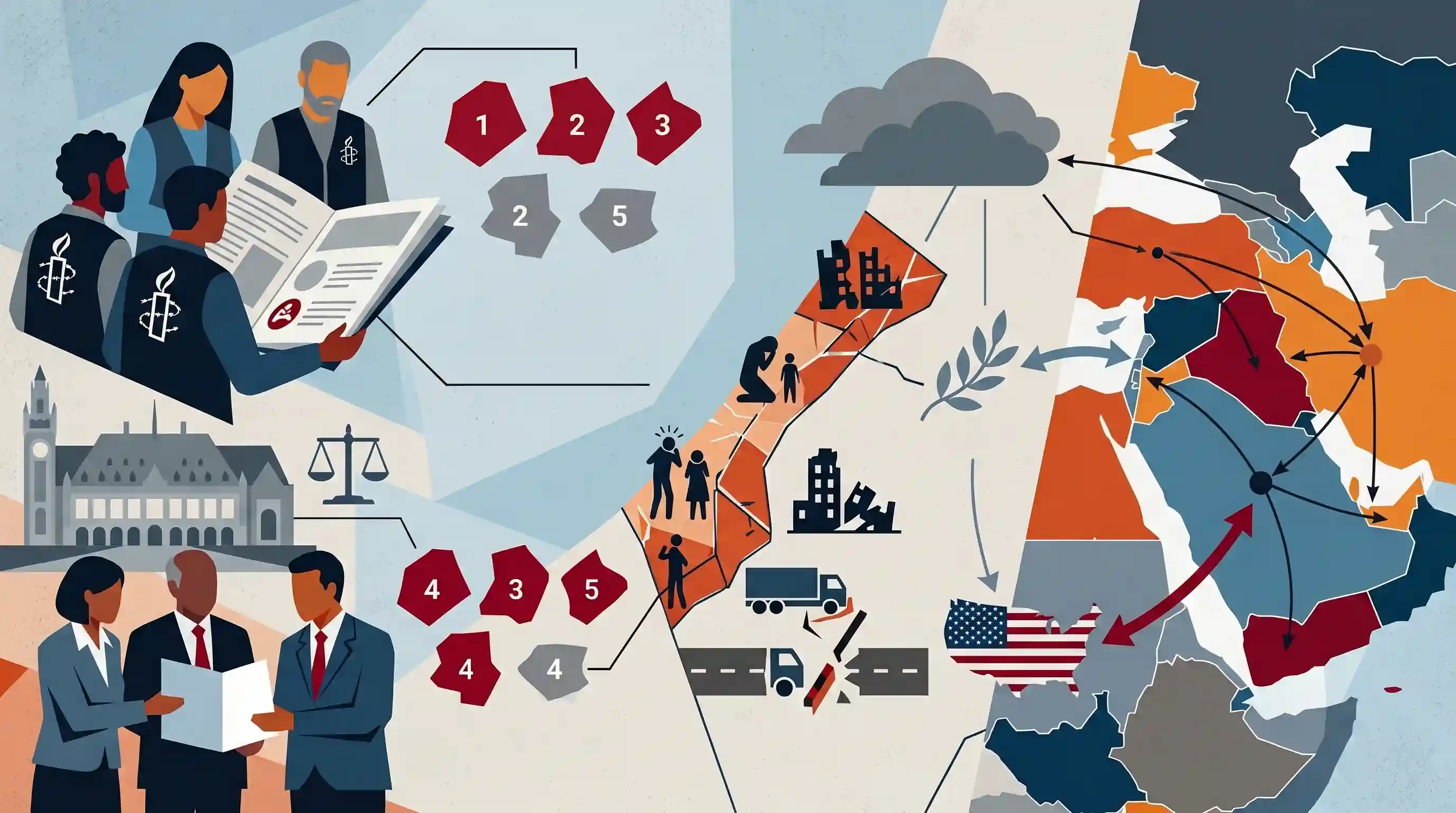
Why It Matters
The article provides critical updates on the Israel-Palestine conflict, invoking international legal frameworks like the UN Genocide Convention and key bodies like the ICJ. Amnesty International's role as a major human rights NGO is directly relevant for Prelims, while the broader humanitarian and geopolitical implications are central to GS2 Mains.
Summary
Amnesty International has released a report concluding that Israel is actively committing genocide against Palestinians in Gaza, fulfilling three out of five acts defined in the 1948 UN Genocide Convention. The findings align with a recent UN Commission of Inquiry report, which accused Israel of four out of five genocidal acts. These declarations underscore the ongoing humanitarian crisis despite a US-brokered truce and echo earlier concerns raised by the International Court of Justice regarding the "plausible" risk of genocide. The developments highlight severe violations of international human rights law and further complicate the geopolitical landscape of West Asia.
Key Points
- Amnesty International has stated that Israel is committing genocide against Palestinians in Gaza, finding evidence for three out of five acts listed in the 1948 UN Genocide Convention.
- A UN independent international Commission of Inquiry also recently concluded that genocide is occurring in Gaza, identifying four out of five genocidal acts.
- The accusations follow prior warnings from the International Court of Justice (ICJ), which ordered Israel to prevent and punish incitement to commit genocide after identifying a "plausible" risk.
- These human rights condemnations come amid a fragile US-brokered truce, underscoring ongoing humanitarian and geopolitical crises in West Asia.
Important Terms
1948 UN Genocide Convention

The first human rights treaty adopted by the UN General Assembly, it defines genocide as five specific acts committed with the intent to destroy a national, ethnical, racial, or religious group.
UPSC context
GS Paper II: International Relations/Treaties. Crucial for understanding the legal threshold of 'genocidal intent' and state obligations.
International Court of Justice (ICJ)
The principal judicial organ of the United Nations that settles legal disputes between states. It recently issued binding provisional measures regarding the 'plausible' risk of genocide in Gaza.
UPSC context
GS Paper II: Important International Institutions. Tests knowledge of ICJ jurisdiction, enforcement powers, and its distinction from the ICC.
Amnesty International
An independent global non-governmental organization (NGO) headquartered in London that researches and campaigns against human rights abuses, often cited in international legal and diplomatic reports.
UPSC context
GS Paper II: Role of NGOs in International Relations. Tests the impact of non-state actors on global human rights policy.
UN Commission of Inquiry
An independent investigative body established by the UN Human Rights Council to investigate alleged violations of international law. Its findings often serve as authoritative evidence for international courts.
UPSC context
GS Paper II: UN Agencies. Relevant for understanding how the UN documents war crimes and human rights violations.
United Nations (UN)
An international organization established in 1945 to maintain international peace and security, protect human rights, and uphold international law through its various organs and specialized agencies.
UPSC context
GS Paper II: Global Groupings and Agreements. The foundational framework for international law and multilateral diplomacy.
Prelims Trap
The International Court of Justice (ICJ) is mandated to prosecute individual political and military leaders for the crime of genocide.
The ICJ settles state-to-state disputes regarding the convention's interpretation. The prosecution of individual political or military leaders for genocide falls exclusively under the International Criminal Court (ICC).
Static Concepts Connected
What are the key provisions of the 1948 UN Genocide Convention?
- Definition: Defines genocide strictly as specific acts committed with the intent to destroy, in whole or in part, a national, ethnical, racial or religious group.
- Dispute Resolution: Mandates that state-to-state disputes regarding the interpretation, application, or fulfillment of the convention are adjudicated by the International Court of Justice (ICJ).
- India's Status: India ratified the convention in 1959, creating binding international obligations, but currently lacks a specific domestic law to penalize genocide.
How do the ICJ and ICC differ in handling international crimes?
- ICJ Mandate: The principal judicial organ of the UN, established in 1945, which exclusively handles state-to-state legal disputes and provides advisory opinions.
- ICC Mandate: An independent, treaty-based court (Rome Statute, 1998) that investigates and prosecutes individuals for genocide, crimes against humanity, and war crimes.
Cross-Topic Patterns
Treaties vs Domestic Legislation
India's ratification of the Genocide Convention without enacting a specific domestic penal law mirrors its approach to the UN Convention against Torture (UNCAT), highlighting a recurring theme in India's international law implementation.
NGOs shaping Global Geopolitics
Amnesty International's findings demonstrate how non-governmental organizations shape international human rights discourse and validate UN independent commissions, wielding significant soft power despite lacking legal enforcement mandates.

Expect a multi-statement Prelims question contrasting ICJ vs ICC jurisdictions regarding genocide, combined with India's ratification status.
Linked PYQs · 4
Linked PYQs · 4
- 2015PrelimsGS1
Amnesty International is
- 2018PrelimsGS1
"Rule of Law Index" is released by which of the following?
- 2018MainsGS2
“India’s relations with Israel have, of late, acquired a depth and diversity, which cannot be rolled back.” Discuss.
- 2019MainsGS2
‘Too little cash, too much politics, leaves UNESCO fighting for life.’ Discuss the statement in the light of US' withdrawal and its accusation of the cultural body as being 'anti-Israel bias'.
