Constitutional Bills on Removal of Detained Ministers and Executives
Source:The Hindu ↗
Why It Matters
These Bills address a major gap in the Constitution regarding the continuation in office of top executive functionaries while under arrest for serious crimes. It directly intersects with the UPSC GS-2 syllabus on Constitutional provisions, representation of people, executive accountability, and ongoing debates surrounding the criminalisation of politics.
Summary
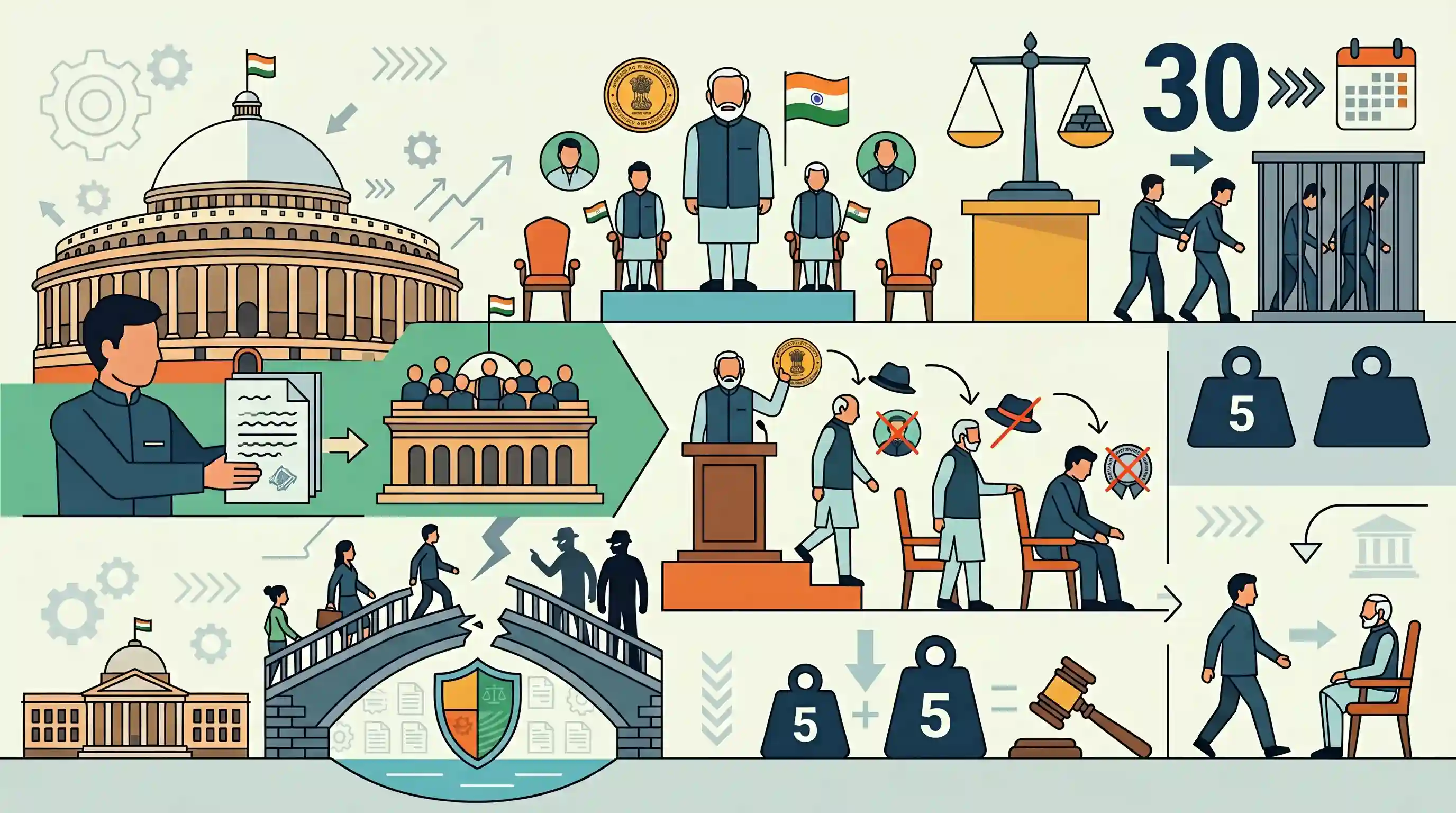
The Union Government introduced three Bills in the Lok Sabha, including the Constitution (130th Amendment) Bill, 2025, to mandate the removal of the Prime Minister, Chief Ministers, and other ministers if they are arrested and detained for 30 consecutive days on serious criminal charges (punishable by five or more years). The Bills seek to amend Articles 75, 164, and 239AA, plugging a constitutional gap, while allowing for reappointment upon release from custody.
Key Points
- Union Home Minister Amit Shah introduced three Bills in the Lok Sabha to establish a legal framework for removing the Prime Minister, Chief Ministers, and Union/State Ministers if arrested on serious criminal charges.
- The Bills mandate the removal of elected representatives held in custody for 30 consecutive days for offences punishable by five or more years in prison, effective on the 31st day.
- Removal authority lies with the President for the PM and Union Ministers, Governors for State CMs/Ministers, and Lt-Governors for UT CMs/Ministers.
- The proposed legislation amends Articles 75, 164, and 239AA of the Constitution, addressing the current lack of constitutional provisions for dismissing detained ministers.
- Removed ministers are eligible for reappointment upon release from custody.
Important Terms
Constitution (130th Amendment) Bill, 2025

A proposed law mandating the removal of the Prime Minister, Chief Ministers, and other Ministers if detained for 30 consecutive days on serious criminal charges (punishable by five or more years).
UPSC context
GS II: Governance and Constitution; tests legislative attempts to curb criminalisation and ensure high standards of conduct in high executive offices.
Article 75
Constitutional provision governing the Union Council of Ministers, specifying that the Prime Minister is appointed by the President and other ministers serve at the President's pleasure.
UPSC context
GS II: Indian Polity; fundamental for understanding the Union Executive, the principle of collective responsibility, and executive accountability to the legislature.
Article 164
Constitutional provision governing State Councils of Ministers, outlining that the Chief Minister is appointed by the Governor and ministers serve at the Governor's pleasure.
UPSC context
GS II: Indian Polity; essential for understanding State Executive dynamics, gubernatorial powers, and the legal framework for state-level governance.
Article 239AA
A constitutional provision granting special status to Delhi as the National Capital Territory, including a Legislative Assembly and a Council of Ministers headed by a Chief Minister.
UPSC context
GS II: Federalism and Union Territories; critical for understanding the unique governance structure of Delhi and ongoing constitutional administrative disputes.
Jammu and Kashmir Reorganisation (Amendment) Bill, 2025
A legislative proposal to amend the 2019 Act, enabling the removal of Jammu and Kashmir’s Chief Minister or ministers if detained for 30 consecutive days for serious offences.
UPSC context
GS II: Governance/Regional dynamics; tests knowledge of the evolving legal status of J&K and central oversight over its internal governance.
Government of Union Territories (Amendment) Bill, 2025
A legislative proposal to amend the 1963 Act, providing a legal framework for removing the Chief Minister or ministers of Puducherry if detained on serious criminal charges.
UPSC context
GS II: Governance; concerns the administration of Union Territories with legislatures and the legal accountability mechanisms for their executive members.
Prelims Trap
Under the 130th Amendment, an MP or MLA is disqualified if detained for 30 consecutive days.
The amendment only removes them from ministerial office (PM/CM/Minister). It does NOT disqualify them as MPs/MLAs. Disqualification from the legislature still requires conviction.
Static Concepts Connected
How does the Representation of the People Act, 1951 govern lawmaker disqualification?
- Section 8(3): Disqualifies lawmakers convicted of any offence and sentenced to imprisonment for two years or more.
- Lily Thomas Case: The Supreme Court struck down Section 8(4), ensuring immediate disqualification upon conviction, removing the appeal window.
How do Articles 75 and 164 govern ministerial tenure?
- Pleasure Doctrine: Ministers are appointed by the President/Governor on the advice of the PM/CM and hold office during their pleasure.
- Collective Responsibility: The Council of Ministers is collectively responsible to the Lok Sabha or the State Legislative Assembly.
Cross-Topic Patterns
RPA Conviction vs. CAA Custody
While RPA Section 8 requires judicial conviction for legislative disqualification, the 130th CAA introduces a novel executive removal mechanism based purely on extended pre-trial custody.
Federalism and Agency Misuse
Granting Governors the power to remove detained CMs intersects with debates on federalism and the alleged weaponization of Central investigative agencies against opposition state governments.

Expect a tricky prelims statement contrasting RPA 1951 'conviction' disqualification against the 130th CAA 'detention' removal of ministers.
Linked PYQs · 2
Linked PYQs · 2
- 2020MainsGS2
There is a need for simplification of procedure for disqualification of persons found guilty of corrupt practices under the Representation of Peoples Act". Comment.
- 2019MainsGS2
On what grounds a people's representative can be disqualified under the Representation of Peoples Act, 1951? Also mention the remedies available to such person against his disqualification.
