Internal Security Counter Terrorism Frameworks and Coordination
Source:The Hindu ↗
Why It Matters
Highlights the evolving strategy in India's internal security framework, focusing on inter-agency coordination, emerging technological tools like digital forensics, and proactive policy measures (upcoming anti-terror policy) to tackle complex terror and financing networks.
Summary
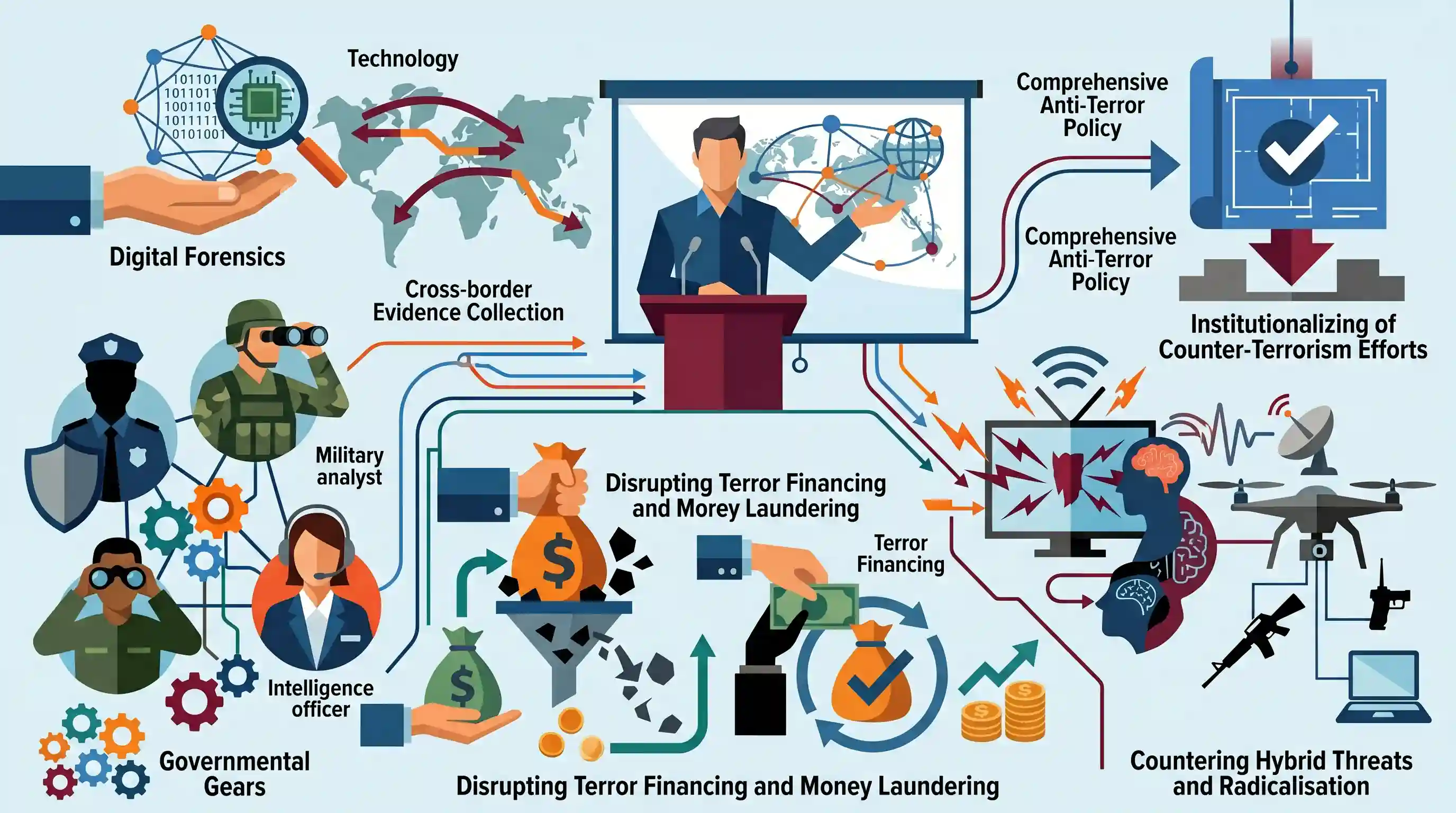
Union Home Minister Amit Shah is set to inaugurate an anti-terror conference in New Delhi, organized by the National Investigation Agency (NIA). The conference aims to strengthen coordination among state police and central agencies through a 'whole of government' approach. Focus areas include digital forensics, cross-border evidence collection, disrupting terror financing, and countering hybrid threats and radicalisation. Additionally, the event precedes the expected release of India's first comprehensive anti-terror policy, highlighting the government's strategic shift toward institutionalizing counter-terrorism efforts and leveraging technology.
Key Points
- The National Investigation Agency (NIA) is organizing an anti-terror conference to foster a 'whole of government' approach to internal security.
- The agenda includes discussions on digital forensics, collecting evidence from foreign jurisdictions, and disrupting terror financing networks.
- It aims to address the multi-dimensional nature of modern security challenges, including radicalisation, espionage, and hybrid threats.
- The central government is preparing to launch India's first comprehensive anti-terror policy to streamline counter-terrorism efforts.
Important Terms
National Investigation Agency (NIA)

India's premier federal counter-terrorism agency, established under the NIA Act, 2008. It has pan-India jurisdiction to investigate and prosecute offences affecting national security without prior state consent.
UPSC context
GS Paper III: Internal Security; essential for understanding institutional frameworks and federal challenges in counter-terrorism.
National Counter-Terrorism Policy (PRAHAAR)
A unified framework (titled 'PRAHAAR') designed to institutionalize counter-terrorism. It focuses on 'zero tolerance,' intelligence-led prevention, de-radicalisation, and standardized anti-terror structures across states.
UPSC context
GS Paper III: Security; relevant for questions on evolving national security doctrines and policy-led responses to terrorism.
Whole-of-Government Approach
An administrative strategy aimed at breaking silos by ensuring seamless coordination, real-time intelligence sharing, and unified action between central agencies (NIA, IB, RAW) and state police forces.
UPSC context
GS Paper III: Internal Security; tests understanding of governance and inter-agency coordination in crisis management.
Multi-Agency Centre (MAC)
An intelligence-sharing platform under the Intelligence Bureau (IB) where various security agencies collaborate to fuse and analyze terror-related information for proactive threat prevention.
UPSC context
GS Paper III: Security; vital for discussing intelligence reforms and real-time security coordination mechanisms.
Unlawful Activities (Prevention) Act (UAPA)
The primary anti-terror law in India used to designate individuals/organisations as terrorists and provide legal powers for investigation, asset seizure, and prosecution.
UPSC context
GS Paper II & III: Governance and Security; tests knowledge of legal frameworks and civil liberty balances.
Digital Radicalisation
The process where individuals are influenced toward extremist ideologies through social media and encrypted platforms; a primary target for India's new anti-terror strategy.
UPSC context
GS Paper III: Cybersecurity and Internal Security; critical for analyzing new-age hybrid threats and propaganda.
Ministry of Home Affairs (MHA)
The nodal ministry for internal security in India. It oversees the NIA and is responsible for formulating counter-terrorism policies and managing state-center security relations.
UPSC context
GS Paper II: Executive and Ministries; core to the administrative framework of national security.
Prelims Trap
"NIA requires prior permission from the respective State Government to investigate terrorism-related offenses."
Under the NIA Act, 2008, the NIA has concurrent jurisdiction. It can take suo motu cognizance of scheduled offenses anywhere in India without needing the State's permission.
Static Concepts Connected
What are the scheduled offenses under the NIA Act, 2008?
- Original Scope: Originally included offenses under UAPA, Atomic Energy Act, Anti-Hijacking Act, and Weapons of Mass Destruction Act.
- 2019 Amendment: Added human trafficking, counterfeit currency, manufacture/sale of prohibited arms, cyber-terrorism, and Explosive Substances Act.
- Extraterritoriality: Extends to Indian citizens outside India and persons committing scheduled offenses against Indian citizens or affecting Indian interests abroad.
How does India institutionally counter terror financing?
- Statutory Backing: Prevention of Money Laundering Act (PMLA) 2002 and Unlawful Activities (Prevention) Act (UAPA) 1967 criminalize terror funding.
- Institutional Framework: Financial Intelligence Unit-India (FIU-IND) tracks suspicious transactions and coordinates with global bodies like the FATF.
- NIA TFFC Cell: A specialized Terror Funding and Fake Currency (TFFC) Cell operates within the NIA to systematically crack down on hawala and formal funding channels.
Cross-Topic Patterns
Organised crime + Terrorism nexus
Disrupting terror financing ties directly to narco-trafficking and illegal arms trade, specifically in border states adjacent to the Golden Crescent and Golden Triangle.
Digital forensics + Cyber-terrorism
'Borderless terrorism' via the dark web and encrypted apps necessitates integrating cybersecurity mandates (like CERT-In) with traditional counter-terrorism law enforcement.

NIA's extraterritorial jurisdiction and the proposed comprehensive anti-terror policy are ripe for a 2026 multi-statement Prelims question.
Linked PYQs · 3
Linked PYQs · 3
- 2021MainsGS3
Analyse the complexity and intensity of terrorism, its causes, linkages and obnoxious nexus. Also suggest measures required to be taken to eradicate the menace of terrorism.
- 2022MainsGS3
Discuss the types of organised crimes. Describe the linkages between terrorists and organised crime that exist at the national and transnational levels.
- 2021MainsGS3
Discuss how emerging technologies and globalisation contribute to money laundering. Elaborate measures to tackle the problem of money laundering both at national and international levels.
