Siliguri Corridor Security Reviewed During Union Home Minister Visit
Source:the-statesman ↗
Why It Matters
The Siliguri Corridor is India's most critical geographical vulnerability; its security is essential to maintaining territorial continuity with the Northeast. The transition to new criminal laws is a landmark administrative reform relevant for competitive exams.
Summary
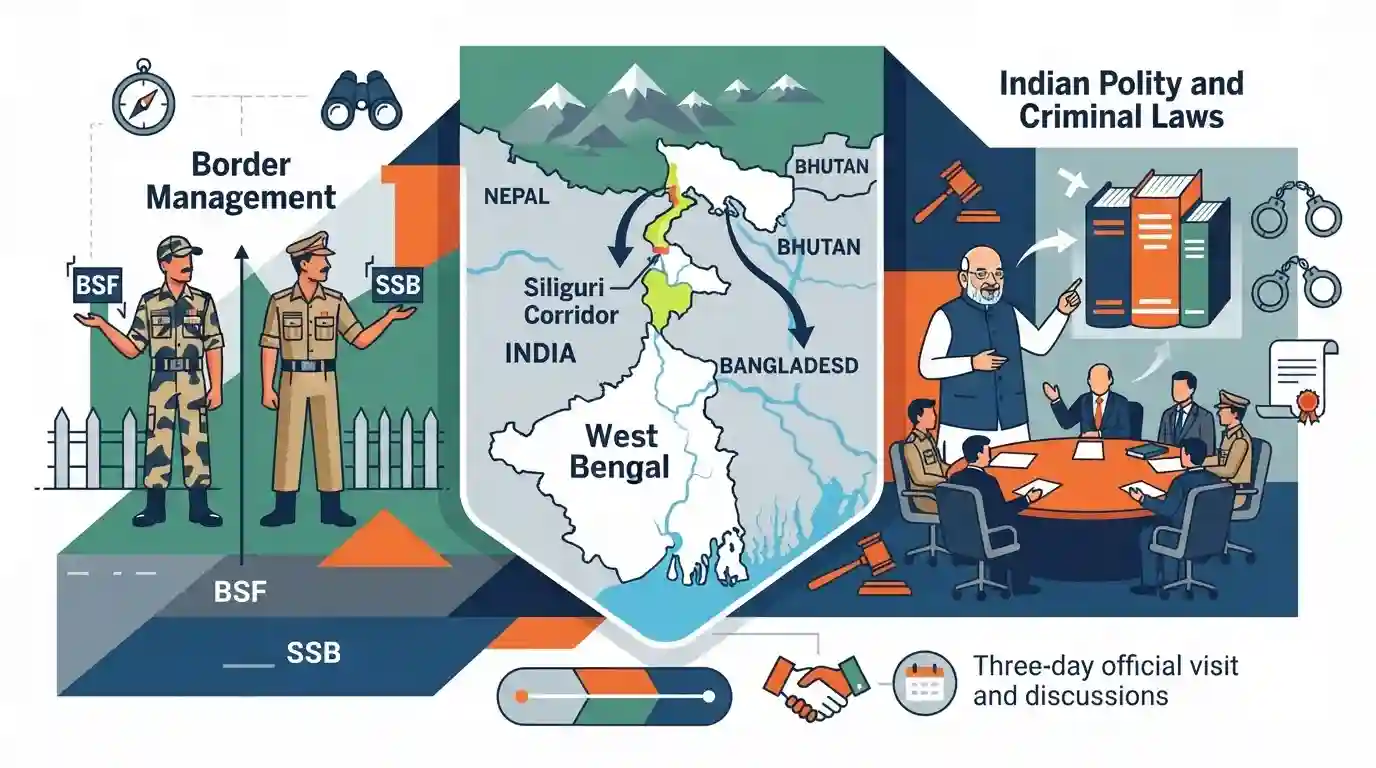
Union Home Minister Amit Shah is on a three-day official visit to Siliguri to review the security apparatus of the Siliguri Corridor (Chicken's Neck). The corridor is of immense strategic importance as it links mainland India to the Northeast and is bordered by Nepal, Bhutan, and Bangladesh. Shah will evaluate border management by forces like the SSB and BSF, and hold discussions regarding the implementation of India's three newly enacted criminal laws replacing the colonial-era penal codes.
Key Points
- Union Home Minister Amit Shah is visiting Siliguri for three days to assess the security of the strategically crucial Siliguri Corridor, also known as the Chicken's Neck.
- The corridor is a sensitive geopolitical chokepoint that connects mainland India with the northeastern states and shares borders with Nepal, Bhutan, and Bangladesh.
- Shah will review the operations and preparedness of the Sashastra Seema Bal (SSB), which guards the Nepal and Bhutan borders, and the Border Security Force (BSF), which guards the Bangladesh border.
- The visit also involves a sensitization program for local officials regarding the implementation of three new criminal laws (Bharatiya Nyay Sanhita, Bharatiya Nagarik Suraksha Sanhita, and Bharatiya Sakshya Adhiniyam).
Important Terms
Bharatiya Nyaya Sanhita

India's new primary criminal code that replaced the colonial-era Indian Penal Code (IPC) on July 1, 2024. It modernizes offenses, introduces community service, and specifically addresses contemporary crimes like terrorism.
UPSC context
Highly relevant for Indian Polity (Paper V). Tests knowledge of the recent landmark overhaul of India's criminal justice system.
Bharatiya Nagarik Suraksha Sanhita
The procedural criminal law replacing the 1973 Criminal Procedure Code. It mandates strict timelines for police investigations, promotes electronic FIRs, and integrates digital forensics to streamline the judicial process.
UPSC context
Crucial for Paper V (Polity). Questions may test its procedural differences from the erstwhile CrPC, such as new timelines and digital integration.
Bharatiya Sakshya Adhiniyam
India's updated evidence law replacing the Indian Evidence Act of 1872. It expands the legal admissibility of electronic and digital records, aligning courtroom procedures with modern technological advancements.
UPSC context
Important for Polity and Current Affairs. Candidates must know the triad of new criminal laws and the specific colonial acts they replaced.
Sashastra Seema Bal (SSB)
A Central Armed Police Force deployed to guard India's open borders with Nepal and Bhutan. Along the strategic Siliguri Corridor, it is responsible for preventing trans-border crimes and managing security.
UPSC context
Vital for Geography (Paper III) and Internal Security. Tests the specific border jurisdictions of various Central Armed Police Forces.
Border Security Force (BSF)
India's primary border guarding force for its boundaries with Bangladesh and Pakistan. Around the Siliguri Corridor, the BSF actively mitigates illegal immigration, human trafficking, and cross-border smuggling.
UPSC context
Features in Geography and Internal Security (Paper III & IV). Aspirants must distinguish BSF's role (Bangladesh/Pakistan) from SSB (Nepal/Bhutan).
Prelims Trap
"The Siliguri Corridor directly shares international borders with Nepal, Bhutan, Bangladesh, and China."
While strategically vulnerable to China's Chumbi Valley, the corridor itself only borders Nepal, Bhutan, and Bangladesh. Aspirants often wrongly assume a direct Chinese border here.
Static Concepts Connected
Which CAPFs guard the international borders surrounding the Siliguri Corridor?
- SSB: Guards the open and unfenced international borders with Nepal and Bhutan. Operated under MHA since 1963.
- BSF: Secures the heavily fenced and riverine border with Bangladesh. West Bengal shares 54% of this boundary.
What are the three new criminal laws replacing India's colonial-era codes?
- BNS: Bharatiya Nyaya Sanhita (BNS) officially replaces the Indian Penal Code (IPC) of 1860.
- BNSS: Bharatiya Nagarik Suraksha Sanhita (BNSS) replaces the Code of Criminal Procedure (CrPC).
- BSA: Bharatiya Sakshya Adhiniyam (BSA) replaces the Indian Evidence Act of 1872.
Cross-Topic Patterns
Chicken's Neck & Chumbi Valley Vulnerability
The corridor's internal security is intrinsically tied to India's geopolitical posturing against China, specifically regarding the proximity of the Chumbi Valley and past Doklam standoffs.
Decolonization of India's Criminal Laws
MHA sensitizations on BNS, BNSS, and BSA link directly to Mains GS-II governance themes, highlighting the operational challenge of transitioning from colonial penal codes to modern frameworks.

Expect a multi-statement question on CAPF mandates (SSB vs BSF) intersecting with the geography of West Bengal's Siliguri Corridor.
Linked PYQs · 2
Linked PYQs · 2
- 2015WBCS_PRELIMSGS1
West Bengal has international boundaries on
- 2020WBCS_PRELIMSGS1
Chumbi Valley is on boundary of
