Manipur Security Review and Post-Conflict Rehabilitation
Source:The Hindu ↗
Why It Matters
The situation in Manipur represents a critical internal security vulnerability, demonstrating the complex interplay between drug cartels, ethnic rivalries, and state governance in border areas. It underscores the challenges of post-conflict reconstruction and Centre-State administrative synergy.
Summary
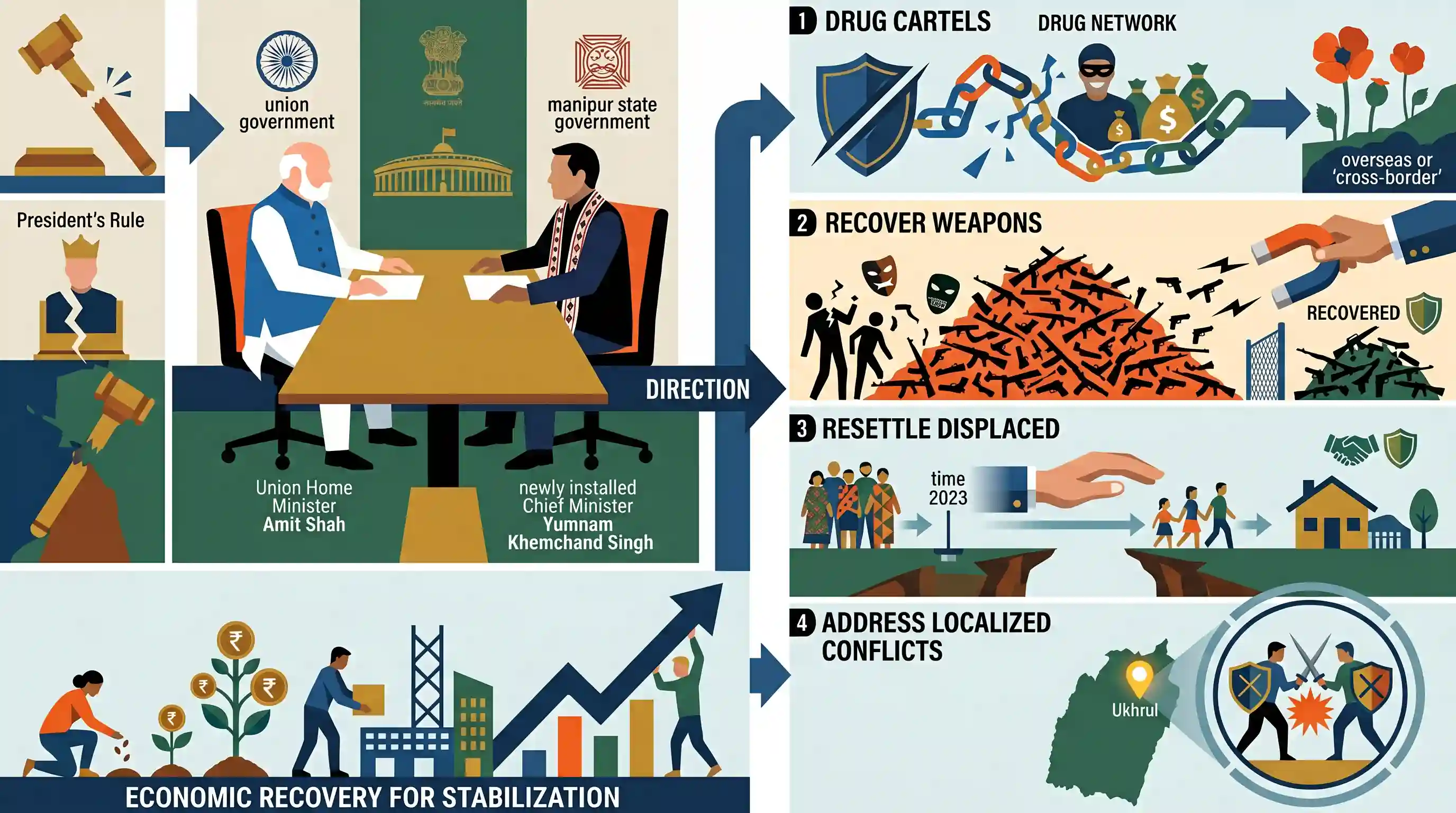
Union Home Minister Amit Shah reviewed the security situation in Manipur, marking the first such meeting since the revocation of President's Rule in the state. Meeting with newly installed Chief Minister Yumnam Khemchand Singh, Shah directed the state administration to aggressively pursue drug cartels, recover over 6,000 looted police weapons, and resettle those displaced by the ethnic violence that began in May 2023. The discussion also addressed emerging localized conflicts, such as tensions between Kuki and Tangkhul Nagas in Ukhrul district, and emphasized economic recovery strategies to stabilize the region.
Key Points
- Union Home Minister Amit Shah held a security review meeting with Manipur's new CM Yumnam Khemchand Singh following the revocation of President's Rule.
- Directives were issued to crack down on drug cartels, recover thousands of looted police weapons, and prioritise the resettlement of 60,000 displaced people.
- The meeting addressed recent tensions between Kuki and Tangkhul Nagas in Ukhrul district, highlighting ongoing inter-ethnic friction beyond the Meitei-Kuki conflict.
- The Home Ministry advised the State to prepare a roadmap for economic revival by identifying sick industrial units.
Important Terms
President's Rule (Article 356)

A constitutional provision (Article 356) allowing the Union to assume direct control of a state if its governance fails. In Manipur, this was revoked in February 2026 to reinstall an elected government.
UPSC context
GS Paper 2: Federalism and Emergency provisions. Tests understanding of Centre-State relations and the 'breakdown of constitutional machinery' threshold.
Article 355
A provision mandating the Union's duty to protect states against 'internal disturbance' and 'external aggression.' It serves as a precursor to direct intervention or the appointment of Central security advisors.
UPSC context
GS Paper 2 & 3: Centre-State relations and Internal Security. Tests the Union's constitutional obligation to maintain state-level order.
Kuki-Zo Council
An umbrella body formed in October 2024 representing various Kuki-Zo tribes in Manipur. It acts as the primary political platform for negotiating peace and administrative safeguards with the Union Government.
UPSC context
GS Paper 3: Internal Security and Ethnic Conflict. Tests knowledge of Northeast ethnic movements and the role of civil society in peace negotiations.
Free Movement Regime (FMR)
A bilateral arrangement allowing tribes living along the India-Myanmar border to travel 16km across without a visa. Its 2024 suspension aims to prevent illegal migration and insurgent movements.
UPSC context
GS Paper 3: Border Management. Tests understanding of porous borders, Act East Policy, and security challenges in the Northeast.
Golden Triangle
A major illicit drug-producing region where the borders of Myanmar, Thailand, and Laos meet. Its proximity to Manipur facilitates narcotic smuggling that funds insurgent groups and fuels local conflict.
UPSC context
GS Paper 3: Organized Crime and Internal Security. Tests knowledge of the linkage between drug trafficking, money laundering, and insurgency.
Ministry of Home Affairs (MHA)
The nodal Central ministry responsible for internal security, border management, and Northeast affairs. It coordinates counter-insurgency operations and peace accords with various ethnic groups in the region.
UPSC context
GS Paper 2 & 3: Statutory bodies and Security architecture. Tests understanding of the executive role in managing domestic crises.
Prelims Trap
"Manipur's tribal hill districts are administered as autonomous districts under the Sixth Schedule."
Manipur is NOT in the Sixth Schedule (which applies to Assam, Meghalaya, Tripura, Mizoram). Its hill areas are protected under Article 371C via a Hill Areas Committee.
Static Concepts Connected
What are the special provisions for Manipur under Article 371C of the Constitution?
- Hill Areas Committee: Mandates the creation of a committee consisting of MLAs elected from the state's designated Hill Areas to safeguard tribal interests.
- Governor's Responsibility: The Governor must submit an annual report to the President specifically regarding the administration of these Hill Areas.
- Union Executive Power: The Union government can give binding directions to the State regarding the administration of the Hill Areas.
How does the 'Golden Triangle' impact Northeast India's internal security?
- Geographic Proximity: Encompasses the borders of Myanmar, Laos, and Thailand, acting as a major global hub for illicit opium production.
- Narco-Terror Nexus: Proceeds from drug trafficking fund regional insurgent outfits, enabling weapon procurement and sustaining armed non-state actors.
- Border Management: Porous Indo-Myanmar borders facilitate this smuggling, prompting recent federal measures like the suspension of the Free Movement Regime (FMR).
Cross-Topic Patterns
Golden Triangle & FMR Suspension
The aggressive push against drug cartels links directly to the Centre's recent move to suspend the Free Movement Regime (FMR) along the porous Indo-Myanmar border to curb narco-terrorism.
Inter-Tribal Faultlines & Geography
Beyond the Meitei-Kuki divide, localized clashes like Kuki vs. Tangkhul Nagas in Ukhrul highlight how mass displacement creates dangerous new resource competition in adjacent border districts.

Expect a multi-statement Prelims question contrasting Manipur's Article 371C (Hill Areas Committee) with 6th Schedule and ILP provisions.
Linked PYQs · 5
Linked PYQs · 5
- 2017MainsGS3
The North-East region of India has been infested with insurgency for a very long time. Analyze the major reasons for the survival of armed insurgency in this region.
- 2019MainsGS3
Cross-border movement of insurgents is only one of the several security challenges facing the policing of the border in North-East India. Examine the various challenges currently emanating across the India-Myanmar border. Also, discuss the steps to counter the challenges.
- 2025MainsGS3
What are the major challenges to internal security and peace process in the North-Eastern States? Map the various peace accords and agreements initiated by the government in the past decade.
- 2023MainsGS3
The use of unmanned aerial vehicles (UAVs) by our adversaries across the borders to ferry arms/ammunitions, drugs, etc., is a serious threat to the internal security. Comment on the measures being taken to tackle this threat.
- 2020MainsGS3
Analyze internal security threats and transborder crimes along Myanmar, Bangladesh and Pakistan borders including Line of Control (LoC). Also discuss the role played by various security forces in this regard.
