Historical Analysis of the 1962 Sino-Indian War and Northeast Security
Source:Indian Express ↗
Why It Matters
Helps aspirants separate political rhetoric from historical context regarding the 1962 India-China War, which is a key topic in GS1 (Post-Independence History) and forms the basis for GS2/GS3 issues related to China border disputes and North East security.
Summary
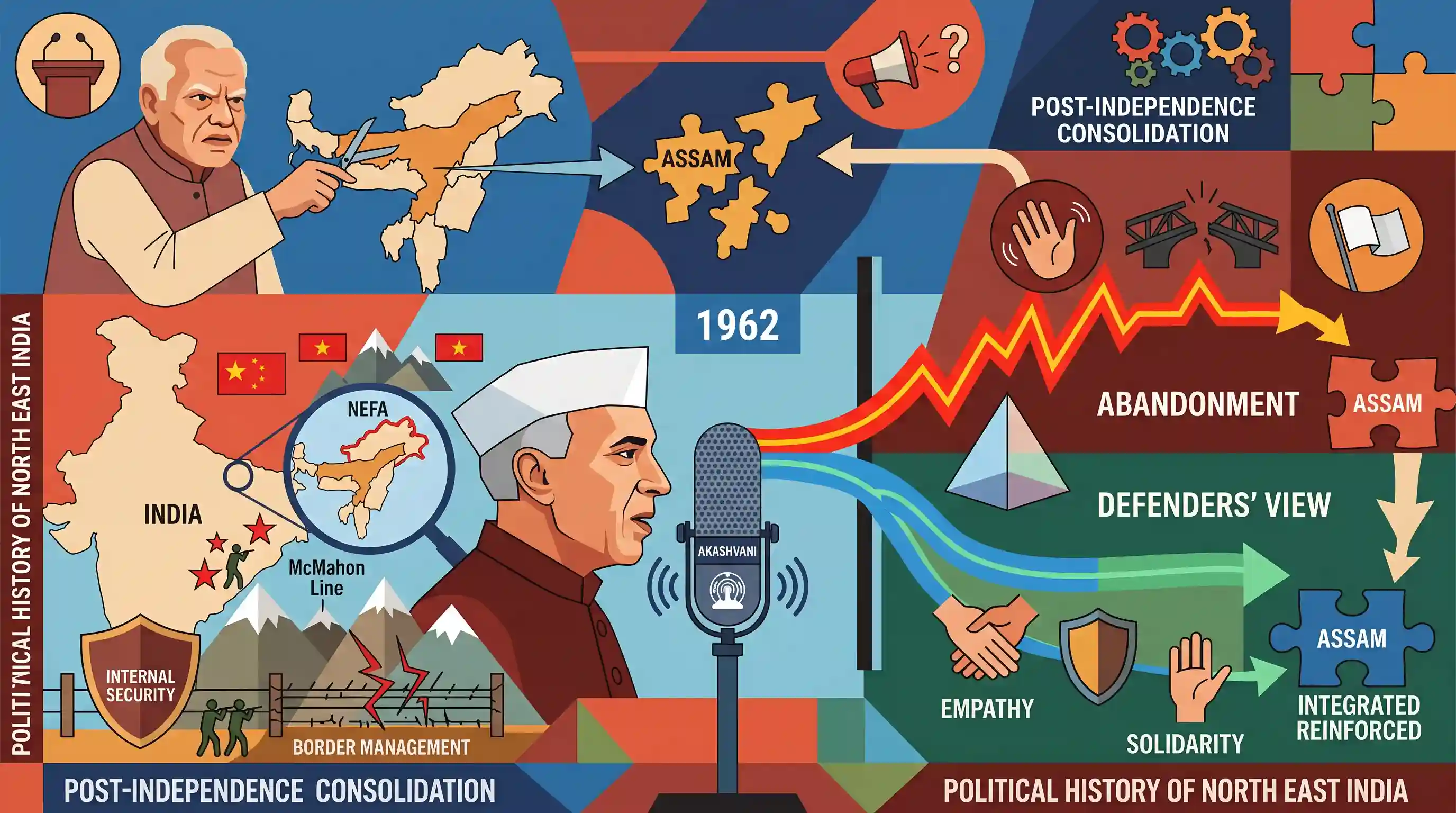
The article fact-checks and contextualizes a political claim by Home Minister Amit Shah that former Prime Minister Jawaharlal Nehru abandoned Assam during the 1962 Sino-Indian War. It examines Nehru's November 1962 radio broadcast—made as Chinese forces breached NEFA (now Arunachal Pradesh) and threatened Assam—detailing the debate between critics who view his words as an admission of defeat and defenders who interpret them as an expression of empathy and solidarity amidst a severe military crisis.
Key Points
- The controversy revolves around former PM Jawaharlal Nehru's November 20, 1962, radio broadcast after Chinese forces captured Bomdila and advanced toward the Assam plains.
- Home Minister Amit Shah claimed Nehru effectively bid 'bye bye' to Assam, leaving the state vulnerable to Chinese aggression.
- Nehru's actual broadcast stated his 'heart goes out to the people of Assam,' which critics view as an abandonment, while defenders argue it was a poignant expression of solidarity and resolve to fight back.
- The historical debate highlights the strategic fragility of the Northeast region during the early years of post-independence consolidation and the lasting political resonance of the 1962 war.
Important Terms
1962 Sino-Indian War

A month-long military conflict (Oct–Nov 1962) between India and China over disputed territories in Aksai Chin and NEFA, ending in a unilateral Chinese ceasefire and significant Indian strategic shifts.
UPSC context
GS Paper I (Modern History/Post-Independence) & GS II (International Relations); tests understanding of border disputes and geopolitical shifts.
North-East Frontier Agency (NEFA)
The former administrative division (now Arunachal Pradesh) that served as the primary eastern theater during the 1962 war, historically administered by the Governor of Assam for the President.
UPSC context
GS Paper I & III; relates to the historical geography of the North-East and border security challenges.
Post-Independence Consolidation
A core syllabus theme describing India's efforts after 1947 to integrate princely states, reorganize states on linguistic lines, and secure its national frontiers against external threats.
UPSC context
GS Paper I (History); critical for analyzing nation-building, the Nehruvian era, and internal territorial reorganization.
Border Management
The coordinated policy of securing national frontiers through infrastructure, surveillance, and military outposts; the 1962 war catalyzed modernization in this sector, including the creation of the BRO.
UPSC context
GS Paper III (Internal Security); focuses on the security of borders and infrastructure development in difficult terrains.
Forward Policy
An Indian strategic policy involving the establishment of military outposts in disputed border areas with China to assert territorial claims, often cited as a precursor to the 1962 war.
UPSC context
GS Paper I & II; relevant for critical evaluation of pre-war military strategies and their diplomatic consequences.
Prelims Trap
"NEFA was an Indian state during the 1962 Sino-Indian War."
NEFA was directly administered by the Centre in 1962. It only became a Union Territory in 1972 and attained full statehood as Arunachal Pradesh in 1987.
Static Concepts Connected
What is the McMahon Line and what is the core of the dispute?
- 1914 Simla Convention: Drawn by Sir Henry McMahon between British India and Tibet, establishing the de facto eastern border.
- Chinese Rejection: China refuses to recognize it, arguing that Tibet was not a sovereign state and therefore lacked the legal authority to sign international treaties.
How did the political status of Arunachal Pradesh evolve post-independence?
- Pre-1972 status: Known as the North-East Frontier Agency (NEFA), it was administered by the Governor of Assam as an agent of the President (MEA, then MHA).
- UT and Statehood: Reorganized into a Union Territory in 1972 and finally granted full statehood in 1987 through the State of Arunachal Pradesh Act.
Cross-Topic Patterns
1962 strategy vs. Vibrant Villages
Historically, India kept border areas underdeveloped to slow potential Chinese incursions post-1962. Modern schemes like Vibrant Villages actively reverse this by prioritizing civilian habitation and border infrastructure.
1962 impact on Non-Alignment
The 1962 military crisis forced Nehru to request US and British aid, exposing the practical limits of early Non-Alignment and laying the groundwork for India's contemporary multi-alignment strategy.

The administrative evolution of NEFA to Arunachal Pradesh paired with McMahon Line history is prime for a Post-Independence 2026 question.
Linked PYQs · 3
Linked PYQs · 3
- 2025MainsGS1
Trace India's consolidation process during early phase of independence in terms of polity, economy, education and international relations.
- 2012MainsGS2
Do you think that China's emergence as one of the largest trading partners of India has adversely affected the settlement of the outstanding border problem?
- 2024MainsGS3
India has a long and troubled border with China and Pakistan fraught with contentious issues. Examine the conflicting issues and security challenges along the border. Also give out the development being undertaken in these areas under the Border Area Development Programme (BADP) and Border Infrastructure and Management (BIM) Scheme.
