Government addresses federal concerns regarding delimitation exercise
Source:Indian Express ↗
Why It Matters
The interplay between women's reservation, the impending delimitation of constituencies, and federal relations is a highly probable topic for both Prelims and Mains. It touches on constitutional principles of proportional representation, federal parity between North and South India, and demographic dividends/penalties.
Summary
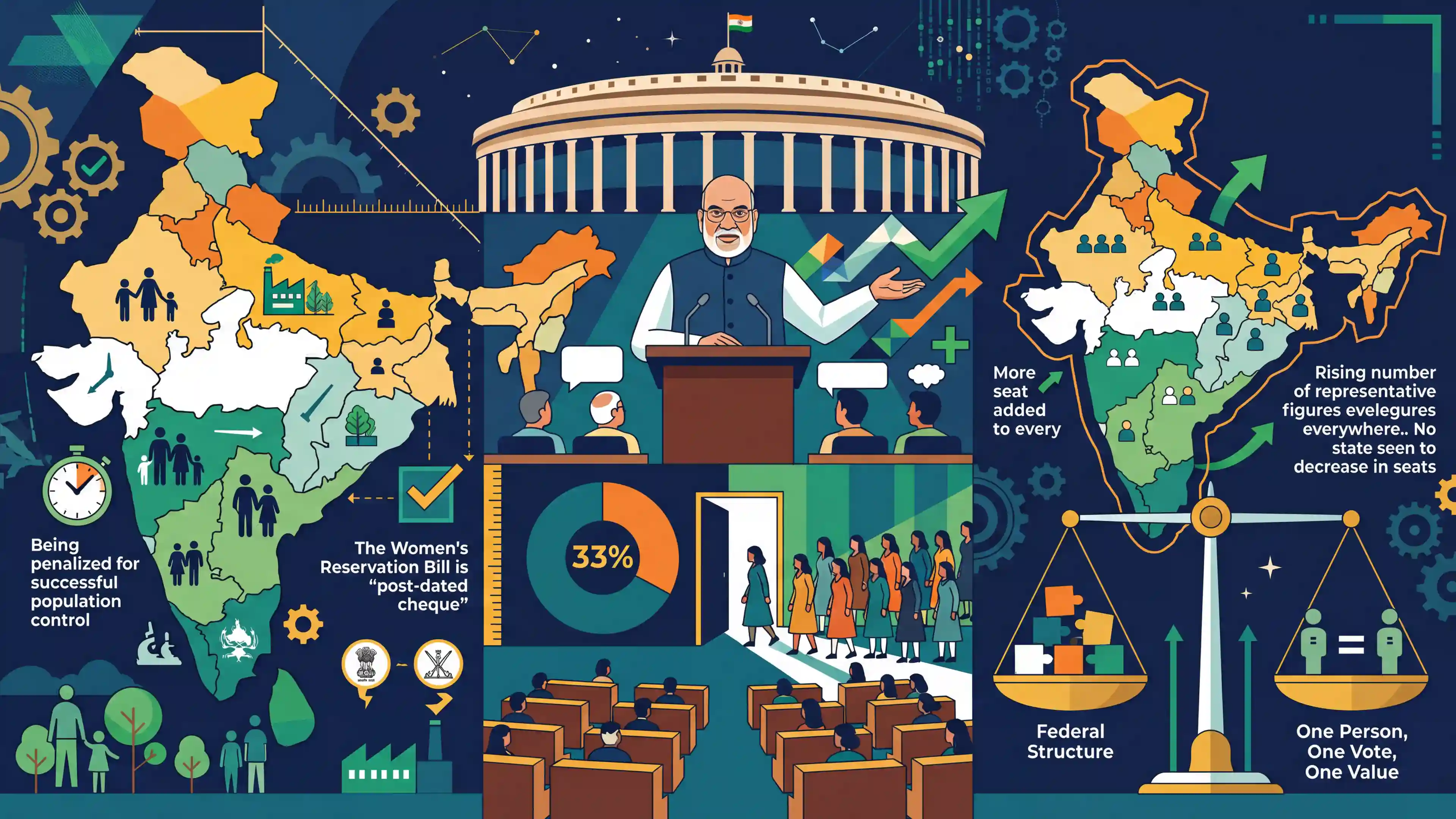
Union Home Minister Amit Shah defended the 131st Amendment Bill (Women's Reservation Bill) in the Lok Sabha, countering Opposition claims that tying the 33% quota to delimitation makes it a 'post-dated cheque'. Crucially, Shah addressed growing anxieties among South Indian states regarding the upcoming delimitation exercise. Southern states fear that recalculating Lok Sabha constituencies based on current population data will penalize them for their successful family planning and population control measures. Assuaging these federal concerns, Shah stated that the delimitation process will not reduce the absolute number of seats for any state; instead, seats are projected to increase by 50% across the board. He emphasized balancing the federal structure with the core democratic tenet of 'one person, one vote, one value'.
Key Points
- Union Home Minister Amit Shah defended the 131st Amendment Bill (Women's Reservation Bill) in the Lok Sabha, warning the Opposition of a backlash from women voters if they oppose it.
- The Opposition, led by Congress, criticized the legislation as a 'post-dated cheque' because its implementation relies on the upcoming delimitation exercise.
- South Indian states have expressed apprehension that a population-based delimitation will reduce their parliamentary representation, penalizing them for successful demographic control.
- To assuage these fears, Shah assured that no Southern state will lose seats post-delimitation, stating that seats across states will be increased by 50%, maintaining absolute representation numbers.
- Shah also emphasized the fundamental democratic principle of 'one person, one vote, one value' while balancing regional representation concerns.
Important Terms
Nari Shakti Vandan Adhiniyam

The official name for the 106th Constitutional Amendment Act, reserving 33% of seats for women in the Lok Sabha and State Legislative Assemblies.
UPSC context
GS Paper II: Governance and Social Justice. Tests knowledge of landmark legislation aimed at gender parity and political empowerment.
106th Constitutional Amendment Act
The 2023 legislation amending the Constitution to provide 33% reservation for women in legislative bodies, effective after the next census and delimitation exercise.
UPSC context
GS Paper II: Constitution. Essential for understanding recent constitutional reforms and their implementation timelines.
Delimitation
The process of redrawing boundaries of territorial constituencies to ensure roughly equal population representation per seat, as mandated by the Constitution.
UPSC context
GS Paper II: Parliament and State Legislatures. Tests understanding of electoral geography and federal representation challenges.
131st Amendment Bill
A 2026 legislative proposal aimed at operationalising women's reservation by expanding Lok Sabha seats to 815 and using 2011 census data for delimitation.
UPSC context
GS Paper II: Issues in Federalism. Highlights the debate over population-based representation and the North-South demographic divide.
Article 82
Constitutional provision empowering Parliament to enact a law for the readjustment of Lok Sabha seats after every census.
UPSC context
GS Paper II: Constitution. Tests specific knowledge of the legal framework governing electoral seat allocation.
One person, one vote, one value
The democratic principle ensuring that every citizen's vote carries the same weight, regardless of their constituency's size or location.
UPSC context
GS Paper II: Polity. Relevant for discussions on electoral reforms and the legitimacy of representative democracy.
Federal Structure
A constitutional system where power is divided between central and regional governments; currently tested by population-based representation concerns between Northern and Southern states.
UPSC context
GS Paper II: Federalism. Focuses on the "penalty for success" debate regarding population control and seat distribution.
Prelims Trap
The 106th Amendment immediately provides 33% reservation for women in the 18th Lok Sabha.
The Act's implementation is constitutionally contingent upon the publication of the first census conducted after its enactment, followed by a new delimitation exercise.
Static Concepts Connected
How does the Delimitation Commission function under the Indian Constitution?
- Presidential appointment: Under Article 82, Parliament enacts a Delimitation Act, and the President appoints the Delimitation Commission to readjust seat allocations.
- Judicial immunity: Its orders have the force of law and cannot be challenged or questioned in any court, ensuring the election process is not delayed.
- No legislative veto: Orders are laid before the Lok Sabha and respective State Legislative Assemblies, but legislatures cannot modify the Commission's orders.
What did the 84th Constitutional Amendment Act (2001) mandate regarding constituency sizes?
- Extended the freeze: It extended the freeze on the total number of Lok Sabha seats allocated to states (based on the 1971 census) until the first census published after 2026.
- Internal readjustment: It permitted the rationalization of territorial constituencies within a state based on newer census data, without altering the state's total absolute number of seats.
Cross-Topic Patterns
Finance Commission vs. Delimitation fears
Similar to delimitation anxieties, Southern states protested the 15th Finance Commission's use of 2011 census data over 1971 data for tax devolution, fearing severe financial penalties for successful demographic control.
Demographic Dividend vs. Representation
India's uneven demographic transition means Northern states have a booming population (driving 'one person, one vote' claims), while aging Southern states face political marginalization despite driving national economic growth.

Expect a 2026 Mains question linking the 106th CAA (Women's Reservation) implementation to the impending North-South delimitation dispute.
Linked PYQs · 3
Linked PYQs · 3
- 2023MainsGS2
Discuss the contribution of civil society groups for women's effective and meaningful participation and representation in state legislatures in India.
- 2019MainsGS2
“The reservation of seats for women in the institutions of local self-government has had a limited impact on the patriarchal character of the Indian Political Process.” Comment.
- 2024PrelimsGS1
How many Delimitation Commissions have been constituted by the Government of India till December 2023?
