Infrastructure and Groundwater Projects in Gandhinagar
Source:indianmasterminds ↗
Why It Matters
The article intersects with multiple GPSC Prelims themes, including the geographical significance of the Sabarmati River basin for groundwater recharge, afforestation techniques like the Miyawaki method, and Gujarat's cultural heritage represented by Jnanpith awardees such as Raghuveer Chaudhary.
Summary
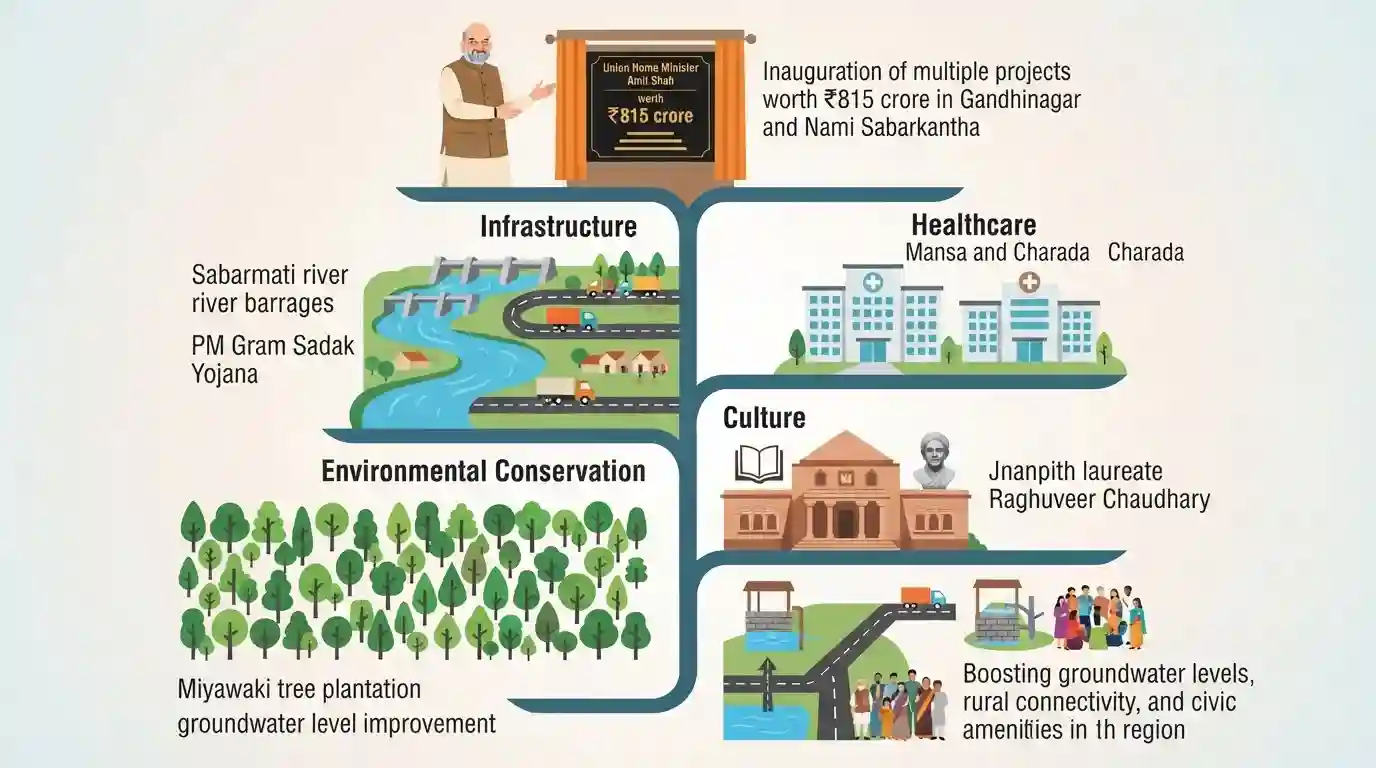
Union Home Minister Amit Shah inaugurated and laid foundation stones for multiple development projects worth ₹815 crore in Gandhinagar and Sabarkantha, Gujarat. Key initiatives span infrastructure (Sabarmati river barrages, PM Gram Sadak Yojana), healthcare (hospitals in Mansa and Charada), environmental conservation (Miyawaki tree plantation), and culture (a building named after Jnanpith laureate Raghuveer Chaudhary). The projects aim to boost groundwater levels, rural connectivity, and civic amenities.
Key Points
- Union Home Minister Amit Shah launched development projects worth ₹815 crore across Gandhinagar and Sabarkantha districts in Gujarat.
- Infrastructure and water conservation efforts include a new bridge over the Sabarmati river in Sadra and foundation stones for barrages in Hirak Village and Rakhiyal to improve groundwater levels and irrigation.
- Healthcare facilities were expanded with the foundation stones for a Community Health Centre (CHC) in Charada and a modernized Civil Hospital in Mansa.
- Environmental initiatives featured a tree plantation drive in Gandhinagar using the rapid-growth Miyawaki method.
- A new 'Sanskar Bhavan' was inaugurated and named in honor of Raghuveer Chaudhary, a renowned Gujarati author and Jnanpith Award recipient.
Important Terms
Pradhan Mantri Gram Sadak Yojana (PMGSY)

A Centrally Sponsored Scheme launched in 2000 to provide all-weather road connectivity to unconnected rural habitations, enhancing socio-economic development and poverty reduction.
UPSC context
GS Paper II (Government Schemes) & GS Paper III (Infrastructure); tests understanding of rural connectivity and infrastructure.
Miyawaki Method
An afforestation technique developed by Japanese botanist Akira Miyawaki to build dense, multi-layered, and self-sustaining native forests in a short period, especially in urban areas.
UPSC context
GS Paper III (Environment & Ecology); tests knowledge of urban forestry, biodiversity restoration, and climate mitigation techniques.
Jnanpith Award
India's highest and oldest annual literary honor, established in 1961, recognizing outstanding lifetime contributions to Indian literature by living Indian citizens.
UPSC context
GS Paper I (Art & Culture) & Prelims; tests awareness of prestigious cultural awards and literary contributions in India.
Prelims Trap
"The Miyawaki method relies on fast-growing exotic plant species to rapidly create dense urban forests."
The Miyawaki method strictly utilizes native/indigenous plant species, not exotic ones, to ensure local ecological balance and high survival rates.
Static Concepts Connected
What are the key geographical features of the Sabarmati River?
- Origin: Rises in the Aravalli Range of Udaipur District, Rajasthan.
- Drainage: A major west-flowing peninsular river draining into the Gulf of Khambhat (Arabian Sea).
- Regime: Entirely rain-fed (monsoon-dependent), meaning it experiences significant seasonal variations in water volume.
How does the Miyawaki method differ from conventional afforestation?
- Species selection: Exclusively uses native indigenous plant species suited to the local soil and climate conditions.
- High density: Saplings are planted very close together, forcing them to compete for sunlight and grow upwards rapidly.
- Self-sustaining: Creates dense, multi-layered micro-forests that become completely self-sustaining after the first 2-3 years.
Cross-Topic Patterns
Urban Forestry & Heat Islands
The Miyawaki method is increasingly linked with mitigating the Urban Heat Island (UHI) effect and improving localized carbon sequestration in GS3 Environment questions.
Literary Awards & Cultural Icons
State-specific cultural icons like Raghuveer Chaudhary often feature in Prelims match-the-following questions linking authors, literary periods, and major awards like the Jnanpith.

The Miyawaki afforestation technique is ripe for a 2026 Prelims statement-based question contrasting its native-species rule with standard compensatory afforestation.
Linked PYQs · 3
Linked PYQs · 3
- 2026GPSC_PRELIMSGS1
Consider the following statements regarding Aravallis: 1. The region is home to important lakes and wetlands including Sambhar, Sultanpur, Pushkar, Fatehsagar and Jaisamand. 2. It is one of the main watersheds, separating the drainage of the Bay of Bengal, through rivers like Chambal and other tributaries of the Yamuna, from that of the Arabian Sea through the Mahi, Sabarmati, Luni and other rivers. 3. The mountain range is home to lead, zinc, copper, gold, tungsten and has reserves of critical minerals such as tin, graphite, molybdenum, niobium, nickel, lithium and rare earth elements (REEs). These are considered to be of strategic relevance for energy transition, high-technology manufacturing and national security. 4. Rocks in the Aravallis are highly fractured, weathered and porous, allowing rainwater to percolate deep into the ground instead of running off the surface. Any disruption to this recharge system, through mining, construction or deforestation poses a direct and serious threat to regional water availability. 5. The Aravalli hills and range are 'green lungs' of North-Western India and serve as the indispensable ecological and socio-economic backbone of the region, functioning as the primary geographical barrier separating the arid North-Western desert from the fertile Northern Indian plains. Which of the above statements are correct?
- 2022GPSC_PRELIMSGS1
How many Gujarati writers have been awarded by Jnanpith award?
- 2026GPSC_PRELIMSGS1
Consider the following prominent works of Gujarati literature: 1. Saapna Bhara (सापना बारा) 2. Dhwani (ध्वनी) 3. Malela Jeev (मळेला जीव) 4. Amrita (अमृता) What is the common characteristic shared by all the literary works listed above?
