Kolkata National Library Immersive Language Museum Shabdalok
Source:The Hindu ↗
কেন এটি গুরুত্বপূর্ণ
Establishment of unique cultural institutions (especially 'first in India' structures) located in Kolkata are highly relevant for the WBCS Prelims exam. Furthermore, it highlights India's linguistic diversity and overlaps with Constitutional provisions (Eighth Schedule).
সারসংক্ষেপ
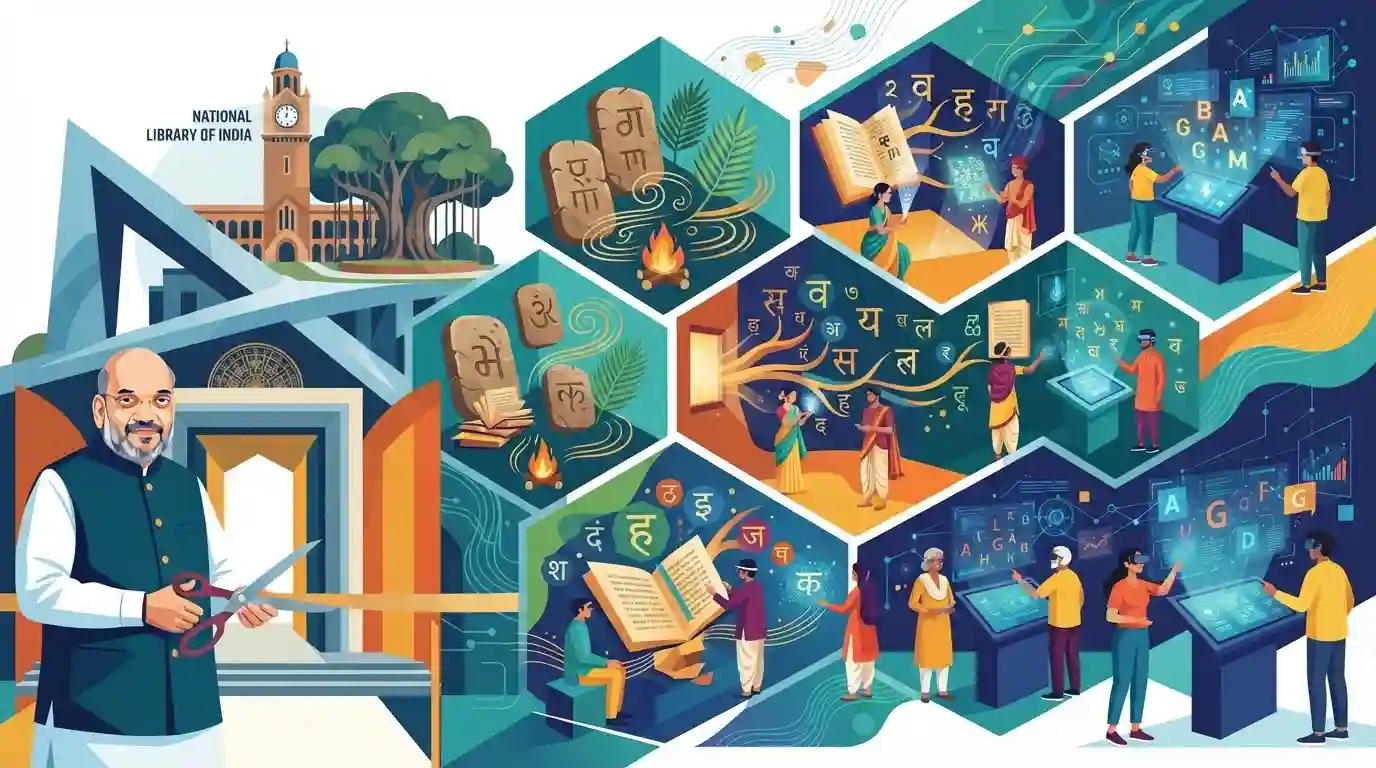
Union Home Minister Amit Shah has inaugurated 'Shabdalok' (Museum of Word), India's first immersive language museum, situated at the National Library campus in Kolkata. Developed under the Union Culture Ministry, the facility features nine high-tech galleries that celebrate India's linguistic heritage and the evolution of its 22 constitutionally recognized official languages. The interactive exhibits chronicle the transition of Indian languages from ancient oral traditions to modern digital formats.
মূল বিষয়
- Union Home Minister Amit Shah inaugurated India's first immersive language museum, 'Shabdalok' (Museum of Word), at the National Library campus in Kolkata.
- Developed by the National Library under the Union Culture Ministry, the museum uses advanced technology such as digital displays and holograms to trace the evolution of Indian languages.
- The museum celebrates the rich linguistic diversity of India, particularly focusing on the 22 official languages recognized under the Eighth Schedule of the Indian Constitution.
- The exhibits chronicle the historical journey of Indian languages, scripts, and literature from ancient oral traditions and manuscripts to modern electronic texts.
গুরুত্বপূর্ণ শব্দ
Eighth Schedule of the Constitution

A Constitutional schedule (Articles 344(1) and 351) that lists 22 officially recognized languages of the Republic of India. The list obliges the government to promote their development and allows their use in public service exams.
UPSC context
GS Paper 2: Indian Constitution. Crucial for understanding language policy, federalism, and the protection of linguistic diversity in India.
Ministry of Culture
The apex government ministry responsible for the preservation, protection, and promotion of India's tangible and intangible cultural heritage. It oversees institutions like the ASI, National Archives, and various national libraries and museums.
UPSC context
GS Paper 1 (Art & Culture) & GS Paper 2 (Governance). Important for evaluating state efforts in heritage conservation.
National Library of India
Located in Kolkata's Belvedere Estate, it is India's largest library by volume and public record. Functioning under the Ministry of Culture, it is designated to collect, disseminate, and preserve printed material produced within India.
UPSC context
GS Paper 1: Art and Culture. Relevant for topics concerning historical institutions and the preservation of national literary heritage.
Shabdalok (Museum of Word)
India's first immersive language museum, located at the National Library campus in Kolkata. Developed under the Ministry of Culture, it celebrates India's linguistic heritage and the evolution of its oral and written traditions.
UPSC context
GS Paper 1: Art and Culture / Current Affairs. Highlights modern technological integration in cultural preservation and linguistic diversity.
প্রিলিমস ফাঁদ
The Shabdalok museum celebrates India's 22 Eighth Schedule languages, alongside English as the primary official language.
English is an official language for Union administration under Article 343, but it is strictly excluded from the 22 languages recognized in the Eighth Schedule.
সংযুক্ত স্থির ধারণা
How did the Eighth Schedule evolve through Constitutional Amendments?
- Original List: The Constitution was originally enacted with 14 languages; the list grew to 22 through three distinct Constitutional Amendment Acts (CAAs).
- Key Amendments: 21st CAA 1967 (Sindhi), 71st CAA 1992 (Konkani, Manipuri, Nepali), and 92nd CAA 2003 (Bodo, Dogri, Maithili, Santhali).
- Notable Omissions: Despite widespread administrative use, English is omitted. Frequently debated languages like Bhojpuri, Rajasthani, and Tulu also remain excluded from the Schedule.
What is the statutory role of the National Library of India?
- Legal Mandate: It serves as one of India's four designated depository libraries under the Delivery of Books and Newspapers (Public Libraries) Act, 1954.
- Publisher Obligation: Every publisher in India is legally bound to deliver a copy of their publication to the National Library at their own expense within 30 days.
আন্তঃবিষয় প্যাটার্ন
Eighth Schedule vs. Classical Status
Shabdalok highlights linguistic evolution, echoing the recent expansion of India's Classical Languages list. UPSC frequently tests the differing criteria between Constitutional scheduling and Classical status.
Archiving Endangered Oral Traditions
The museum’s transition from oral to digital intersects with the government's Scheme for Protection and Preservation of Endangered Languages (SPPEL), a key topic for cultural conservation.

Expect a Prelims multi-statement question pairing Eighth Schedule amendments (21st, 71st, 92nd) with Classical Language criteria.
সংযুক্ত PYQ · 1
সংযুক্ত PYQ · 1
- 2015WBCS_PRELIMSGS1
Which language was replaced by English as the official language for the government of India in 1835 ?
