Gujarat water conservation efforts maintain drought free status
Source:india-today ↗
Why It Matters
This article provides practical examples of regional water management and conservation schemes (like SAUNI and Sujalam Sufalam) that can be cited in Mains answers regarding drought mitigation and climate resilience. It also connects global climate phenomena (El Nino) to localized agricultural and environmental impacts, making it highly relevant for Geography and Environment sections.
Summary
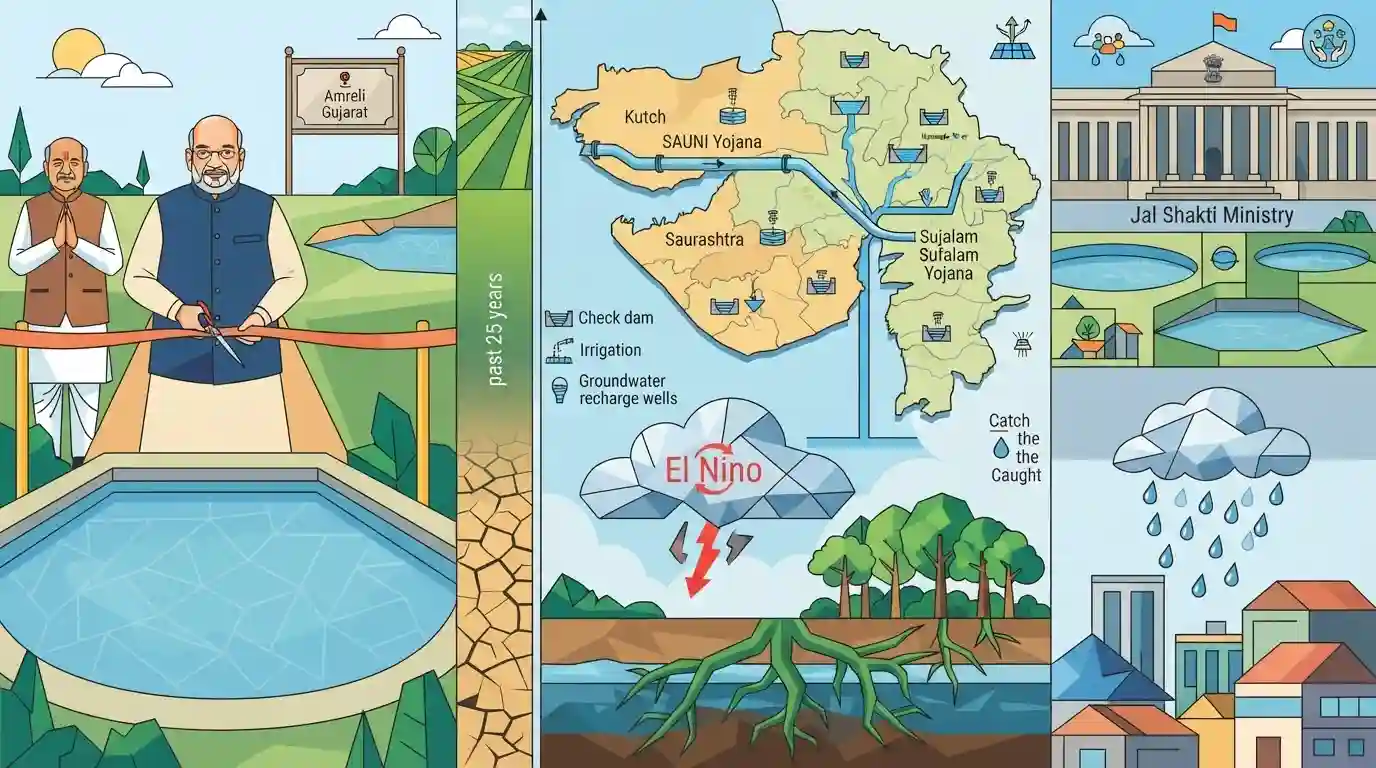
Home Minister Amit Shah recently inaugurated a 21-acre lake in Amreli, Gujarat, built by Padma Shri awardee Savjibhai Dholakia. During the event, Shah highlighted that Gujarat has remained drought-free for the past 25 years due to robust water conservation strategies initiated by Narendra Modi. He underscored the success of large-scale infrastructure projects such as the construction of check dams, the SAUNI Yojana, and the Sujalam Sufalam Yojana, which successfully routed surplus Narmada water to arid regions like Saurashtra and Kutch. Shah also pointed out that despite the looming threat of the El Nino effect this year, Gujarat averted drought-like conditions thanks to improved groundwater levels and expanded green cover. Central initiatives like the Catch the Rain campaign and the establishment of the Ministry of Jal Shakti were also praised for institutionalizing water conservation.
Key Points
- Home Minister Amit Shah inaugurated a 21-acre lake in Dudhala village, Amreli, built by Padma Shri awardee Savjibhai Dholakia, to aid groundwater recharge.
- Shah credited the last 25 years of drought-free conditions in Gujarat to extensive water conservation efforts initiated by Narendra Modi during his tenure as Chief Minister.
- Major interventions include the construction of 1.5 lakh check dams, the Narmada canal network, SAUNI Yojana (diverting surplus Narmada water to Saurashtra and Kutch), and the Sujalam Sufalam Yojana.
- National water management efforts like the creation of the Ministry of Jal Shakti and the Catch the Rain campaign were also highlighted as transformative steps.
- Despite rainfall deficits and fears of El Nino-induced droughts this year, the state's improved water infrastructure prevented severe distress or mass cattle migration.
Important Terms
SAUNI Yojana

An irrigation project in Gujarat that diverts excess floodwaters from the Narmada River via underground pipelines to fill over 100 dams in the drought-prone Saurashtra region.
UPSC context
GPSC Mains (Gujarat Geography/Economy). Tests knowledge of state-level drought mitigation, regional water security, and large-scale infrastructure.
Sujalam Sufalam Yojana
A Gujarat government water management scheme focusing on rejuvenating rivers, de-silting lakes, constructing check dams, and diverting surplus river water to recharge groundwater in semi-arid regions.
UPSC context
GPSC Paper 2 (State Govt Schemes). Highlights Gujarat's successful drought-proofing, agriculture resilience, and groundwater recharge models.
Catch the Rain campaign
A mass-movement initiative under the Jal Shakti Abhiyan aiming to promote community-led rainwater harvesting at the grassroots level with the motto "catch the rain, where it falls, when it falls."
UPSC context
GPSC Paper 3 (Environment). Tests awareness of national water conservation policies and participatory citizen governance in climate resilience.
Ministry of Jal Shakti
A central government ministry established in 2019 to holistically manage India's water resources, resolving disputes, providing clean drinking water, and overseeing river rejuvenation and sanitation projects.
UPSC context
GPSC Paper 2 (Governance). Tests understanding of central administrative restructuring aimed at addressing India's mounting water and sanitation challenges.
Prelims Trap
"The SAUNI Yojana is an inter-basin river linking project utilizing open canal networks to supply water."
SAUNI diverts surplus Narmada floodwaters to Saurashtra's reservoirs using an extensive underground pipeline network, not open canals, to minimize land acquisition and evaporation losses.
Static Concepts Connected
How does the El Niño phenomenon impact the Indian monsoon?
- Ocean Warming: It involves the abnormal warming of surface waters in the central and eastern equatorial Pacific Ocean.
- Weakened Trade Winds: This disrupts the Walker circulation and weakens the trade winds, shifting rainfall patterns away from the western Pacific.
- Monsoon Deficit: It weakens the monsoon trough over India, frequently leading to deficient rainfall and drought-like conditions.
What are the three main types of drought recognized in India?
- Meteorological Drought: A significant shortfall in precipitation over a region compared to its long-term average.
- Hydrological Drought: Marked depletion of surface and sub-surface water resources like lakes, reservoirs, and groundwater levels.
- Agricultural Drought: Insufficient soil moisture affecting crop growth and yield, even if the total meteorological rainfall appears normal.
Cross-Topic Patterns
Modern schemes vs traditional harvesting
While schemes like SAUNI rely on massive engineering, Sujalam Sufalam mirrors traditional community-led desilting. GPSC often pairs modern schemes with historical Gujarat water systems like Stepwells (Vavs) or Tankas.
El Nino and IOD interplay
Articles celebrating averted droughts often omit the positive Indian Ocean Dipole (IOD). The GPSC frequently tests how a positive IOD can neutralize El Nino's negative impact on the Indian monsoon.

Multi-statement questions will likely contrast Gujarat's SAUNI (pipeline floodwater diversion) with national 'Catch the Rain' initiatives.
Linked PYQs · 2
Linked PYQs · 2
- 2026GPSC_PRELIMSGS1
Consider the following statements: 1. When the temperature decrease in the South Pacific Ocean, India receives deficient rainfall. 2. El Nino is an important factor in the drought situation in India. 3. El Nino is a warm current that flows along the coast of Peru in December. Which of the above statement/s is/are correct?
- 2026GPSC_PRELIMSGS1
Consider the following statements regarding climate change: 1. Floods and droughts are increasing in India. 2. There has been a sharp increase in the number of tropical cyclones in India. 3. Humidity levels are gradually increasing in the regions of central India. Which of the above statement/s is/are correct?
