Home Minister Stresses Tech Solutions for Border Security
Source:Indian Express ↗
Why It Matters
India faces significant transborder crimes and infiltration challenges across its varied and difficult terrains. Understanding the shift towards technology-integrated border management is crucial for the GS3 syllabus, which focuses on internal security challenges, border management strategies, and the mandate of various security forces.
Summary
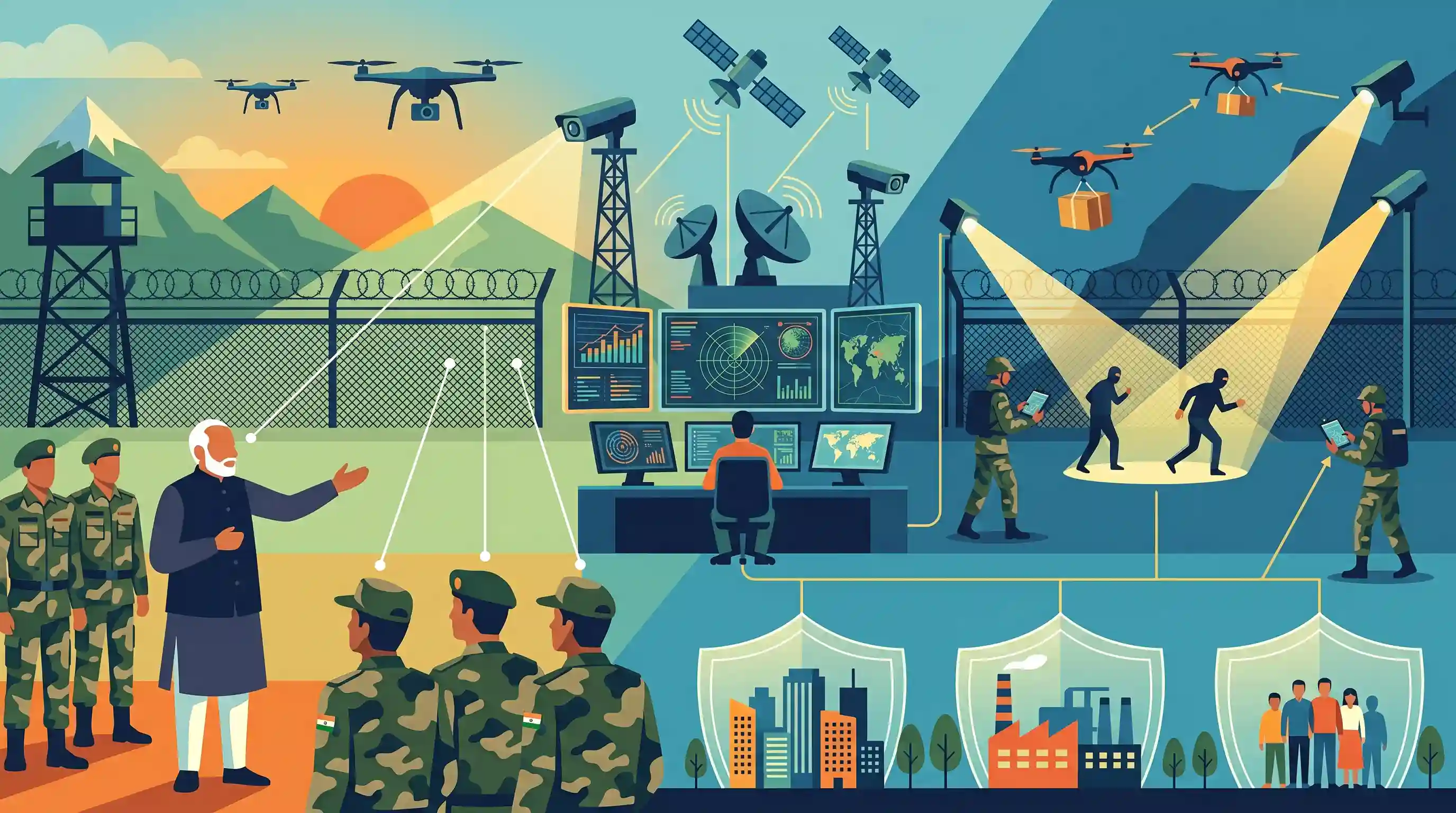
During a visit to a Border Security Force (BSF) forward post, Union Home Minister Amit Shah praised the personnel while underscoring the necessity of integrating advanced technological solutions into border management. He cautioned against complex, emerging security threats—such as drone-facilitated smuggling of arms and drugs, and cross-border infiltration—which necessitate a proactive and modernized approach. The emphasis reflects the government's broader strategy to create 'smart borders' by blending human vigilance with surveillance technology to ensure robust internal security.
Key Points
- Union Home Minister Amit Shah visited a BSF forward post, commending the jawans for their vigilance and dedication in securing the borders.
- He emphasized the urgent need to adopt technological solutions to effectively counter emerging security challenges along the international borders.
- Emerging border threats increasingly involve the use of technology by adversaries, such as cross-border drone flights for smuggling narcotics and weapons, and sophisticated infiltration techniques.
- The push towards modernization focuses on augmenting physical patrolling with smart border management tools, including advanced sensors, UAVs, and integrated surveillance systems.
Important Terms
Border Security Force (BSF)

India’s primary border-guarding organization for the Pakistan and Bangladesh borders. Established in 1965, it acts as the 'First Line of Defence' during peacetime and assists the Army during war.
UPSC context
GS Paper III: Internal Security; essential for topics on border management and the mandate of specific security forces.
Ministry of Home Affairs (MHA)
A nodal ministry of the Government of India responsible for maintaining internal security, border management, and the administrative control of Central Armed Police Forces (CAPFs).
UPSC context
GS Paper II: Governance/Ministries; tests understanding of the executive’s role in national security and federal coordination.
Comprehensive Integrated Border Management System (CIBMS)
A tech-heavy security framework integrating sensors, laser walls, drones, and radars with human resources to provide 24/7 surveillance, especially in difficult riverine or mountainous terrains.
UPSC context
GS Paper III: Security Challenges; focuses on the role of technology and 'smart' solutions in border management.
Central Armed Police Forces (CAPFs)
Seven specialized security forces under the MHA (including BSF, CRPF, and ITBP) tasked with internal security, counter-insurgency, and safeguarding India's international borders.
UPSC context
GS Paper III: Various Security forces and their mandate; central to questions on internal security architecture.
Smart Borders
A strategy to replace or augment physical barriers with advanced surveillance technology like AI, thermal imaging, and underground sensors to detect infiltration without continuous human patrolling.
UPSC context
GS Paper III: Internal Security; tests the application of modernization and AI in addressing asymmetric threats like drones.
One Border, One Force Principle
The recommendation of the Kargil Review Committee that a single specialized force should be responsible for each specific international border to ensure accountability and avoid jurisdictional overlaps.
UPSC context
GS Paper III: Internal Security; a fundamental concept in Indian border management policy and institutional reforms.
Prelims Trap
BSF is deployed along all international borders and functions under the operational command of the Ministry of Defence.
Under the 'One Border, One Force' policy, BSF exclusively guards the Pakistan and Bangladesh borders. Furthermore, it operates under the Ministry of Home Affairs.
Static Concepts Connected
Which CAPF guards which Indian border under the 'One Border, One Force' principle?
- BSF: Guards the sensitive Indo-Pakistan and Indo-Bangladesh borders.
- ITBP & SSB: ITBP guards the Indo-China border; SSB secures the open borders with Nepal and Bhutan.
- Assam Rifles: Guards the Indo-Myanmar border with a unique dual control structure (administrative under MHA, operational under MoD).
What are the core components of the CIBMS (Comprehensive Integrated Border Management System)?
- Sensory Tech: Deploys thermal imagers, ground-based radars, and laser fences to seal vulnerable or riverine gaps.
- Unified Command: Secure communication networks that feed real-time sensor data to centralized command and control centers.
- QRT Response: Shifts personnel from routine physical patrols to Quick Reaction Teams (QRTs) for rapid interception.
Cross-Topic Patterns
Drones + Narco-Terrorism
Cross-border drone flights directly link tech-enabled smuggling to the Golden Crescent drug trade, amplifying narco-terrorism threats in Punjab and J&K.
Space Tech + Border Management
ISRO's radar imaging satellites (RISAT) complement ground-based CIBMS by providing all-weather surveillance over difficult riverine terrains like the Brahmaputra and Sir Creek.

Expect a 2026 Prelims statement swapping CAPF border mandates or explicitly linking CIBMS to the Madhukar Gupta Committee.
Linked PYQs · 5
Linked PYQs · 5
- 2024MainsGS3
India has a long and troubled border with China and Pakistan fraught with contentious issues. Examine the conflicting issues and security challenges along the border. Also give out the development being undertaken in these areas under the Border Area Development Programme (BADP) and Border Infrastructure and Management (BIM) Scheme.
- 2016MainsGS3
Border management is a complex task due to difficult terrain and hostile relations with some countries. Elucidate the challenges and strategies for effective border management.
- 2023MainsGS3
The use of unmanned aerial vehicles (UAVs) by our adversaries across the borders to ferry arms/ammunitions, drugs, etc., is a serious threat to the internal security. Comment on the measures being taken to tackle this threat.
- 2020MainsGS3
Analyze internal security threats and transborder crimes along Myanmar, Bangladesh and Pakistan borders including Line of Control (LoC). Also discuss the role played by various security forces in this regard.
- 2023PrelimsGS1
With reference to Home Guards, consider the following statements: 1. Home Guards are raised under the Home Guards Act and Rules of the Central Government. 2. The role of the Home Guards is to serve as an auxiliary force to the police in maintenance of internal security. 3. To prevent infiltration on the international border/coastal areas, the Border Wing Home Guards Battalions have been raised in some States. How many of the above statements are correct?
