Cyber Fraud Prevention and Internal Security Frameworks
Source:The Hindu ↗
Why It Matters
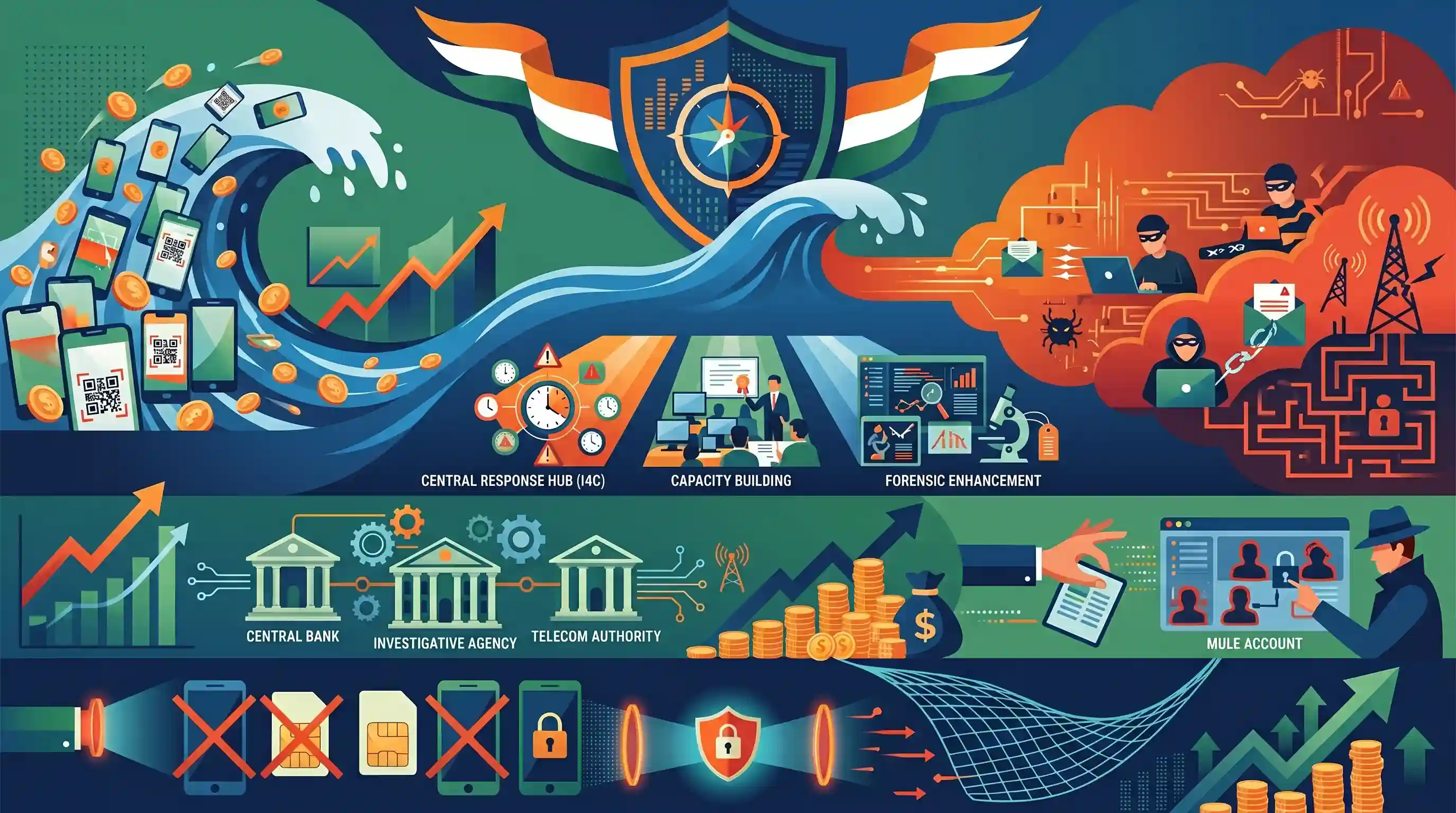
Demonstrates the escalating threat of cyber fraud to India's burgeoning digital economy (UPI, financial inclusion) and internal security. It provides crucial data points on government interventions (I4C, Mule Account Hunter, ₹8,189 crore frozen) useful for GS3 answers on cybersecurity frameworks and tackling emerging technological threats.
Summary
Union Home Minister Amit Shah emphasized that cybersecurity is no longer merely an economic issue but a core component of India's national security framework. Addressing a CBI-organized national conference on cyber-enabled frauds, Shah highlighted the massive surge in India's digital economy—recording 181 billion UPI transactions in 2024—and the corresponding escalation in cyber threats. To tackle this, the government has adopted a multi-pronged approach encompassing real-time reporting via the Indian Cyber Crime Coordination Centre (I4C), capacity building, and forensic enhancement. Collaborative efforts involving the RBI, CBI, DoT, and other agencies have led to the recovery of ₹8,189 crore from fraudsters. Institutional responses include deploying the 'Mule Account Hunter' software to trace illicit funds and executing massive blockages of suspicious SIM cards and mobile devices to dismantle cybercrime ecosystems.
Key Points
- Cybersecurity is now formally recognized as an integral component of national security, transcending its traditional role in economic security.
- India's massive digital transition recorded 181 billion UPI transactions worth over ₹233 trillion in 2024, handling 97% of total payments digitally and necessitating stringent cybersecurity measures.
- A multi-pronged government strategy involves real-time reporting, robust forensic networks, capacity building, R&D, and public cyber hygiene campaigns.
- Over ₹8,189 crore has been frozen or rescued from cybercriminals out of an estimated ₹20,000 crore defrauded, based on millions of complaints on the I4C portal.
- Enforcement actions include the cancellation of 1.2 million suspicious SIM cards, blocking of 300,000 mobile IMEIs, and the adoption of the 'Mule Account Hunter' software jointly developed by GoI and RBI.
Important Terms
Indian Cyber Crime Coordination Centre (I4C)

A nodal initiative by the Ministry of Home Affairs providing a comprehensive framework for law enforcement agencies to deal with cybercrime through coordination, analytics units, and reporting portals.
UPSC context
GS III: Internal Security; tests knowledge of nodal agencies for cybersecurity coordination and inter-agency frameworks.
Mule Account Hunter
A specialized AI-based software tool developed by the Government of India and the Reserve Bank of India to identify, track, and flag suspicious bank accounts used for laundering defrauded money.
UPSC context
GS III: Internal Security/Cyber Security; relevant for specific technical measures used to curb financial cybercrimes.
Money Mule
An individual who transfers illegally obtained funds on behalf of others, often to launder proceeds of cyber-enabled fraud or to move money through various bank layers to avoid detection.
UPSC context
GS III: Money-Laundering and its prevention; essential for understanding the mechanics and layering process of financial crimes.
Unified Payments Interface (UPI)
A real-time payment system developed by the NPCI that facilitates instant inter-bank transactions via mobile phones, forming the backbone of India's rapid digital economic expansion.
UPSC context
GS III: Indian Economy/Digital Infrastructure; tests understanding of digital payment adoption and associated security risks.
Central Bureau of Investigation (CBI)
India's premier investigating agency, functioning under the Ministry of Personnel, responsible for probing major corruption, serious economic crimes, and coordinating with international bodies like Interpol.
UPSC context
GS II: Statutory/Regulatory Bodies; tests knowledge of central agencies' roles in governance and law enforcement.
Reserve Bank of India (RBI)
The nation's central bank and regulatory body for the banking system, which oversees financial stability and co-develops technological standards to secure digital payment channels.
UPSC context
GS III: Indian Economy; relevant for the regulator's role in preventing financial fraud and money laundering.
Prelims Trap
The Indian Cyber Crime Coordination Centre (I4C) operates under MeitY.
I4C operates under the Ministry of Home Affairs (MHA). CERT-In, which handles cybersecurity incident response, is the body that falls under MeitY.
Static Concepts Connected
What are the key institutional bodies for cybersecurity governance in India?
- CERT-In (MeitY): Nodal agency for responding to computer security incidents and issuing alerts.
- I4C (MHA): Nodal centre to tackle cybercrime in a coordinated manner across law enforcement agencies.
- NCIIPC (NTRO): National nodal agency to protect Critical Information Infrastructure (CII) like power and banking.
What is a "mule account" in the context of money laundering?
- Definition: Bank accounts used by third parties to receive and transfer illicit funds, masking the money's origin.
- Mechanism: Cybercriminals recruit unsuspecting individuals ("money mules") to open or rent their accounts for small commissions.
- Enforcement: RBI and the Government deploy software like 'Mule Account Hunter' to identify and freeze these nodes.
Cross-Topic Patterns
Financial inclusion vs. digital literacy
Rapid digital onboarding via Jan Dhan and UPI has outpaced digital literacy, making first-time banking users highly susceptible to social engineering and financial frauds.
Telecom regulation as cyber policing
DoT's blocking of millions of fake SIMs/IMEIs highlights telecom infrastructure regulation (e.g., Sanchar Saathi) as the crucial first line of defense against financial cybercrime.

Expect a Prelims question distinguishing the exact mandates of I4C (MHA), CERT-In (MeitY), and NCIIPC (NTRO) in cybersecurity governance.
Linked PYQs · 5
Linked PYQs · 5
- 2022MainsGS3
What are the different elements of cyber security ? Keeping in view the challenges in cyber security, examine the extent to which India has successfully developed a comprehensive National Cyber Security Strategy.
- 2020MainsGS3
Discuss different types of cyber crimes and measures required to be taken to fight the menace.
- 2017MainsGS3
Discuss the potential threats of Cyber attack and the security framework to prevent it.
- 2021MainsGS3
Keeping in view India's internal security, analyse the impact of cross-border cyber attacks. Also discuss defensive measures against these sophisticated attacks.
- 2021MainsGS3
Discuss how emerging technologies and globalisation contribute to money laundering. Elaborate measures to tackle the problem of money laundering both at national and international levels.
