Home Minister Defends Free Trade Agreements and Launches Digital PDS
Source:The Hindu ↗
Why It Matters
The launch of a CBDC-based PDS and Grain ATMs provides excellent case studies for Mains GS3 answers on making the Public Distribution System more transparent and effective using e-technology. Furthermore, the debate around FTAs versus domestic agricultural protection (especially the dairy sector) is central to India's foreign trade policy and WTO negotiations.
Summary
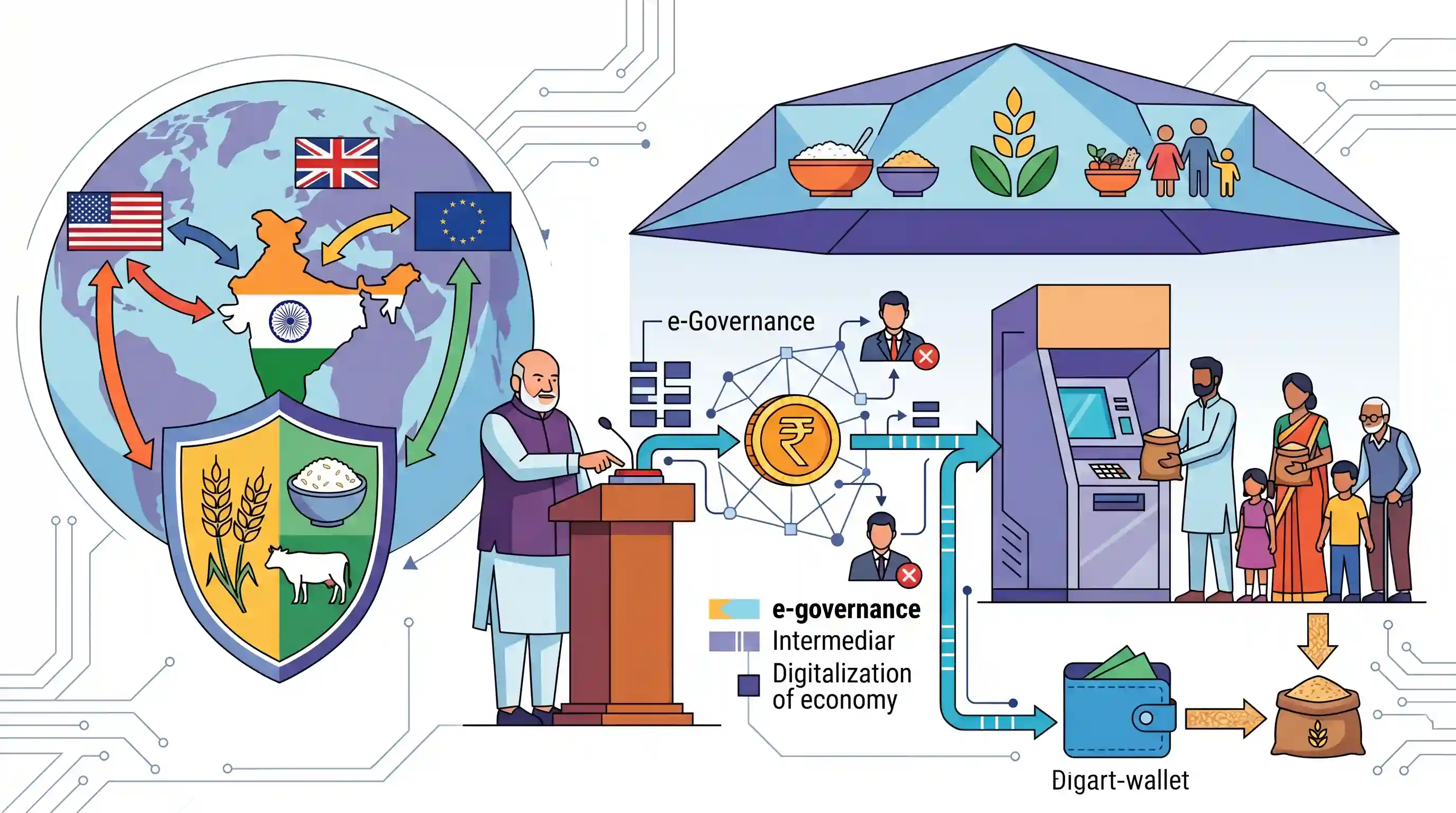
Union Home Minister Amit Shah rebutted claims that India's trade negotiations with the US, UK, and EU would jeopardize the domestic agriculture and dairy sectors, emphasizing that farmers' interests are fully protected. Alongside trade assurances, Shah launched India's first Central Bank Digital Currency (CBDC)-based Public Distribution System (PDS) and the 'Annapurti' Grain ATM in Gujarat. These technological interventions represent a major shift in e-governance, aiming to digitize food subsidy distribution, eliminate intermediaries, and ensure transparent, leak-proof delivery of foodgrains to millions of beneficiaries under the national food security framework.
Key Points
- The Union Home Minister rejected opposition claims that upcoming Free Trade Agreements (FTAs) with the US, UK, and EU will harm India's dairy and agriculture sectors, asserting robust protection for farmers.
- India’s first Central Bank Digital Currency (CBDC)-based Public Distribution System (PDS) and an automated 'Grain ATM' named 'Annapurti' were launched in Gujarat.
- These e-governance initiatives aim to create an end-to-end transparent foodgrain delivery mechanism, eliminating middlemen and effectively tackling pilferage.
- The implementation of Direct Benefit Transfer (DBT) and digital welfare schemes has prevented systemic leakages and enabled targeted agricultural subsidies and MSP procurements.
Important Terms
Central Bank Digital Currency (CBDC)

Digital form of sovereign currency issued by the RBI. In Gujarat's PDS pilot, it functions as 'programmable money' used for purpose-bound food subsidies through digital wallets.
UPSC context
GS Paper 3: Indian Economy and Science & Tech; tests digital economy shifts and financial inclusion.
Annapurti (Grain ATM)
Known as 'Annapurti', this automated multi-commodity dispensing machine provides 24/7 access to subsidized grains, ensuring precise weighing and eliminating human error or intermediaries in ration distribution.
UPSC context
GS Paper 2 & 3: e-Governance and Food Security; tests technological interventions in welfare delivery.
Public Distribution System (PDS)
A government-run food security mechanism distributing subsidized grains to eligible households. Modern reforms aim to digitize this supply chain to reduce leakages and ensure last-mile delivery.
UPSC context
GS Paper 3: Food Security; core topic regarding poverty alleviation and administrative reforms.
Free Trade Agreements (FTAs)
Economic treaties between nations to reduce trade barriers. India’s current strategy focuses on 'defensive' interests, specifically excluding sensitive sectors like dairy and agriculture to safeguard small-scale domestic producers.
UPSC context
GS Paper 2 & 3: International Relations and Economy; tests trade policy and sectoral protectionism.
National Food Security Act (NFSA)
A 2013 law that provides legal entitlement for subsidized foodgrains to roughly 67% of India's population, forming the statutory basis for the PDS and PMGKAY schemes.
UPSC context
GS Paper 2: Social Justice; tests knowledge of rights-based welfare legislation.
Programmable Money
A specific CBDC application where digital tokens (e-Rupee) are coded to be redeemable only for authorized goods (e.g., foodgrains), preventing the diversion of subsidies for non-intended uses.
UPSC context
GS Paper 3: Indian Economy/Fintech; tests understanding of advanced digital payment frameworks in governance.
Prelims Trap
CBDC-based PDS mandates active internet connectivity and biometric authentication to redeem subsidized food grains.
The CBDC framework supports offline and SMS/QR-based authentication, specifically designed to bypass common e-PoS network failures and worn-fingerprint biometric issues in rural areas.
Static Concepts Connected
What makes CBDC "programmable" for welfare schemes like PDS?
- Purpose-bound: Funds can be programmed for specific use cases (e.g., foodgrains) and redeemed only at authorized merchants like Fair Price Shops.
- Offline capability: Vouchers can be authenticated via offline QR codes or SMS, bypassing the need for active internet or smartphones in rural areas.
- Leakage prevention: Unlike cash-based DBT which can be diverted, programmable CBDC restricts expenditure strictly to the intended welfare subsidy.
Why does India keep dairy and agriculture on the "Negative List" in FTAs?
- Livelihood protection: The dairy sector supports millions of marginal farmers and landless laborers, making it highly sensitive to cheap foreign imports.
- Unequal subsidies: Developed nations heavily subsidize their agriculture; opening the market would flood India with artificially cheap, subsidized products.
- Non-tariff barriers: Western markets often block Indian agri-exports using strict Sanitary and Phytosanitary (SPS) measures, making reciprocal access fundamentally asymmetric.
Cross-Topic Patterns
CBDC meets Food Security
Merges monetary policy (digital rupee) with governance (PDS), showcasing a shift from cash-based DBT to purpose-bound digital vouchers to prevent subsidy diversion.
FTAs vs. Rural Livelihoods
Highlights the classic tension between securing advanced service/manufacturing trade deals (EU/UK) and defending India's unorganized dairy sector from subsidized imports.

Programmable CBDC vs traditional DBT for offline welfare delivery is a highly probable Prelims multi-statement question for 2026.
Linked PYQs · 3
Linked PYQs · 3
- 2022MainsGS3
What are the major challenges of Public Distribution System (PDS) in India ? How can it be made effective and transparent ?
- 2023MainsGS3
What is the status of digitalization in the Indian economy? Examine the problems faced in this regard and suggest improvements.
- 2016MainsGS2
The broader aims and objectives of WTO are to manage and promote international trade in the era of globalization. But the Doha round of negotiations seem doomed due to differences between the developed and the developing countries." Discuss in the Indian perspective.
