India Maintains Neutrality Amid US Venezuela Diplomatic Standoff
Source:The Hindu ↗
Why It Matters
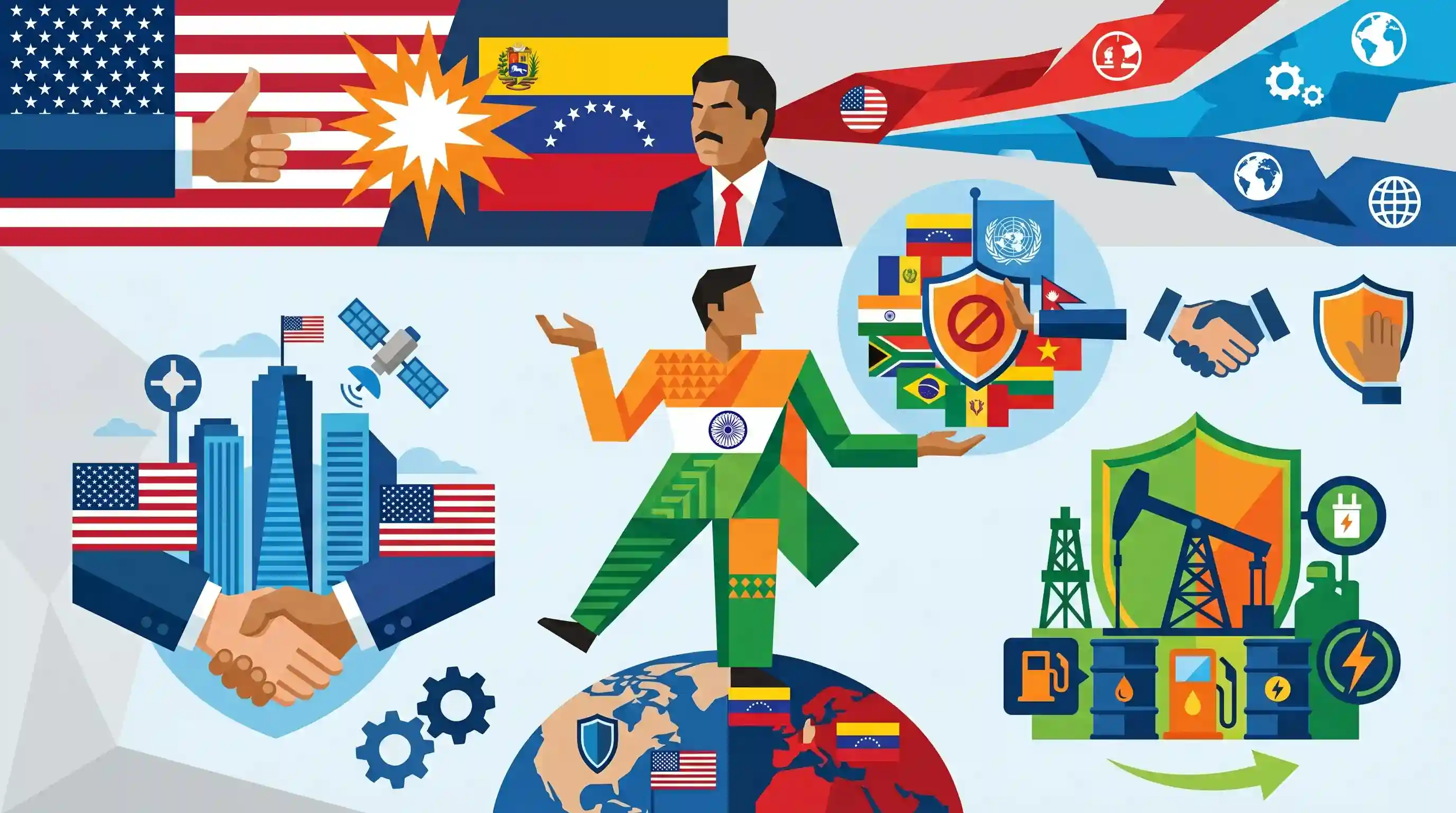
Demonstrates India's diplomatic balancing act, highlighting how New Delhi navigates complex geopolitical crises to maintain strategic autonomy, protect energy interests, and balance relations with the US while adhering to principles of non-intervention.
Summary
As global opinion remains divided following a US strike ordered by President Donald Trump targeting Venezuelan President Nicolas Maduro, the Indian government has adopted a cautious and neutral stance. Emphasizing its core foreign policy principle of non-interference in the internal affairs of sovereign nations, New Delhi has refrained from outright condemnation or endorsement of the US action. India's approach reflects its broader strategy of maintaining strategic autonomy, balancing its growing partnership with the United States against its traditional commitment to multilateralism, sovereignty, and safeguarding its own energy security interests in the face of international geopolitical disruptions.
Key Points
- The US administration under President Trump executed a targeted strike against Venezuelan President Nicolas Maduro, sparking a polarized response from the international community.
- The Indian government has maintained a cautious, neutral stance, neither endorsing nor explicitly condemning the United States' action.
- India's response highlights its core foreign policy principle of non-interference in the internal affairs of sovereign nations.
- This approach reflects India's broader strategy of strategic autonomy, balancing its deepening bilateral ties with the US while safeguarding its energy security and standing in the Global South.
Important Terms
Strategic Autonomy

A nation's capacity to pursue its national interests and make independent foreign policy decisions without being structurally dependent on or constrained by external powers or alliance obligations.
UPSC context
GS Paper 2: International Relations. Tests India’s shift from non-alignment to multi-alignment while maintaining independent agency.
Energy Security
The reliable and affordable availability of energy sources. For India, this involves diversifying crude oil imports to mitigate risks from geopolitical instability and sanctions.
UPSC context
GS Paper 3: Economy/Energy. Crucial for assessing India’s external sector resilience and resource diplomacy.
Multilateralism
The process by which multiple countries work together on a given issue, typically through international organizations (like the UN) to establish shared norms and collective solutions.
UPSC context
GS Paper 2: Important International institutions. Tests India’s commitment to a rules-based world order.
Non-interference
A core diplomatic principle where a state refrains from intervening in the domestic political or internal affairs of another sovereign nation, upholding international law.
UPSC context
GS Paper 2: Foreign Policy. A foundational pillar of Panchsheel and India’s traditional diplomatic posture.
Sovereignty
The supreme authority of a state to govern itself and exercise jurisdiction over its territory without interference from outside bodies or other states.
UPSC context
GS Paper 2: Polity and Constitution/IR. Central to debates on international law and national territorial integrity.
Prelims Trap
Venezuela, possessing the world's largest proven oil reserves, is currently among the top three crude oil suppliers to India.
Despite having the largest reserves, India's imports from Venezuela plummeted to ~0.3% of its basket to avoid US secondary sanctions imposed since 2019.
Static Concepts Connected
What distinguishes India's modern Strategic Autonomy from traditional Non-Alignment?
- Non-Alignment: A Cold War strategy focused on avoiding formal military alliances and maintaining an equal distance from rival superpower blocs.
- Strategic Autonomy: A contemporary approach focusing on issue-based alignments and maximizing national interest through multiple concurrent partnerships, without ideological constraints.
Why is heavy, high-sulphur crude attractive to India's private oil refiners?
- Discounted Pricing: Extra-heavy, sour crude like Venezuela's trades at a steep discount due to the difficulty and high cost associated with refining it.
- High Complexity: Advanced Indian refineries possess specialized coking units, allowing them to process cheap, low-grade crude into high-value distillates, maximizing refining margins.
Cross-Topic Patterns
Secondary Sanctions vs Energy Security
India's dramatic reduction of Venezuelan oil imports mirrors past compliance with US sanctions on Iranian crude, highlighting the recurring friction between US geoeconomics and India's strategic energy needs.
Panchsheel in modern geopolitics
India's refusal to endorse unilateral strikes or regime change anchors its modern Global South leadership posture in the 1954 Panchsheel principle of mutual non-interference in sovereign affairs.

Expect a 2026 Prelims question linking global crude variations (heavy/sour) to India’s advanced refining capabilities and import baskets.
Linked PYQs · 3
Linked PYQs · 3
- 2019MainsGS2
‘What introduces friction into the ties between India and the United States is that Washington is still unable to find for India a position in its global strategy, which would satisfy India's national self-esteem and ambitions.’ Explain with suitable examples.
- 2025MainsGS2
"With the waning of globalization, post-Cold War world is becoming a site of sovereign nationalism.” Elucidate.
- 2025MainsGS2
"Energy security constitutes the dominant kingpin of India's foreign policy, and is linked with India's overarching influence in Middle Eastern countries.” How would you integrate energy security with India's foreign policy trajectories in the coming years?
