Ministry of Home Affairs Committee for Citizenship Amendment Act
Source:The Hindu ↗
Why It Matters
This article illustrates the practical implementation of the Citizenship Amendment Act (CAA) and its direct intersection with the electoral process via the Special Intensive Revision (SIR) of voter rolls. It highlights the Union government's mechanisms (forming an empowered committee of central officials) in a state that previously opposed the CAA, bringing to light issues of federalism and the electoral significance of marginalized groups like the Matua community.
Summary
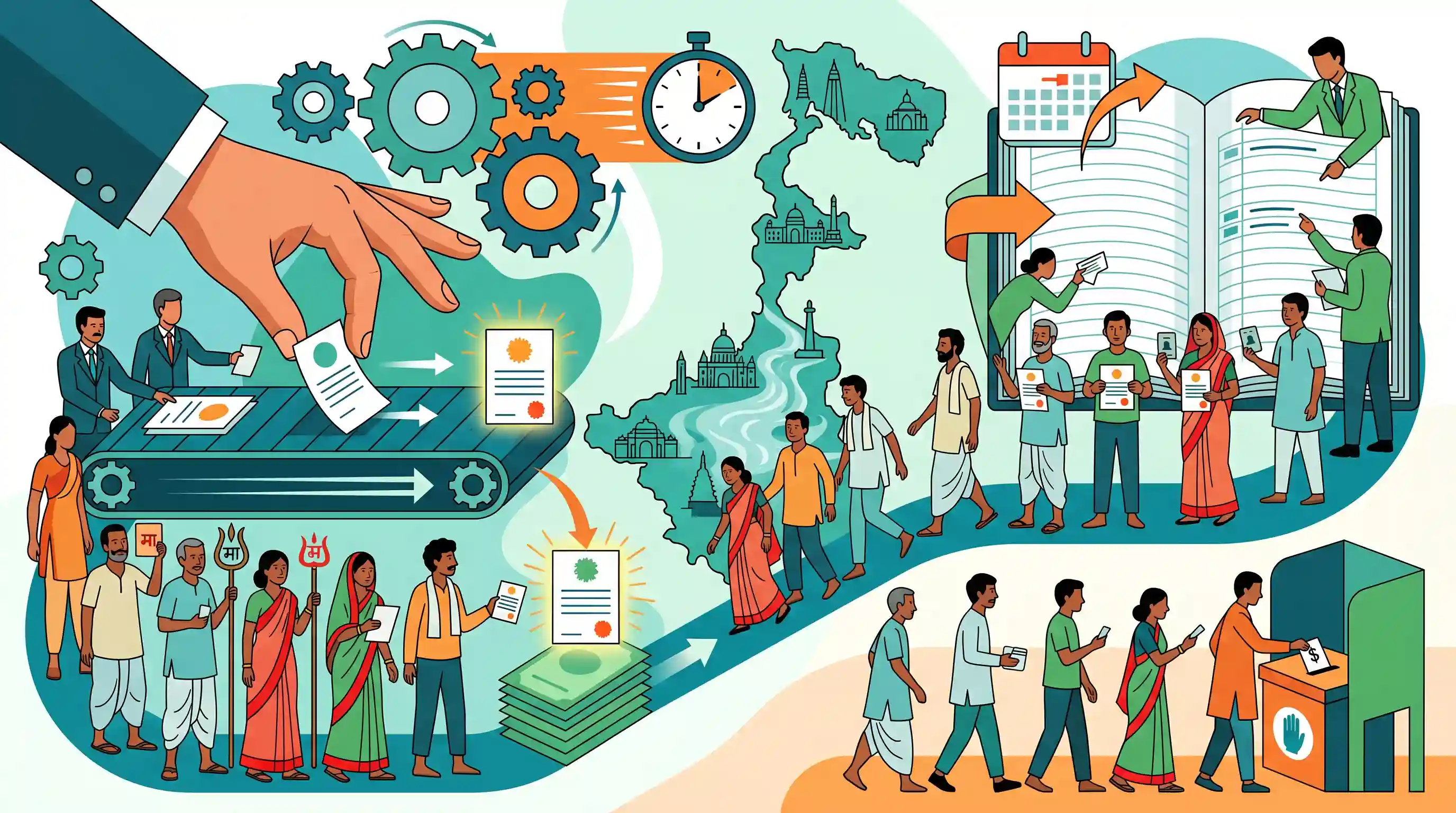
The Union Ministry of Home Affairs (MHA) has established a new empowered committee in West Bengal comprising Central officials to expedite pending citizenship applications under the Citizenship Amendment Act (CAA). Primarily targeting the politically significant Matua community, this fast-track clearance is timed to coincide with the Election Commission's ongoing Special Intensive Revision (SIR) of electoral rolls. The objective is to issue citizenship certificates prior to the publication of the final electoral rolls on January 6, thereby ensuring that newly naturalised citizens are officially enrolled as voters.
Key Points
- The Union Ministry of Home Affairs (MHA) has formed a new empowered committee to clear pending citizenship applications under the CAA in West Bengal.
- The committee, comprising officials from the Census, postal department, and Intelligence Bureau, overrides the state machinery to fast-track applications.
- The expedited process primarily targets the Matua community, a Scheduled Caste group with significant electoral influence in West Bengal.
- This clearance process coincides with the Election Commission's Special Intensive Revision (SIR) of electoral rolls, aiming to issue citizenship certificates before the final roll publication on January 6 so new citizens can vote.
Important Terms
Citizenship Amendment Act (CAA), 2019

2019 legislation providing expedited citizenship for persecuted religious minorities (Hindus, Sikhs, Buddhists, Jains, Parsis, Christians) from Afghanistan, Bangladesh, and Pakistan who entered India before 2015.
UPSC context
GS II (Polity/Governance); tests knowledge of citizenship laws, constitutional exceptions (6th Schedule), and federal-security implications.
Special Intensive Revision (SIR)
A comprehensive door-to-door verification and update of electoral rolls conducted by the Election Commission to ensure voter lists are accurate and free from duplicates or illegal entries.
UPSC context
GS II (Elections); tests understanding of Article 324 and the Representation of the People Act, 1950 in maintaining electoral integrity.
Empowered Committee
A state-level body comprising Central officials (Census, IB, Post) authorized to grant citizenship certificates under the CAA after verifying applications forwarded by district-level committees.
UPSC context
GS II (Statutory Bodies); focuses on the administrative mechanism for implementing complex laws and Centre-State administrative relations.
Intelligence Bureau (IB)
India's premier internal intelligence agency responsible for performing mandatory security background checks on CAA applicants to ensure they pose no risk to national security.
UPSC context
GS III (Internal Security); pertains to the role of security agencies in civil administration and verification processes.
Ministry of Home Affairs (MHA)
The nodal Union ministry responsible for national security, border management, and citizenship; it notifies the rules and committees essential for the CAA’s implementation.
UPSC context
GS II (Government Policies); examines the executive’s role in legislative implementation and the functionality of central ministries.
Matua Community
A politically significant Bengali Hindu community (Namasudras) originating from Bangladesh, whose citizenship status and voter enrollment are central to recent CAA fast-tracking efforts in West Bengal.
UPSC context
GS II (Vulnerable Sections); relates to the socio-political inclusion of Scheduled Castes and the impact of migration laws on specific groups.
Prelims Trap
State governments play a statutory role in verifying and approving citizenship applications under the CAA.
Citizenship is strictly a Union subject (Entry 17). The 2024 CAA Rules completely bypass state machinery, utilizing Empowered Committees comprised solely of Central officials.
Static Concepts Connected
How does the Constitution distribute power regarding citizenship and naturalisation?
- Union List: "Citizenship, naturalisation and aliens" falls exclusively under Entry 17 of the Union List in the Seventh Schedule.
- Article 11: Empowers Parliament to regulate the right of citizenship by law, explicitly barring state legislatures from interference.
- Executive Implementation: Empowered Committees established under the CAA rules consist of Central officials (Census, IB, Postal), structurally rendering state government opposition legally ineffective.
What is the Special Intensive Revision (SIR) of electoral rolls?
- Statutory Basis: Conducted by the Election Commission of India under Section 21(3) of the Representation of the People Act, 1950.
- Methodology: Unlike standard Summary Revisions, an SIR involves comprehensive, house-to-house verification to clean and update electoral data.
- Objective: Aims to thoroughly rectify discrepancies before major elections, determining the final list of eligible enfranchised citizens.
Cross-Topic Patterns
CAA rules + RPA 1950 voter registration
The synchronisation of fast-tracked naturalisation (CAA) with the Election Commission's SIR connects Constitutional citizenship provisions with the Representation of the People Act (voter enrollment mechanics).
Historical reform + modern electoral politics
The focus on the Matua sect links 19th-century socio-religious reform (Namasudra movement by Harichand Thakur against caste discrimination) to contemporary demographic and citizenship politics in Bengal.

Expect a 2026 prelims question mixing CAA's exclusive central committee rules (bypassing states) with Matua community historical origins.
Linked PYQs · 3
Linked PYQs · 3
- 2017PrelimsGS1
Right to vote and to be elected in India is a
- 2024MainsGS2
What changes has the Union Government recently introduced in the domain of Centre-State relations ? Suggest measures to be adopted to build the trust between the Centre and the States and for strengthening federalism.
- 2022MainsGS2
“Right of movement and residence throughout the territory of India are freely available to the Indian citizens, but these rights are not absolute.” Comment.
