Statutory Protection and Constitutional Status of National Symbols
Source:The Hindu ↗
Why It Matters
The debate touches upon a crucial historical and constitutional nuance regarding the legal status of India's National Symbols. Understanding the distinction between the National Anthem and the National Song, as debated in the Constituent Assembly, and the scope of the Prevention of Insults to National Honour Act, 1971 (linked to Article 51A Fundamental Duties), is essential for UPSC Polity and Governance.
Summary
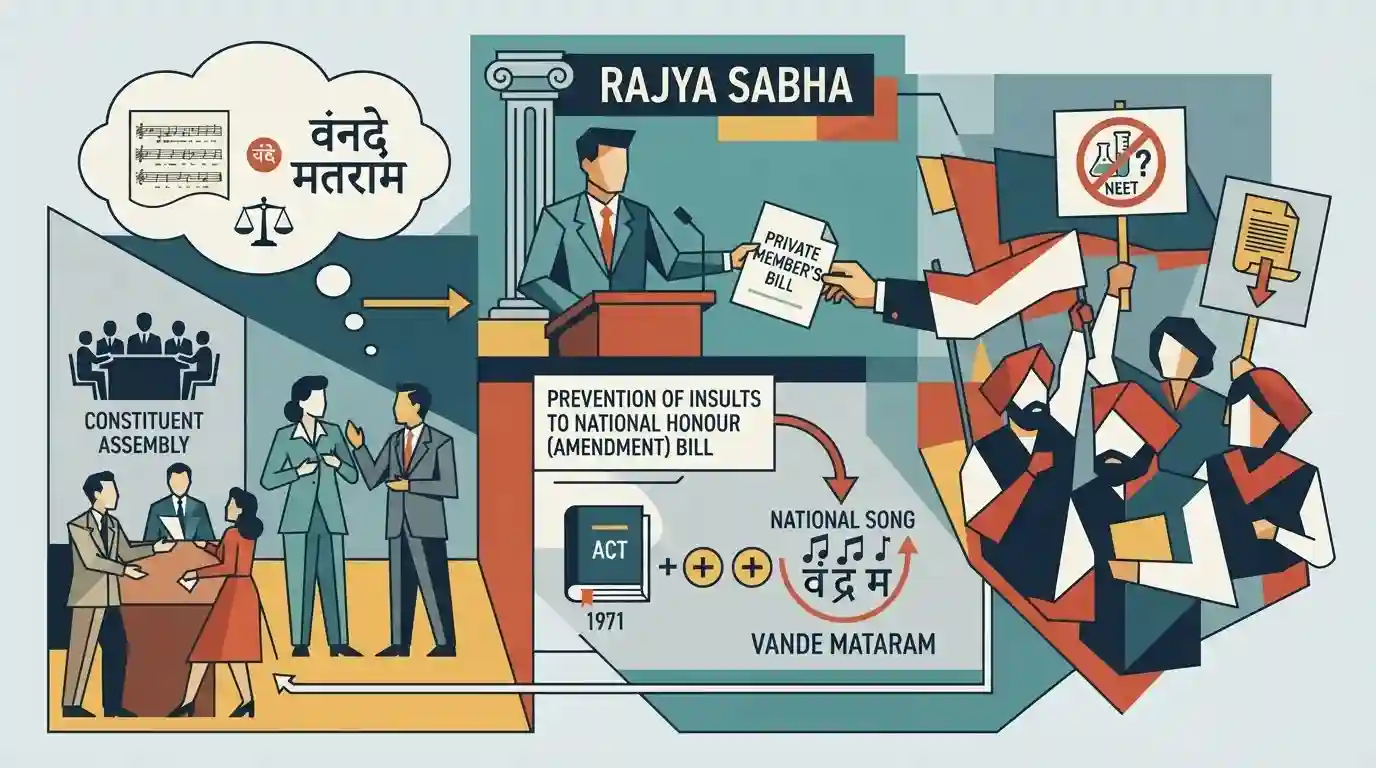
A Private Member's Bill, the Prevention of Insults to National Honour (Amendment) Bill, was introduced in the Rajya Sabha amidst opposition protests. The Bill aims to amend the 1971 Act to criminalize insults to the National Song, 'Vande Mataram'. Opposition members opposed the move by citing the Constituent Assembly's historical stance, which distinguished between the statutory protections for the National Anthem and the National Song, despite Dr. Rajendra Prasad's assertion of their equal status in 1950. The introduction occurred amidst broader parliamentary disruptions over NEET exam irregularities.
Key Points
- A Private Member's Bill was introduced in the Rajya Sabha seeking to amend the Prevention of Insults to National Honour Act, 1971 to penalize insults to the National Song, 'Vande Mataram'.
- Currently, the 1971 Act prescribes punishments for insulting the National Flag, the Constitution, and preventing the singing of the National Anthem, but does not explicitly cover the National Song.
- Opposition MPs objected to the Bill's introduction, arguing that the Constituent Assembly consciously refrained from placing the National Song and National Anthem on the exact same statutory footing regarding punitive measures.
- Debates invoked Dr. Rajendra Prasad's 1950 declaration that 'Vande Mataram' should be honored equally with 'Jana Gana Mana'.
- The Rajya Sabha proceedings were also disrupted by opposition protests demanding discussions on NEET paper leaks and the resignation of Education Minister Dharmendra Pradhan.
Important Terms
Prevention of Insults to National Honour Act, 1971

An Indian law that penalizes the desecration, mutilation, or disrespect of the nation's key sovereign symbols, including the National Flag, the Constitution, and the National Anthem.
UPSC context
GS Paper II (Polity); tests knowledge of statutory protections for national symbols and limits on free expression.
Private Member's Bill
A legislative proposal introduced in either House of Parliament by any Member of Parliament who is not currently serving as a government minister.
UPSC context
GS Paper II (Parliamentary Proceedings); tests understanding of law-making procedures, non-ministerial rights, and legislative trends.
National Song
The patriotic poem 'Vande Mataram', composed by Bankim Chandra Chatterjee and adopted in 1950 by the Constituent Assembly to be honored equally with the National Anthem.
UPSC context
GS Paper I & II (Modern History & Polity); tests historical milestones of the freedom movement and state symbols.
Constituent Assembly
The sovereign body of elected representatives tasked with drafting and adopting the Constitution of India, also responsible for selecting key national symbols.
UPSC context
GS Paper II (Polity); tests foundational knowledge of constitutional history, debates, and the origin of democratic conventions.
Prelims Trap
The Constitution of India and the Prevention of Insults to National Honour Act, 1971, treat the National Anthem and National Song on par.
Article 51A(a) explicitly mandates respect for the Constitution, National Flag, and National Anthem, but completely omits the National Song. Similarly, the 1971 Act excludes the National Song.
Static Concepts Connected
What is the legal status of the National Song vs the National Anthem?
- Constitutional Status: Article 51A(a) explicitly lists the National Flag and National Anthem, but does not mention the National Song ('Vande Mataram').
- Statutory Gap: The Act penalizes desecration of the Flag, Constitution, and preventing the singing of the Anthem, but does not cover the National Song.
- Historical Adoption: Adopted on 24 January 1950 by the President of the Constituent Assembly; only the first two stanzas are officially recognized to maintain pluralistic inclusivity.
How do Private Member's Bills (PMBs) function in the Indian Parliament?
- Introduction & Notice: Any Member of Parliament who is not a Minister is a private member; introduction of their bills requires one month's prior notice.
- Scheduling Limits: PMBs can only be introduced and discussed on Fridays (every Friday in Lok Sabha, alternate Fridays in Rajya Sabha).
- Drafting & Success: The responsibility of drafting lies solely with the member concerned, unlike government bills drafted by the law ministry. No PMB has passed since 1970.
Cross-Topic Patterns
Private Member's Bills + Judicial Activism
While PMBs rarely become law, they historically serve as policy bellwethers, signaling major socio-political debates that later trigger executive action or judicial interpretation.
Fundamental Duties + Statutory Enforcement
The Verma Committee (1999) mapped statutory penal provisions (like the 1971 Act) to non-justiciable Fundamental Duties, showing how the state enforces moral obligations.

Distinction between National Anthem and Song under Art 51A(a) paired with Private Member Bill rules is highly probable for Prelims 2026.
Linked PYQs · 2
Linked PYQs · 2
- 2003PrelimsGS1
Which one of the following statements is correct?
- 2015PrelimsGS1
"To uphold and protect the Sovereignty, Unity and Integrity of India" is a provision made in the
