Chhattisgarh judge appointed as Rajasthan High Court Chief Justice
Source:times-of-india ↗
Why It Matters
Crucial for RPSC RAS aspirants to understand the constitutional provisions governing the appointment of High Court judges and Chief Justices, the role of the Collegium system, and executive-judiciary dynamics in judicial transfers.
Summary
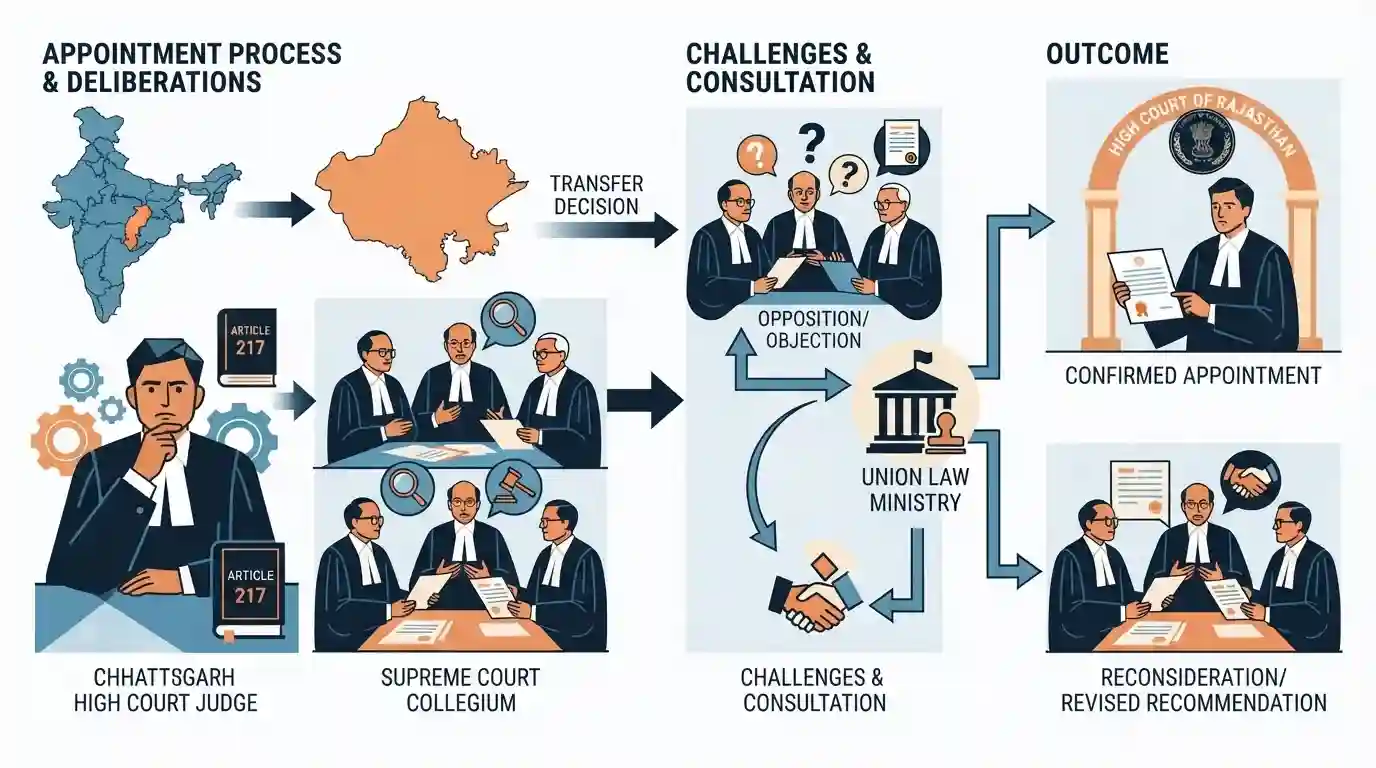
An appointment controversy emerged regarding the naming of a Chhattisgarh High Court judge as the Chief Justice of the Rajasthan High Court, highlighting the processes and deliberations involved in judicial appointments and inter-state transfers under the Indian Constitution.
Key Points
- A controversy arose surrounding the appointment of a judge from the Chhattisgarh High Court as the Chief Justice of the Rajasthan High Court.
- High Court judges and Chief Justices are appointed by the President of India under Article 217 of the Constitution after consultation with the Chief Justice of India and the Governor of the State.
- The Collegium system plays the primary role in recommending transfers and appointments of High Court judges and chief justices across states.
Important Terms
Article 217 of the Constitution of India

Constitutional article outlining the appointment, qualifications, tenure, retirement age (62 years), and transfer mechanisms for judges of Indian High Courts.
UPSC context
Important for UPSC/RPSC Polity (Paper II); tests knowledge of constitutional provisions governing the higher judiciary and appointment procedures.
Supreme Court Collegium
The apex body comprising the Chief Justice of India and four senior-most judges that decides appointments, promotions, and transfers of judges in the Supreme Court and High Courts.
UPSC context
Core topic under Indian Polity and Governance; tests understanding of judicial independence, appointments, and institutional friction.
Rajasthan High Court
The principal judicial institution of the state of Rajasthan, exercising original and appellate civil and criminal jurisdiction, with principal seat at Jodhpur and a bench at Jaipur.
UPSC context
Essential for RPSC Rajasthan Polity syllabus; tests awareness of state-level judicial administration, leadership, and institutional developments.
Chhattisgarh High Court
A constitutional court located in Bilaspur, serving as the High Court for the state of Chhattisgarh.
UPSC context
Relevant for inter-state judicial transfers and comparative polity, tracking institutions from which judges are elevated or transferred.
Prelims Trap
The Governor of the State must concur with the appointment of a High Court Chief Justice under Article 217.
Article 217 requires consulting the Governor for appointing a High Court Chief Justice, but the Governor's concurrence is not constitutionally mandated; consultation is distinct from concurrence.
Static Concepts Connected
What are the constitutional provisions governing the appointment and transfer of High Court judges in India?
- Appointment (Article 217):: Appointed by the President of India under Article 217(1) after consulting the CJI and the State Governor.
- Transfer (Article 222):: Transferred by the President under Article 222 after consultation with the Chief Justice of India.
- Retirement Age:: Holds office until attaining the age of 62 years as per constitutional stipulation.
Cross-Topic Patterns
Judiciary vs Executive in State Appointments
Judicial transfers and federal tensions frequently intersect with Governor's discretionary powers under Article 161 and the consultative role under Article 217.
Collegium System Evolution and Constitutional Conventions
The Collegium system's supremacy, established through the Three Judges Cases, continues to shape executive-judicial relations at both state and national levels.

Article 217 consultation nuances and Article 222 transfer powers will likely feature in a matching or multi-statement RPSC polity question.
Linked PYQs · 2
Linked PYQs · 2
- 2023RPSC_PRELIMSGS1
According to Article 217 (1) of the Constitution, the President shall make the appointment of a judge of the Rajasthan High Court (other than the Chief Justice) after consultation with whom?
- 2023RPSC_PRELIMSGS1
According to Article 217(1) of the Constitution, who does the President appoint on the advice of whom, other than the Chief Justice of the Rajasthan High Court?
