Act East Policy and India Strategy Amid US-China Rivalry in ASEAN
Source:Indian Express ↗
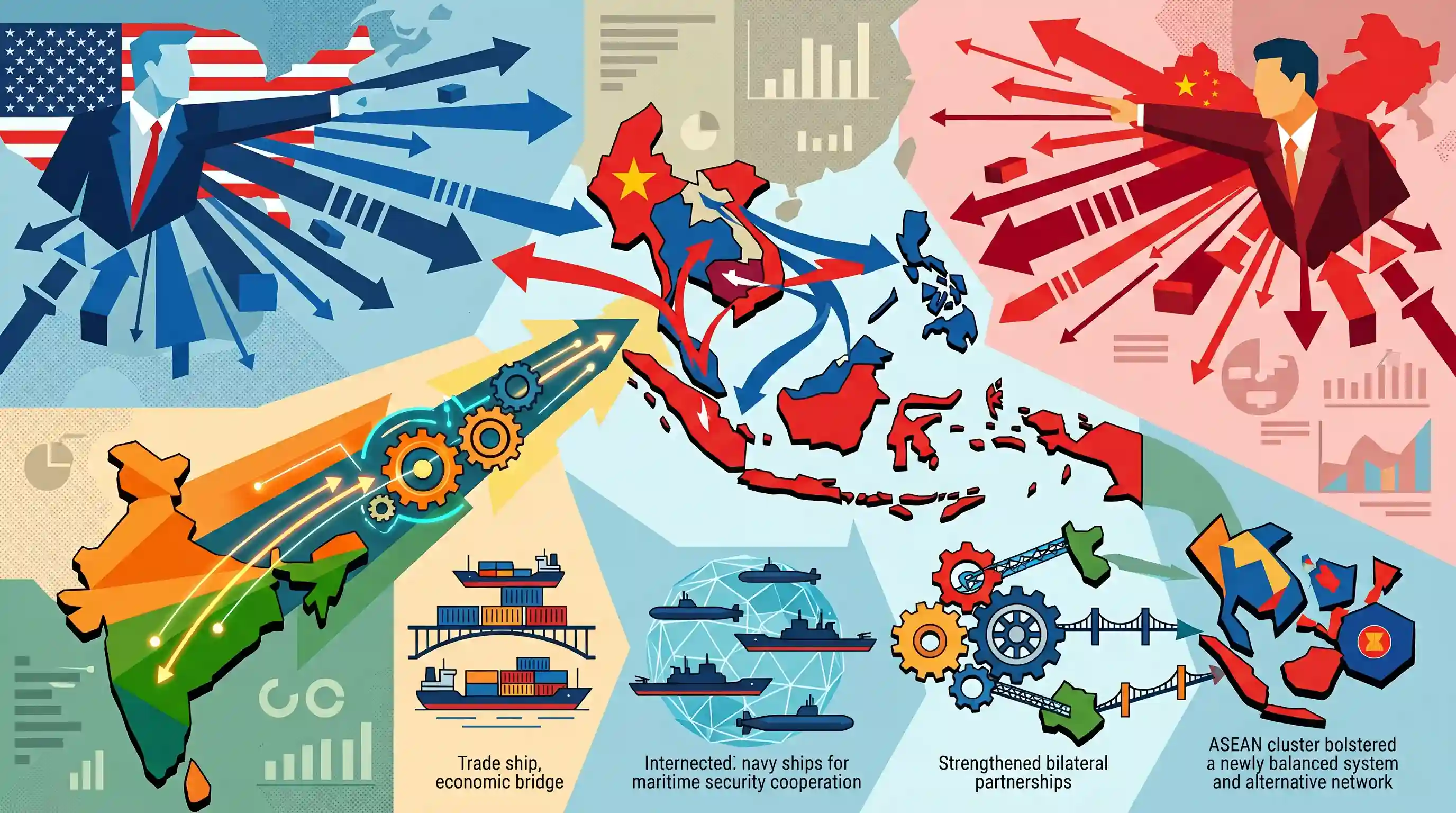
Why It Matters
Southeast Asia is the fulcrum of the Indo-Pacific and crucial to India's Act East Policy. Understanding how the US-China competition affects this region is essential for aspirants to analyze India's foreign policy options, security architecture, and economic strategies in its extended neighborhood.
Summary
The article analyzes the evolving geopolitical environment in Southeast Asia, highlighting the profound impact of the intensifying US-China strategic rivalry on the region. As both powers vie for influence, ASEAN's traditional centrality is being tested, creating a complex diplomatic terrain. In this context, India's Act East Policy faces new challenges and opportunities. To remain relevant and secure its strategic interests in the Indo-Pacific, India must recalibrate its approach. This involves deepening economic ties, enhancing maritime security cooperation, and building stronger bilateral partnerships with Southeast Asian nations, thereby positioning itself as a stabilizing force and a viable alternative partner amidst the great power competition.
Key Points
- The escalating strategic competition between the US and China is reshaping the geopolitical landscape of Southeast Asia and the broader Indo-Pacific region.
- ASEAN nations are facing increasing pressure to navigate this great power rivalry, which threatens to undermine ASEAN centrality and regional stability.
- India's Act East Policy must evolve to address these new dynamics, requiring a shift from historical and cultural engagement to deeper economic, technological, and strategic integration.
- To safeguard its interests and offer an alternative to Chinese dominance, India needs to position itself as a reliable security provider and development partner for Southeast Asian nations.
- Key focus areas for India should include enhancing maritime security cooperation, building resilient supply chains, and participating more actively in regional economic frameworks.
Important Terms
Act East Policy

India's proactive engagement strategy with Southeast and East Asia, emphasizing action-oriented outcomes, security cooperation, and connectivity through India’s Northeast to foster Indo-Pacific stability.
UPSC context
GS II (International Relations); critical for questions on regional connectivity, maritime security, and India's leadership in the Indo-Pacific.
ASEAN
A regional intergovernmental organization of ten Southeast Asian nations established in 1967 (Bangkok Declaration) to promote economic growth, social progress, and regional peace and stability.
UPSC context
GS II (International Relations); core of India's Act East Policy and vital for regional economic architecture and trade.
Quad
An informal strategic forum of India, the USA, Japan, and Australia committed to supporting a "free, open, and inclusive" Indo-Pacific through security and economic cooperation.
UPSC context
GS II (International Relations); tests understanding of maritime security, plurilateralism, and balancing major power influence in Asia.
ASEAN Centrality
The principle that ASEAN should remain the primary platform and driving force for regional cooperation and security architecture in the Indo-Pacific.
UPSC context
GS II (International Relations); key to India's diplomatic balancing between US-led and China-led regional initiatives.
Look East Policy
India's 1991 strategic shift toward Southeast Asia to revive economic ties post-Cold War, focusing primarily on trade, cultural diplomacy, and dialogue partnerships.
UPSC context
GS II (International Relations); relevant for the historical evolution of India’s foreign policy and trade liberalization.
Indo-Pacific
A vast geopolitical region spanning the Indian and Pacific Oceans, characterized by shared maritime security concerns and critical global trade routes.
UPSC context
GS II (International Relations); central theater for 21st-century geopolitics, maritime law (UNCLOS), and security competition.
Prelims Trap
India is a founding member of the ASEAN-centered Regional Comprehensive Economic Partnership (RCEP).
India withdrew from RCEP negotiations in 2019 due to trade deficit concerns with China, though it remains active in ASEAN strategic forums like the East Asia Summit (EAS).
Static Concepts Connected
What distinguishes India's 'Act East' from the earlier 'Look East' policy?
- Focus shift: Look East (1991) was primarily economic, while Act East (2014) heavily integrates strategic, defense, and maritime cooperation.
- Geographic scope: Act East expands beyond ASEAN to include the broader Indo-Pacific and major East Asian economic powers like Japan and South Korea.
- Domestic linkage: Act East explicitly links the economic development and connectivity of India's landlocked North Eastern Region to Southeast Asia.
What are the key ASEAN-led strategic forums where India participates?
- East Asia Summit (EAS): A premier leaders-led forum for strategic dialogue in the Indo-Pacific, involving ASEAN and 8 dialogue partners, including India and the US.
- ADMM-Plus: A platform for ASEAN and its eight Dialogue Partners to strengthen practical security and defense cooperation for regional peace.
- ASEAN Regional Forum (ARF): A 27-member multilateral framework designed to foster constructive dialogue and consultation on regional political and security issues.
Cross-Topic Patterns
Act East & Internal Security
Enhancing connectivity to Southeast Asia relies on stabilizing India's North East. Projects like the Kaladan multimodal transit necessitate cross-border counter-insurgency cooperation, as seen in joint operations with Myanmar.
SCRI & Critical Mineral Supply Chains
The Supply Chain Resilience Initiative intersects with economic geography. Moving supply chains away from China directly links to Quad's mandate to secure critical mineral pathways in the Indo-Pacific.

Expect a 2026 Prelims multi-statement Q linking India's non-membership in RCEP with its participation in the East Asia Summit and SCRI.
Linked PYQs · 5
Linked PYQs · 5
- 2016MainsGS2
Evaluate the economic and strategic dimensions of India's Look East Policy in the context of the post Cold War international scenario.
- 2020MainsGS2
What is the significance of Indo-US defence deals over Indo-Russian defence deals? Discuss with reference to stability in the Indo-Pacific region.
- 2021MainsGS2
The newly tri-nation partnership AUKUS is aimed at countering China's ambitions in the Indo-Pacific region. Is it going to supersede the existing partnerships in the region? Discuss the strength and impact of AUKUS in the present scenario.
- 2018PrelimsGS1
Consider the following countries: 1. Australia 2. Canada 3. China 4. India 5. Japan 6. USA Which of the above are among the 'free-trade partners' of ASEAN?
- 2016PrelimsGS1
The term 'Regional Comprehensive Economic Partnership' often appears in the news in the context of the affairs of a group of countries known as
