RBI Monetary Policy Growth Inflation Trade Off Challenges
Source:Indian Express ↗
Why It Matters
The article provides a real-world application of the 'growth vs inflation' dilemma faced by central banks. It highlights the crucial distinction between demand-pull and cost-push inflation, illustrating why monetary tools like repo rate hikes are ineffective against supply-side shocks (e.g., geopolitical energy crises or poor monsoons). This is a highly probable analytical area for UPSC GS3 Mains.
Summary
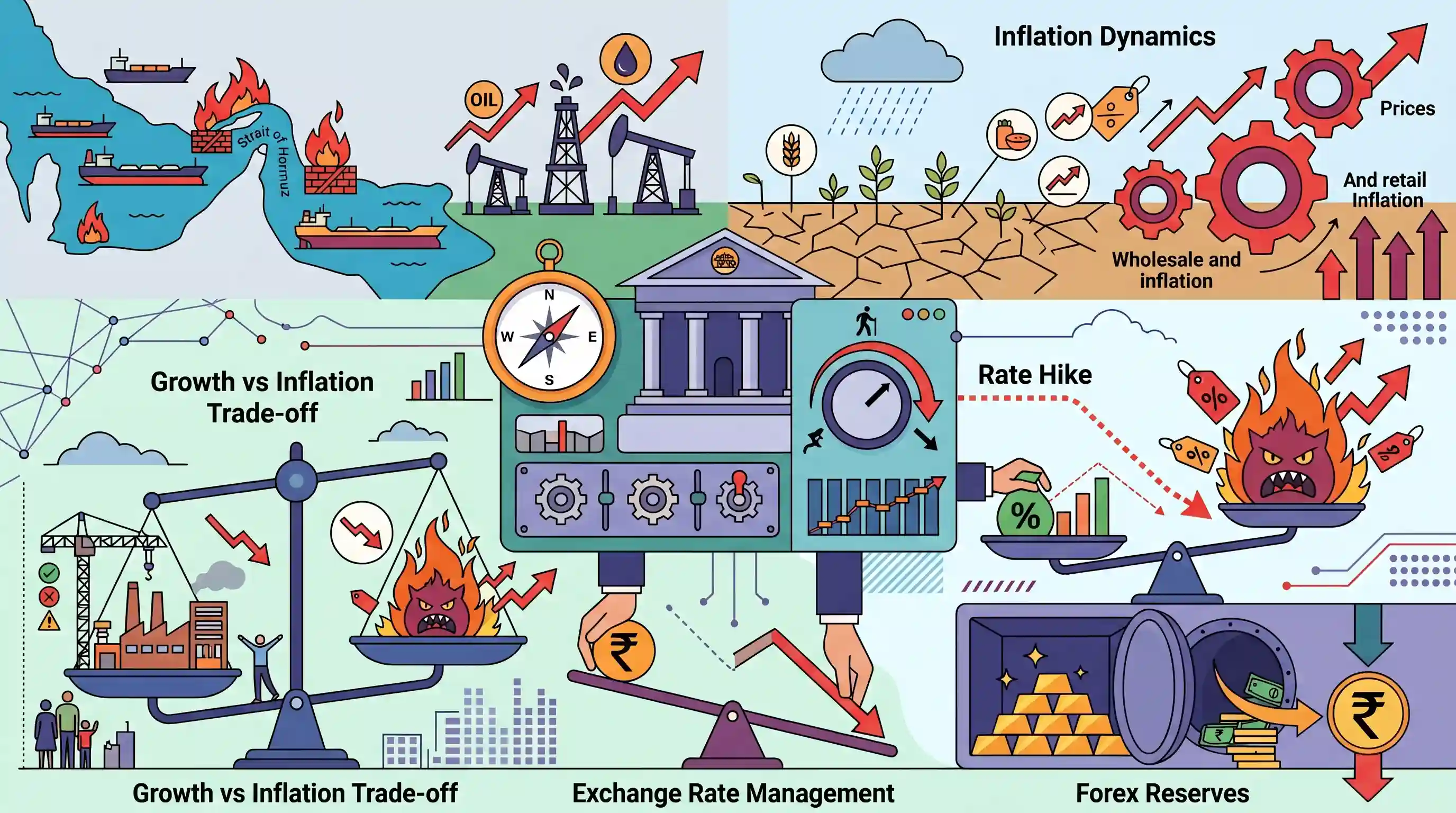
The article analyzes the dilemma faced by the Reserve Bank of India’s Monetary Policy Committee (MPC) amidst rising inflation and a sluggish economic recovery. While wholesale and retail inflation are climbing—primarily driven by supply-side shocks like the blockade in the Strait of Hormuz disrupting crude oil imports and potential food inflation from a weak monsoon—the RBI is cautioned against aggressively hiking the repo rate. The author argues that monetary tightening cannot resolve structural supply constraints and risks stifling domestic growth, particularly when key sectors demonstrate weak demand. Additionally, the RBI must balance defending the depreciating rupee with preserving its foreign exchange reserves, highlighting the limits of monetary policy in tackling cost-push inflation.
Key Points
- Wholesale inflation has crossed 8%, and retail inflation is projected to breach 5%, nearing the upper tolerance band of the RBI's target.
- Current inflationary pressures are primarily cost-push (supply-side), driven by geopolitical tensions in Iran and the Strait of Hormuz raising crude oil prices, and potential food inflation from a weak monsoon.
- The RBI's Monetary Policy Committee (MPC) is cautioned against aggressively hiking the repo rate, as monetary tightening cannot fix supply bottlenecks and risks stifling domestic growth.
- Core economic indicators reflect weak domestic demand, including stagnant auto sales and declining consumer non-durables output, emphasizing the need to support recovery.
- The RBI faces a secondary dilemma of managing a depreciating rupee while preserving foreign exchange reserves, which have fallen below 10 months of import cover.
Important Terms
Monetary Policy Committee (MPC)

A statutory six-member body established under the RBI Act, 1934, responsible for determining the benchmark repo rate to achieve the inflation target of 4% (±2%).
UPSC context
GS-III (Indian Economy); tests knowledge of statutory institutions and the flexible inflation targeting framework.
Repo Rate
The short-term interest rate at which the RBI lends money to commercial banks against government securities to regulate liquidity and control inflation.
UPSC context
GS-III (Indian Economy); critical for understanding monetary policy instruments and their impact on money supply and growth.
Cost-push Inflation
A type of inflation where prices rise due to increased production costs—such as raw materials or wages—rather than excessive demand.
UPSC context
GS-III (Indian Economy); tests conceptual clarity on supply-side shocks and the limits of monetary policy.
Consumer Price Index (CPI)
A measure that tracks changes in the retail prices of a basket of goods and services, serving as India’s primary anchor for inflation targeting.
UPSC context
GS-III (Indian Economy); essential for analyzing retail inflation’s impact on household purchasing power.
Wholesale Price Index (WPI)
An index tracking price changes of goods at the wholesale level, primarily reflecting producer-side inflation and excluding services.
UPSC context
GS-III (Indian Economy); important for understanding industrial price trends and wholesale-retail inflation divergence.
Foreign Exchange Reserves
External assets (foreign currencies, gold, SDRs) held by the RBI to maintain rupee stability, manage the balance of payments, and cover imports.
UPSC context
GS-III (External Sector); tests knowledge of balance of payments management and external economic resilience.
Prelims Trap
The MPC is legally mandated to keep Wholesale Price Inflation (WPI) within the 4% (±2%) tolerance band.
The MPC is mandated under the RBI Act to target Retail Inflation (CPI-Combined), not WPI. WPI excludes services and is not the legal nominal anchor.
Static Concepts Connected
How does cost-push inflation differ from demand-pull inflation in monetary policy?
- Demand-pull: Occurs when aggregate demand exceeds supply; it is effectively managed by the RBI hiking repo rates to cool down spending.
- Cost-push: Driven by supply-side shocks (e.g., global oil prices, droughts). Raising rates hurts growth without solving the underlying supply bottleneck.
What is Import Cover and what comprises India's Forex Reserves?
- Import Cover: An indicator denoting the number of months a country's current foreign exchange reserves can sustain its import bill.
- Forex Components: Consists of Foreign Currency Assets (FCA), Gold reserves, Special Drawing Rights (SDRs), and the Reserve Tranche Position (RTP) in the IMF.
Cross-Topic Patterns
Maritime Chokepoints & Imported Inflation
Geopolitical blockades at the Strait of Hormuz directly transmit into India's CPI via imported crude inflation, linking IR maritime mapping to domestic macroeconomic stability.
Rupee defense vs. Import Cover
The RBI's intervention to sell dollars and defend a depreciating rupee depletes forex reserves, worsening the import cover ratio during global supply shocks.

Expect a 2026 prelims question linking RBI's CPI mandate limitations during cost-push inflation with forex depletion and import cover.
Linked PYQs · 5
Linked PYQs · 5
- 2022PrelimsGS1
With reference to the Indian economy, consider the following statements: 1. If the inflation is too high, Reserve Bank of India (RBI) is likely to buy government securities. 2. If the rupee is rapidly depreciating, RBI is likely to sell dollars in the market. 3. If interest rates in the USA or European Union were to fall, that is likely to induce RBI to buy dollars. Which of the statements given above are correct?
- 2017PrelimsGS1
Which of the following statements is/are correct regarding the Monetary Policy Committee (MPC)? 1. It decides the RBI's benchmark interest rates. 2. It is a 12-member body including the Governor of RBI and is reconstituted every year. 3. It functions under the chairmanship of the Union Finance Minister. Select the correct answer using the code given below:
- 2022PrelimsGS1
In India, which one of the following is responsible for maintaining price stability by controlling inflation?
- 2024MainsGS3
What are the causes of persistent high food inflation in India? Comment on the effectiveness of the monetary policy of the RBI to control this type of inflation.
- 2025MainsGS2
"Energy security constitutes the dominant kingpin of India's foreign policy, and is linked with India's overarching influence in Middle Eastern countries.” How would you integrate energy security with India's foreign policy trajectories in the coming years?
