Rajya Sabha Bill Criminalising Insult to Vande Mataram
Source:Indian Express ↗
हे का महत्त्वाचे आहे
This article touches upon core constitutional and governance themes, including the limits of legislative power in criminalising behavior related to national symbols, the intersection of nationalism with freedom of speech and expression (Article 19), and the dynamics of parliamentary functioning amid opposition protests.
सारांश
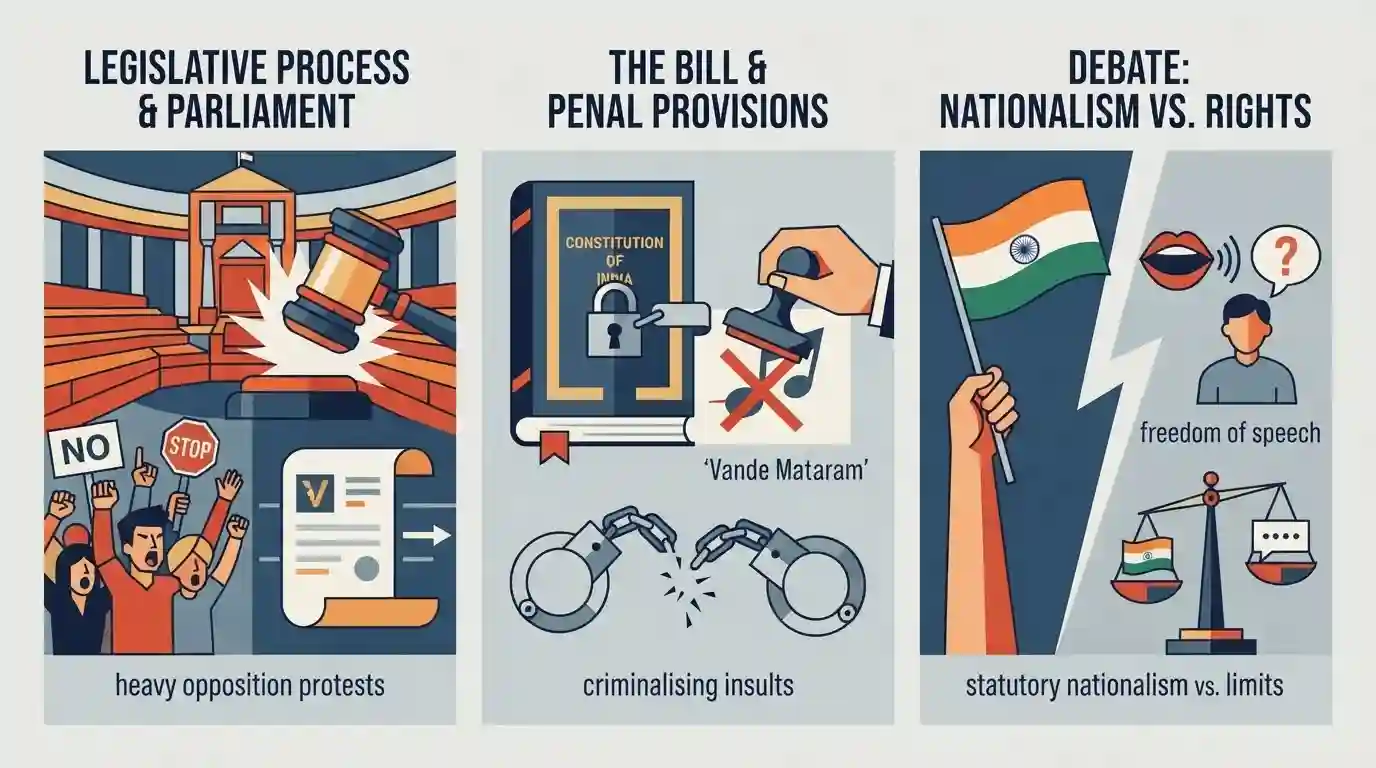
The Rajya Sabha passed a controversial bill criminalising insults to the national song 'Vande Mataram' despite heavy opposition protests. The legislation introduces penal provisions for disrespecting the national song, triggering debates on the limits of statutory nationalism, freedom of speech, and parliamentary procedures.
मुख्य मुद्दे
- The Rajya Sabha passed a bill criminalising the insult to India's national song, 'Vande Mataram', amidst strong protests and opposition from opposition members.
- The legislation introduces penal consequences for showing disrespect or insulting the national song, raising important questions about freedom of speech, nationalism, and legislative boundaries.
- Opposition parties strongly protested the passage of the bill, pointing to procedural issues and concerns regarding democratic dissent and free expression.
- The move highlights ongoing debates surrounding statutory enforcement of patriotism versus constitutional fundamental duties and civil liberties.
महत्त्वाच्या संज्ञा
Bill criminalising insult to Vande Mataram

A legislative proposal that amends the Prevention of Insults to National Honour Act, 1971, to introduce penal provisions for intentionally showing disrespect or obstructing the singing of the national song 'Vande Mataram'.
UPSC context
Important for GS Paper II under Indian Polity (Statutory Nationalism, Fundamental Rights, and Freedom of Speech vs. National Honour).
Vande Mataram
India's national song, composed by Bankim Chandra Chattopadhyay in Sanskrit, which played a pivotal role in the Indian freedom struggle and holds equal constitutional status in respect to the national anthem.
UPSC context
Important for GS Paper I (Modern Indian History, National Movement) and GS Paper II (National Symbols and Constitutional provisions).
Rajya Sabha
The Upper House of the Indian Parliament, representing the states and union territories, plays a crucial role in revising legislation and reviewing national policy.
UPSC context
Important for GS Paper II under Parliament and State Legislatures—Structure, Functioning, Conduct of Business, Powers and Privileges.
पूर्वपरीक्षा सापळा
Vande Mataram automatically enjoys the same statutory protection against insults as the National Anthem under the 1971 Act.
Aspirants often confuse constitutional status with statutory protection. While the National Anthem and National Flag have explicit statutory backing under the Prevention of Insults to National Honour Act, 1971, the National Song (Vande Mataram) requires specific legislative amendment to be included under the Act.
संबंधित स्थिर संकल्पना
What are the legal provisions regarding the National Anthem, National Flag, and National Song in India?
- Statutory Protection: National Anthem and Flag are protected under the Prevention of Insults to National Honour Act, 1971.
- Fundamental Duties: Article 51A(a) makes it a fundamental duty of every citizen to abide by the Constitution and respect its ideals and institutions, the National Flag and the National Anthem.
- Constitutional Status: Unlike the National Anthem, Vande Mataram (National Song) does not have explicit mention in Article 51A(a), though it holds equal national reverence.
आंतर-विषय नमुने
National Symbols vs. Freedom of Speech
Statutory enforcement of national symbols under the 1971 Act intersects with Article 19(1)(a) reasonable restrictions and fundamental duties under Article 51A.
Parliamentary Procedures and Legislative Consensus
Passing contentious bills via voice vote amidst opposition walkouts highlights growing tensions in parliamentary procedures and bicameral federalism.

Statutory nationalism vs Fundamental Duties (Art 51A) and Art 19(1)(a) freedom of speech will feature in polity statements.
संबंधित PYQ · 2
संबंधित PYQ · 2
- 2025MainsGS2
Indian Constitution has conferred the amending power on the ordinary legislative institutions with a few procedural hurdles. In view of this statement, examine the procedural and substantive limitations on the amending power of the Parliament to change the Constitution.
- 2023MainsGS2
Compare and contrast the British and Indian approaches to Parliamentary sovereignty.
