Fiscal Federalism and RTE Funding Disputes in Education
Source:The Hindu ↗
Why It Matters
This issue is a prime example of friction in India's fiscal federalism, specifically illustrating how political and policy disagreements (over the NEP) can disrupt the functioning of concurrent list subjects (Education) and statutory fundamental rights guarantees (RTE Act). It offers a case study on conditionalities attached to Centrally Sponsored Schemes.
Summary
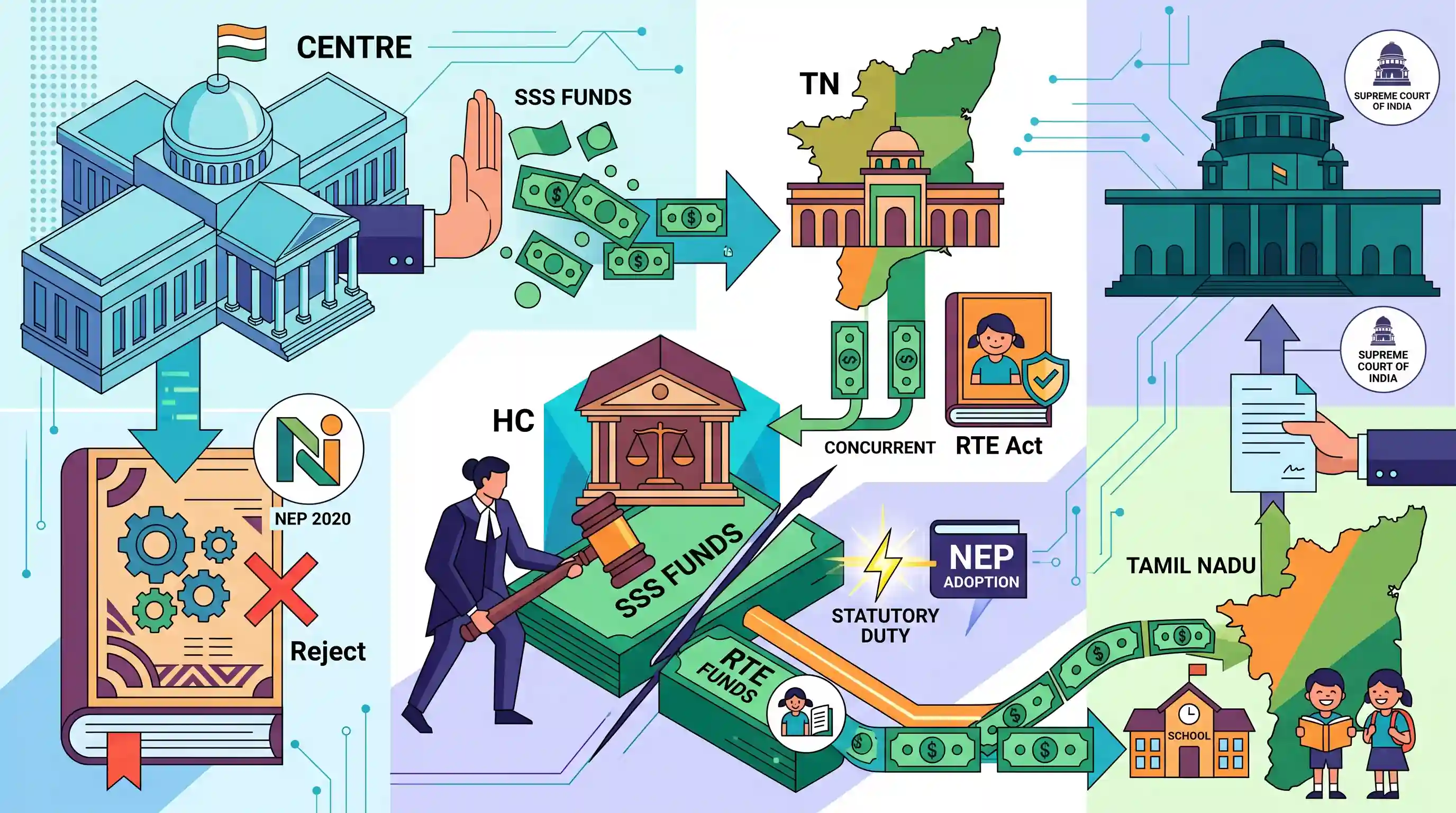
The Madras High Court has intervened in the ongoing dispute between the Centre and Tamil Nadu over the withholding of Samagra Shiksha Scheme (SSS) funds due to the State's rejection of the National Education Policy (NEP) 2020. The Court asked the Union Ministry of Education to consider releasing the specific funds required for Right to Education (RTE) reimbursements independently of the broader SSS block. Noting that Section 7 of the RTE Act assigns concurrent funding responsibility to both the Union and the State, the Court asserted that statutory RTE duties must not be held hostage to NEP adoption. Concurrently, it instructed the Tamil Nadu government to fulfill its mandate to reimburse private schools for RTE admissions, despite the lack of central funds, acknowledging that the State has already filed a suit in the Supreme Court to recover the total SSS dues.
Key Points
- The Madras High Court directed the Centre to consider delinking RTE funds (₹200 crore) from the pending Samagra Shiksha Scheme (SSS) funds (₹2,151.59 crore) owed to Tamil Nadu.
- The Union government withheld SSS funds because Tamil Nadu refused to implement the National Education Policy (NEP) 2020.
- The Court emphasized that under Section 7 of the RTE Act, funding education is a concurrent responsibility, and RTE obligations cannot be tied to the adoption of the NEP.
- The HC also clarified that Tamil Nadu cannot cite the Centre's non-payment to evade its own statutory obligation to reimburse private unaided schools for RTE admissions.
- The State government has separately filed an original civil suit in the Supreme Court demanding the release of the withheld SSS funds.
Important Terms
Samagra Shiksha Scheme (SSS)

An integrated centrally sponsored scheme for school education from pre-school to Class 12, subsuming Sarva Shiksha Abhiyan (SSA), Rashtriya Madhyamik Shiksha Abhiyan (RMSA), and Teacher Education (TE).
UPSC context
GS Paper 2: Governance and Social Justice. Tests knowledge of integrated educational frameworks and funding mechanisms between Centre and States.
Right of Children to Free and Compulsory Education (RTE) Act 2009
A 2009 law making free and compulsory education a fundamental right for children aged 6-14 under Article 21A, mandating 25% reservation in private schools for disadvantaged groups.
UPSC context
GS Paper 2: Fundamental Rights and Statutory Provisions. Tests understanding of educational rights and State versus Union implementation duties.
National Education Policy (NEP) 2020
India's third education policy, replacing the 1986 framework. It introduces a 5+3+3+4 structure, multidisciplinary learning, and foundational literacy/numeracy goals to modernize the national education system.
UPSC context
GS Paper 2: Social Sector (Education). Tests policy analysis of major educational reforms and their impact on state autonomy.
Fiscal Federalism
The financial relationship and distribution of taxing powers, revenues, and expenditures between the Union and State governments to ensure balance in a federal structure.
UPSC context
GS Paper 2: Federal Structure and Issues. Tests knowledge of Centre-State financial friction and Article 275/280/282 mechanisms.
Original Jurisdiction (Article 131)
Grants the Supreme Court exclusive original jurisdiction to hear and decide legal disputes between the Government of India and one or more States.
UPSC context
GS Paper 2: Judiciary. Tests awareness of constitutional remedies for states in disputes against the Union government.
Centrally Sponsored Schemes (CSS)
Schemes designed by the Centre but implemented by States, typically involving a shared funding ratio (often 60:40) to meet national development objectives.
UPSC context
GS Paper 2 & 3: Federalism and Economic Development. Tests understanding of conditional funding and cooperative vs. competitive federalism.
Section 7 of the RTE Act
A specific provision in the RTE Act 2009 that establishes the concurrent responsibility of both the Central and State governments to provide necessary funds for the Act’s implementation.
UPSC context
GS Paper 2: Governance. Tests detailed understanding of legislative clauses governing shared financial obligations between levels of government.
Prelims Trap
States can legally suspend RTE reimbursements to private schools if the Centre withholds its share of Samagra Shiksha funds.
Under Section 7, RTE funding is a concurrent duty. However, reimbursing private schools is the State's statutory obligation and cannot be evaded citing lack of Central funds.
Static Concepts Connected
What are the essentials of the Supreme Court's Original Jurisdiction (Article 131)?
- Federal Disputes: It exclusively resolves legal disputes between the Centre and States, or between two or more States.
- Legal Rights: The dispute must inherently involve a question (of law or fact) on which the existence of a legal right depends.
- Specific Exclusions: Purely political disputes and disputes arising from pre-Constitution treaties or agreements are expressly excluded from Article 131.
What distinguishes Centrally Sponsored Schemes (CSS) from Central Sector Schemes?
- Funding Ratio: CSS are jointly funded by the Centre and States (e.g., 60:40 or 90:10), while Central Sector Schemes are 100% funded by the Union government.
- Implementation Agency: CSS are primarily executed by State governments. Central Sector schemes are implemented directly by Union ministries and their agencies.
- Subject Domain: CSS typically cover subjects in the State List (like Agriculture, Health) to supplement state efforts. Central Sector schemes usually cover Union List subjects.
Cross-Topic Patterns
Conditional devolution in CSS funding
Tying Samagra Shiksha funds to NEP compliance closely mirrors recent disputes over National Health Mission (NHM) funds being linked to Ayushman Bharat branding, illustrating a growing trend of conditional devolution.
Concurrent List friction points
Education's shift to the Concurrent List (42nd Amendment) creates structural clashes where overarching Central policy frameworks (like NEP) inevitably collide with State-level operational autonomy and political priorities.

Article 131 + conditional funding in Centrally Sponsored Schemes is highly likely to form a complex multi-statement Polity question in 2026.
Linked PYQs · 4
Linked PYQs · 4
- 2022MainsGS2
The Right of Children to Free and Compulsory Education Act, 2009 remains inadequate in promoting incentive-based system for children's education without generating awareness about the importance of schooling. Analyse.
- 2020MainsGS2
National Education Policy 2020 is in conformity with the Sustainable Development Goal-4 (2030). It intends to restructure and reorient education system in India. Critically examine the statement.
- 2024MainsGS2
What changes has the Union Government recently introduced in the domain of Centre-State relations ? Suggest measures to be adopted to build the trust between the Centre and the States and for strengthening federalism.
- 2025MainsGS2
Examine the evolving pattern of Centre-State financial relations in the context of planned development in India. How far have the recent reforms impacted the fiscal federalism in India?
