India Multi-Aligned Foreign Policy and Energy Diplomacy
Source:Indian Express ↗
Why It Matters
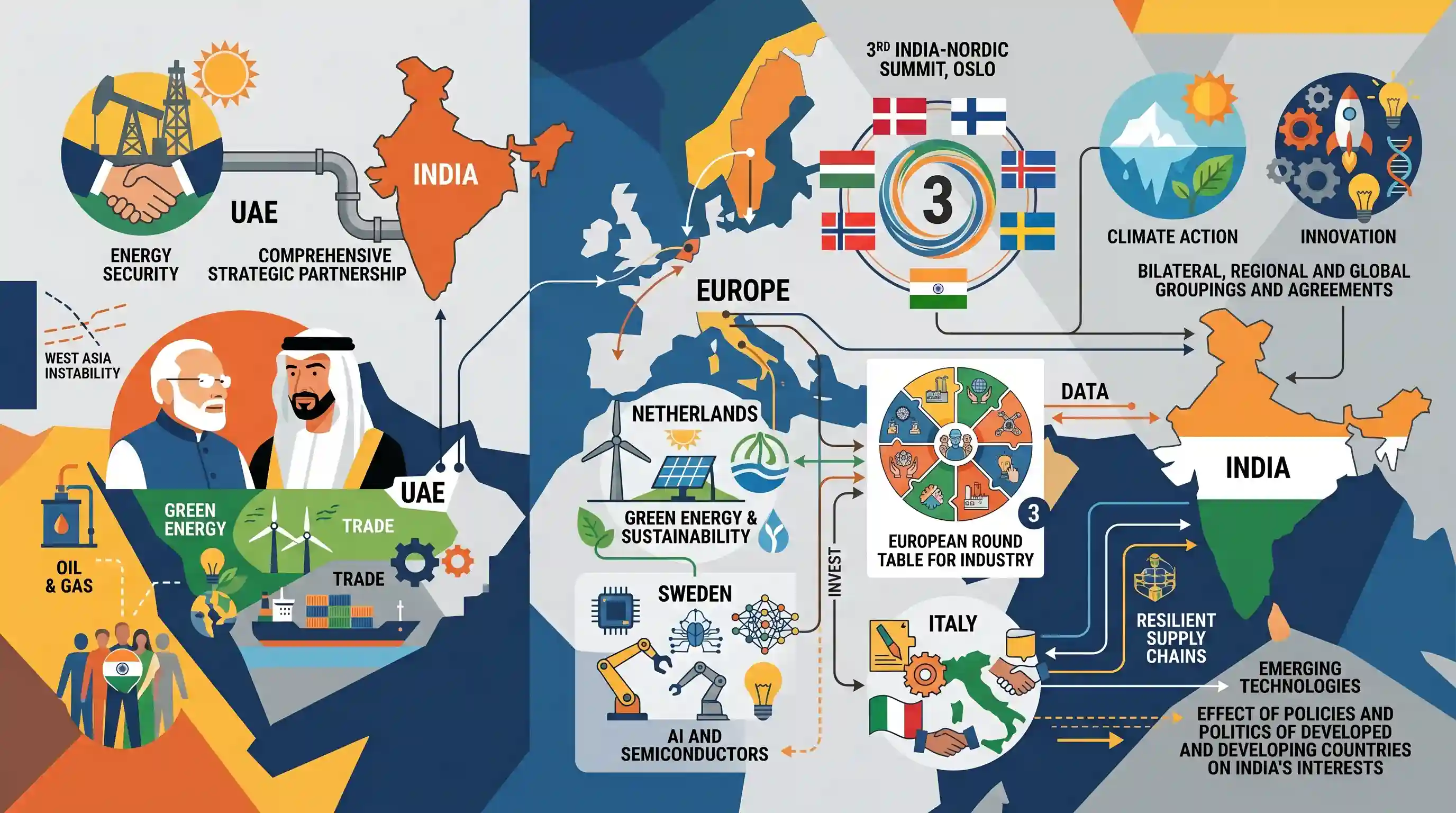
This extensive diplomatic tour highlights India's multi-aligned foreign policy approach. The engagements illustrate how India actively balances energy security concerns in an unstable Middle East while forging future-oriented partnerships in green technology and innovation with European and Nordic countries.
Summary
Prime Minister Narendra Modi is set to embark on a significant five-nation diplomatic tour starting May 15, covering the UAE, the Netherlands, Sweden, Norway, and Italy. The visit to the UAE aims to bolster energy cooperation and the bilateral Comprehensive Strategic Partnership, coming at a critical juncture of instability in West Asia. The European leg will focus heavily on green transition, emerging technologies like AI and semiconductors, and resilient supply chains, with PM Modi scheduled to address the European Round Table for Industry. A major highlight is the 3rd India-Nordic Summit in Oslo, where India will engage with leaders from five Nordic countries to deepen ties across sectors like climate action and innovation.
Key Points
- Prime Minister Narendra Modi is undertaking a five-nation visit from May 15, covering the UAE, the Netherlands, Sweden, Norway, and Italy.
- The inclusion of the UAE highlights India's focus on energy cooperation and the Comprehensive Strategic Partnership amid geopolitical instability in the Gulf/West Asia region.
- In the Netherlands and Sweden, the agenda centers on emerging technologies, green hydrogen, AI, semiconductors, and resilient supply chains.
- Norway will host the 3rd India-Nordic Summit, bringing together leaders from Norway, Denmark, Finland, Iceland, and Sweden to deepen multilateral engagement.
- The visit demonstrates India's strategy to balance energy security needs in the Middle East with advanced technological and environmental partnerships in Europe.
Important Terms
Comprehensive Strategic Partnership

A high-level bilateral framework elevating ties beyond trade to include deep cooperation in defense, energy security, and technology. India and the UAE upgraded to this status in 2017.
UPSC context
GS II: Bilateral agreements involving India; crucial for understanding India's 'West Asia' and 'Extended Neighborhood' policies.
India-Nordic Summit
A unique diplomatic forum between India and the five Nordic nations (Denmark, Finland, Iceland, Norway, Sweden). India is the only country besides the US with this engagement.
UPSC context
GS II: Regional groupings affecting India’s interests; tests knowledge of niche diplomatic platforms and cooperation on climate/innovation.
European Round Table for Industry
A forum of approximately 60 CEOs and Chairmen of major European multinational companies aimed at promoting competitiveness and prosperity through policy advocacy in Europe.
UPSC context
GS II/III: Effect of policies of developed countries; relevant for India’s industrial diplomacy and 'Make in India' global outreach.
Green Transition
The systemic shift from fossil-fuel-based economies to sustainable, low-carbon models through renewable energy, circular economy practices, and decarbonization of heavy industries.
UPSC context
GS III: Environment and Economy; tests understanding of India's Net Zero 2070 goals and international climate collaboration.
Supply Chain Resilience
The capacity of a supply chain to persist, adapt, or transform in the face of disruptions (geopolitical, pandemic, or climatic) to ensure continuous flow of goods.
UPSC context
GS III: Economic development and security; focuses on 'de-risking' from single-source dependencies and securing critical technology components.
Comprehensive Economic Partnership Agreement (CEPA)
A comprehensive free trade agreement that reduces tariffs on goods and opens services and investment markets. India and the UAE signed one in 2022.
UPSC context
GS II/III: Trade agreements and economic diplomacy; a cornerstone of India's current foreign trade strategy.
Prelims Trap
The recent India-EFTA trade agreement covers all five participating nations of the India-Nordic Summit.
The India-Nordic Summit involves 5 nations. The India-EFTA trade deal covers 4 European states, of which only two (Iceland, Norway) are Nordic. Denmark, Finland, and Sweden are not in EFTA.
Static Concepts Connected
What is the composition of the Arctic Council and India's current status?
- Member States: Comprises eight circumpolar nations: Canada, Denmark, Finland, Iceland, Norway, Russia, Sweden, and the United States.
- India's Status: India holds Observer status (granted in 2013, renewed subsequently) alongside nations like China, Japan, and South Korea, operating the Himadri research station.
- Core Mandate: Established by the 1996 Ottawa Declaration to promote cooperation and environmental protection in the Arctic, explicitly excluding military security matters.
How does a CEPA differ from a traditional Free Trade Agreement?
- Broader Scope: CEPA goes beyond trade in goods to comprehensively include services, cross-border investments, intellectual property, and mutual recognition agreements.
- Key Partners: India currently has operational CEPAs with the UAE, South Korea, and Japan, reflecting deep strategic and economic integration.
- Tariff Reductions: Typically involves deeper and faster phased tariff reductions and robust customs cooperation compared to standard FTAs or preferential trade pacts.
Cross-Topic Patterns
Gulf Hydrocarbons + Nordic Clean Tech
India balances traditional energy security via the UAE's strategic petroleum reserves while aggressively pursuing 'Green Strategic Partnerships' in Europe for offshore wind and green hydrogen.
Overlapping European Trade Groupings
India's signed EFTA deal overlaps with the India-Nordic summit (Norway, Iceland), whereas Nordic states Denmark, Finland, and Sweden fall under the distinct, pending India-EU FTA framework.

Expect a Prelims question mapping European groupings (EFTA vs Nordic) against India's recent trade pacts and Arctic Council missions.
Linked PYQs · 3
Linked PYQs · 3
- 2025MainsGS2
"Energy security constitutes the dominant kingpin of India's foreign policy, and is linked with India's overarching influence in Middle Eastern countries.” How would you integrate energy security with India's foreign policy trajectories in the coming years?
- 2017MainsGS2
The question of India's Energy Security constitutes the most important part of India's economic progress. Analyze India's energy policy cooperation with West Asian countries.
- 2022MainsGS2
‘Clean energy is the order of the day.’ Describe briefly India's changing policy towards climate change in various international fora in the context of geopolitics.
