ECLGS 5.0 Credit Support for MSMEs and Aviation Sector
Source:Indian Express ↗
Why It Matters
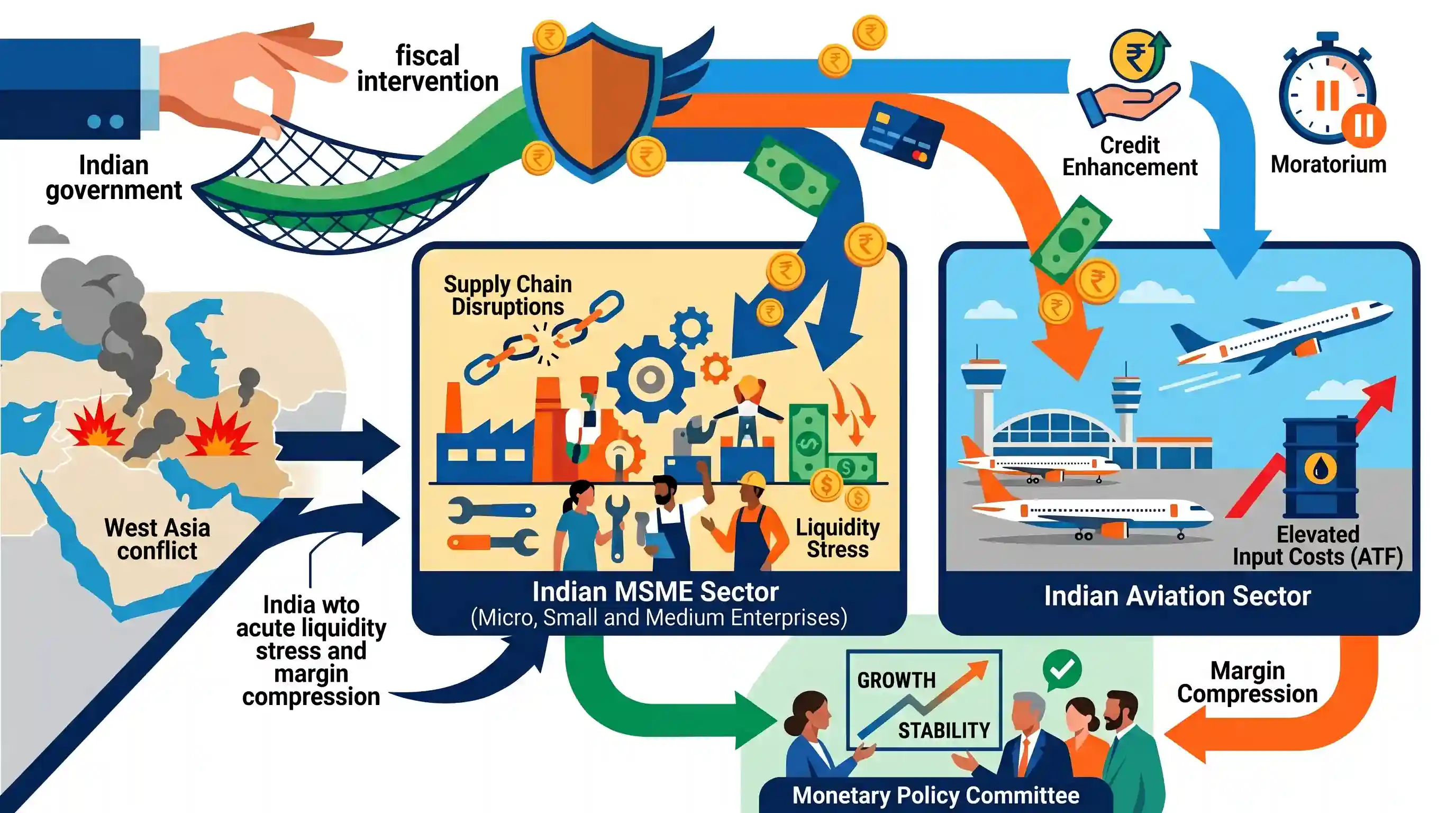
Provides a contemporary example of government fiscal intervention designed to insulate domestic sectors (MSME and Aviation) from external geopolitical shocks. It demonstrates the interplay between global supply chain disruptions, energy costs, and targeted economic policy in ensuring macroeconomic stability.
Summary
The launch of the Emergency Credit Line Guarantee Scheme (ECLGS) 5.0 serves as a targeted fiscal intervention to support Indian MSMEs and the aviation sector, both currently grappling with acute liquidity stress and margin compression induced by the West Asia conflict. Modeled on its successful pandemic-era predecessor, the scheme offers sector-specific credit enhancements and moratoriums to absorb the shocks of elevated input costs (like Aviation Turbine Fuel) and supply chain disruptions, aligning with the Monetary Policy Committee's recent concerns over macroeconomic stability and growth.
Key Points
- ECLGS 5.0 targets short-term liquidity mismatches faced by MSMEs and airlines due to supply chain and energy disruptions caused by the West Asia conflict.
- The scheme guarantees Rs 2.55 lakh crore in credit, including a dedicated Rs 5,000 crore sub-allocation for the aviation sector.
- MSMEs receive credit up to 20% of peak working capital utilized (capped at Rs 100 crore) with a one-year moratorium.
- Airlines, severely impacted by soaring Aviation Turbine Fuel (ATF) costs, can access up to 100% of working capital (capped at Rs 1,500 crore) with a two-year moratorium.
- Monetary Policy Committee (MPC) members have recently emphasized the acute squeeze on MSME margins from elevated input costs and supply constraints, necessitating such interventions.
Important Terms
Emergency Credit Line Guarantee Scheme (ECLGS) 5.0

A fiscal intervention providing 100% or 90% credit guarantees to banks for additional loans to MSMEs and the aviation sector, easing liquidity during geopolitical crises.
UPSC context
GS Paper III (Indian Economy); tests knowledge of government interventions to support industrial sectors and macroeconomic stability.
Monetary Policy Committee (MPC)
A statutory six-member body led by the RBI Governor that determines benchmark interest rates (repo rate) to maintain price stability while supporting economic growth.
UPSC context
GS Paper III (Indian Economy); critical for understanding monetary policy framework, inflation targeting (4% +/- 2%), and RBI's role.
Aviation Turbine Fuel (ATF)
Specialized fuel for powering aircraft; high prices (influenced by global crude and West Asia conflict) directly impact airline margins and are a key driver for fiscal relief.
UPSC context
GS Paper III (Infrastructure/Energy); tests understanding of input costs and their impact on the service sector and trade balance.
National Credit Guarantee Trustee Company (NCGTC)
A wholly-owned company of the Ministry of Finance that acts as a common trustee for multiple credit guarantee funds, including implementing the ECLGS.
UPSC context
GS Paper III (Indian Economy/Institutional Framework); relevant for questions on institutional mechanisms supporting financial inclusion and credit flow.
Moratorium
A temporary period during which a borrower is not required to make principal repayments on a loan, providing "breathing room" to stabilize cash flows.
UPSC context
GS Paper III (Banking/Economy); essential term for understanding debt restructuring and government-led relief measures for stressed sectors.
MSMEs (Micro, Small and Medium Enterprises)
The backbone of the Indian economy, defined by investment and turnover limits; they receive 100% guarantee coverage under ECLGS 5.0 to maintain operations.
UPSC context
GS Paper III (Indian Economy); frequent topic regarding employment, exports, and industrial growth.
Prelims Trap
"ECLGS provides interest-free, direct loans from the RBI to distressed MSMEs."
ECLGS provides a 100% government-backed guarantee on collateral-free loans via NCGTC, but they are issued by banks/NBFCs and carry capped interest rates, not zero interest.
Static Concepts Connected
How does the Emergency Credit Line Guarantee Scheme structurally work?
- Sovereign Guarantee: The government, via NCGTC, promises to repay lenders if borrowers default, absorbing the credit risk.
- Collateral-free: Banks provide emergency working capital term loans without demanding additional collateral from distressed MSMEs.
- Capped Interest: While not interest-free, the scheme caps lending rates (e.g., around 9% for banks) to ensure borrowing remains affordable during crises.
Why is the Indian aviation sector structurally vulnerable to macroeconomic shocks?
- ATF Dependency: Aviation Turbine Fuel (ATF) comprises 30-50% of operating expenses, making airlines highly vulnerable to global crude price volatility.
- Non-GST Status: ATF is excluded from GST, subjecting it to cascading central excise and high, variable state VAT without input tax credit benefits.
- Exchange Rate Risk: Aircraft leases, maintenance, and ATF are heavily dollar-denominated; thus, a depreciating rupee steeply inflates input costs.
Cross-Topic Patterns
Red Sea crisis + Imported inflation
West Asia conflicts trigger supply chain bottlenecks and crude volatility, demonstrating how geopolitical disruptions directly transmit into domestic inflation and margin compression for Indian MSMEs.
GST anomalies + Aviation sectoral stress
The aviation sector's need for ECLGS liquidity highlights structural fiscal issues, notably the exclusion of ATF from GST, which denies airlines crucial input tax credits and exacerbates stress.

Expect a 2026 prelims question contrasting the RBI's inflation-targeting mandate with the government's fiscal credit guarantees (ECLGS).
Linked PYQs · 5
Linked PYQs · 5
- 2023MainsGS3
Faster economic growth requires increased share of the manufacturing sector in GDP, particularly of MSMEs. Comment on the present policies of the Government in this regard.
- 2023PrelimsGS1
Consider the following statements with reference to India: 1. According to the 'Micro, Small and Medium Enterprises Development (MSMED) Act, 2006', the 'medium enterprises' are those with investments in plant and machinery between ₹ 15 crore and ₹ 25 crore. 2. All bank loans to the Micro, Small and Medium Enterprises qualify under the priority sector. Which of the statements given above is/are correct?
- 2024PrelimsGS1
With reference to physical capital in Indian economy, consider the following pairs: Items | Category 1. Farmer's plough | Working capital 2. Computer | Fixed capital 3. Yarn used by the weaver | Fixed capital 4. Petrol | Working capital How many of the above pairs are correctly matched?
- 2022PrelimsGS1
In India, which one of the following is responsible for maintaining price stability by controlling inflation?
- 2025MainsGS3
Elaborate the scope and significance of supply chain management of agricultural commodities in India.
