Tribunal Selection Panel Bill and Appointment Mechanism of Tribunals
Source:Indian Express ↗
ఇది ఎందుకు ముఖ్యం
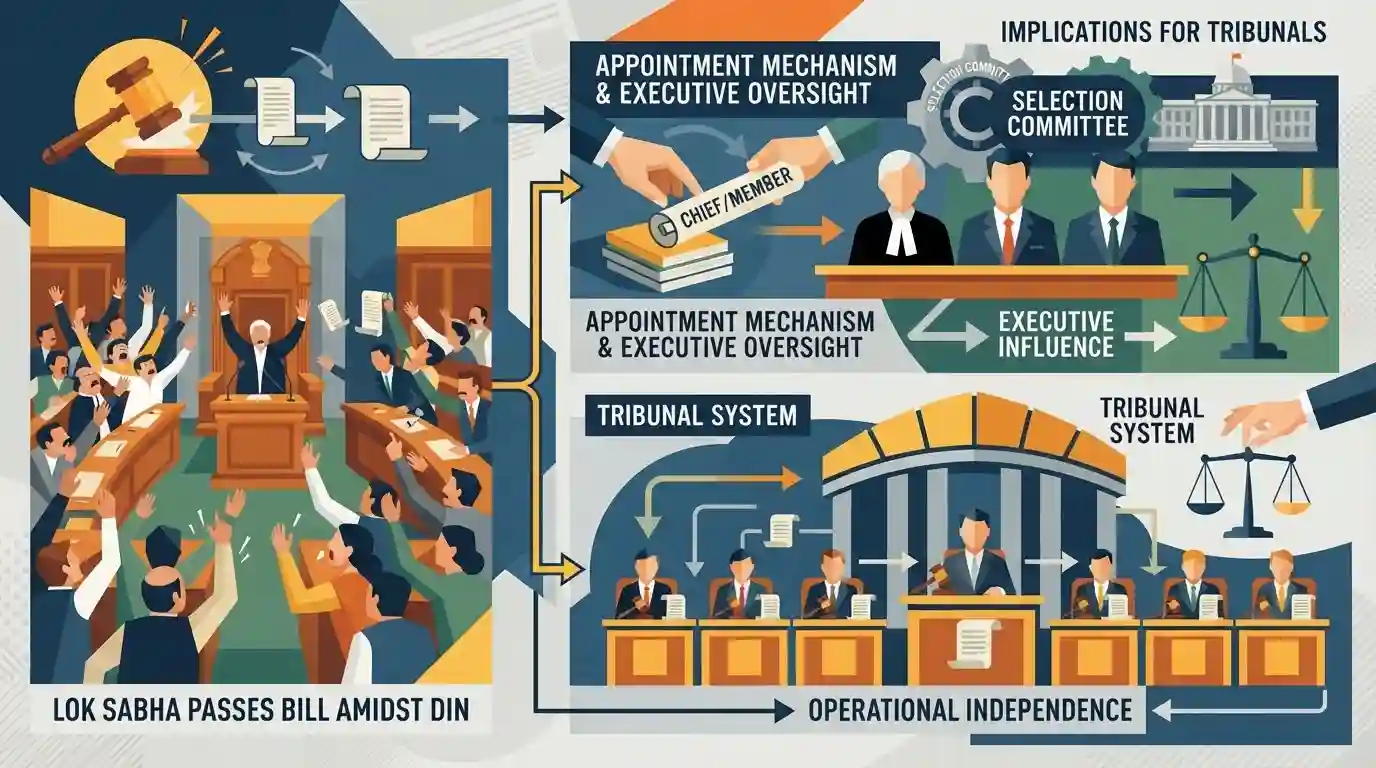
The legislation directly impacts the appointment mechanism of tribunals, balancing executive oversight with judicial independence, which is a core theme under GS2 (Separation of powers, dispute redressal mechanisms).
సారాంశం
The Lok Sabha passed a bill to set up a committee for selecting chiefs and members of various tribunals amidst din. The legislation has major implications for the governance, appointment mechanism, and operational independence of tribunals in India, touching upon ongoing debates regarding judicial independence and executive oversight.
ముఖ్య అంశాలు
- Lok Sabha passed a bill to establish a panel for selecting chairpersons and members of tribunals amidst opposition din.
- The legislation deals with the selection process, service conditions, and tenure of tribunal heads and members, addressing earlier judicial scrutiny regarding tribunal independence.
- Tribunals operate outside traditional court frameworks to ensure speedy dispute resolution in specific technical, administrative, or taxation domains.
ముఖ్యమైన పదాలు
Lok Sabha

The lower house of India’s bicameral Parliament, composed of representatives directly elected by the citizens of India on the basis of universal adult suffrage.
UPSC context
UPSC CSE GS Paper II: Structure, organization, and functioning of the Parliament and legislative procedures.
Parliament
The supreme legislative body of India comprising the President, Lok Sabha, and Rajya Sabha, responsible for enacting laws, deliberating national policies, and holding the executive accountable.
UPSC context
UPSC CSE GS Paper II: Parliament and State legislatures—structure, functioning, conduct of business, powers & privileges.
Supreme Court
The apex judicial court of India under the Constitution, acting as the guardian of the Constitution and the highest court of appeal with powers of judicial review.
UPSC context
UPSC CSE GS Paper II: Structure, organization, and functioning of the Judiciary and separation of powers.
అనుసంధానమైన స్థిర భావనలు
What is the constitutional basis and jurisdiction of Administrative Tribunals in India?
- Constitutional Basis: Articles 323A and 323B were inserted by the 42nd Constitutional Amendment Act, 1976, empowering Parliament and state legislatures to set up tribunals.
- Dual Provision: Article 323A deals specifically with administrative tribunals for public service matters, whereas Article 323B covers other matters like taxation, foreign exchange, and labor.
- Judicial Review: The Supreme Court in the L. Chandra Kumar case (1997) held that the power of judicial review vested in High Courts under Articles 226/227 is a part of the basic structure.
అంతర-అంశ నమూనాలు
Tribunal Reforms vs. Separation of Powers
Tribunals bypass traditional court backlogs but require rigorous separation of powers. Past judgments like Madras Bar Association cases consistently strike down executive overreach in search-cum-selection committees.
Administrative Justice and Article 323A/323B
Specialized tribunals touch upon administrative law and federal disputes, intersecting with civil service accountability and judicial review under Article 136 and 226.

Expect a 2-statement Prelims question on whether tribunals derive from original constitutional articles (323A/323B) or ordinary legislation.
అనుసంధాన PYQలు · 2
అనుసంధాన PYQలు · 2
- 2023MainsGS2
“Constitutionally guaranteed judicial independence is a prerequisite of democracy.” Comment.
- 2025MainsGS2
"Constitutional morality is the fulcrum which acts as an essential check upon the high functionaries and citizens alike...." In view of the above observation of the Supreme Court, explain the concept of constitutional morality and its application to ensure balance between judicial independence and judicial accountability in India.
