Parliamentary legislation on selection panel for tribunal appointments
Source:Indian Express ↗
কেন এটি গুরুত্বপূর্ণ
It relates directly to the governance framework of tribunals, judicial independence, separation of powers, and the administration of justice in India, which are core themes in the GS2 syllabus.
সারসংক্ষেপ
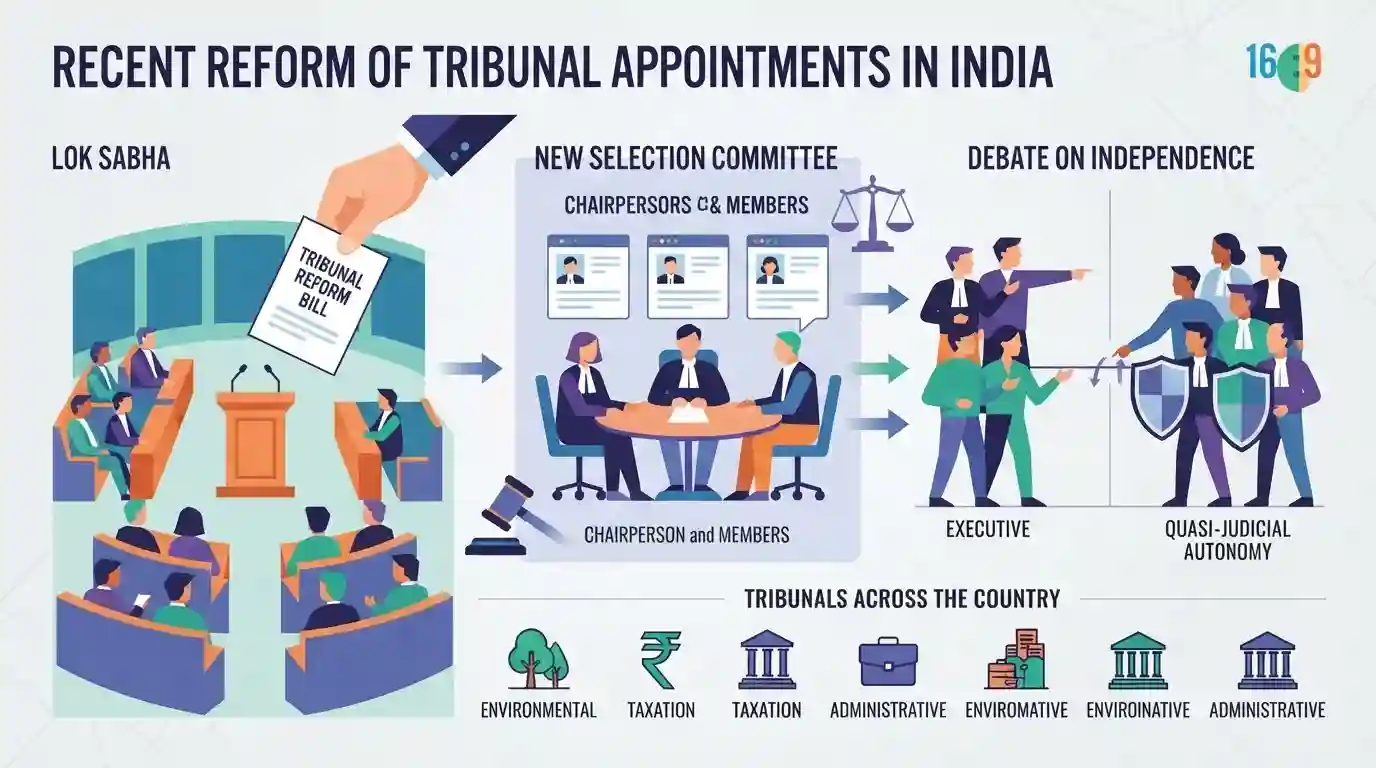
The Lok Sabha recently passed a bill to establish a structured selection panel for appointing chairpersons and members of various tribunals across the country. The move is aimed at reforming the tribunal appointment process, though it has sparked parliamentary debate regarding executive influence and the independence of quasi-judicial bodies.
মূল বিষয়
- The Lok Sabha passed a bill to set up a selection panel for appointing chiefs and members of various tribunals.
- The legislation aims to streamline the appointment mechanism and governance structure of tribunals in India.
- The passage took place amid opposition din and protests in the House.
- Tribunals handle specialized disputes, reducing the backlog of traditional courts, making their transparent and independent appointment process crucial for judicial administration.
গুরুত্বপূর্ণ শব্দ
Lok Sabha

The lower house of India’s bicameral Parliament, composed of representatives directly elected by the public on the basis of adult suffrage.
UPSC context
UPSC CSE Prelims and Mains (GS Paper II): Essential for understanding the legislative process, parliamentary privileges, and the structure of the Union legislature.
Parliament
The supreme legislative body of India, consisting of the President and two houses: the Rajya Sabha and the Lok Sabha.
UPSC context
UPSC CSE Prelims and Mains (GS Paper II): Core topic under Polity covering law-making, executive accountability, and parliamentary control over administration.
প্রিলিমস ফাঁদ
Tribunals are original bodies established directly under the unamended text of the Constitution of India in 1950.
Tribunals under Articles 323A and 323B were not part of the original 1950 Constitution; they were introduced via the 42nd Constitutional Amendment Act, 1976.
সংযুক্ত স্থির ধারণা
What are the constitutional provisions and key judicial rulings regarding tribunals in India?
- Constitutional Basis: Added by 42nd Amendment Act, 1976, inserting Article 323A (Administrative Tribunals) and Article 323B (Tribunals for other matters).
- Judicial Review: L. Chandra Kumar case (1997) ruled that the power of judicial review vested in High Courts (Art. 226) and Supreme Court (Art. 32) over tribunal orders is a part of the basic structure.
- Appointments & Tenure: Madras Bar Association judgments laid down strict guidelines on search-cum-selection committees, tenure, and service conditions to prevent excessive executive dominance.
আন্তঃবিষয় প্যাটার্ন
Tribunal Reforms & Separation of Powers
Tribunal appointment disputes directly test the doctrine of separation of powers, a core pillar of the GS-2 polity syllabus tested across both judicial reforms and executive overreach questions.
Appointments & Institutional Autonomy Benchmarks
The legislative-judicial friction over tribunal search-cum-selection committees mirrors broader debates surrounding the appointment of election commissioners and central investigators.

Expect a 2-statement Prelims question on whether tribunals derive power from original Constitution or amendments, or Mains on tribunal independence.
সংযুক্ত PYQ · 1
সংযুক্ত PYQ · 1
- 2025MainsGS2
Comment on the need of administrative tribunals as compared to the court system. Assess the impact of the recent tribunal reforms through rationalization of tribunals made in 2021.
