Karnataka waives hospital referral norms under health scheme
Source:The Hindu ↗
Why It Matters
Demonstrates an actionable model for bridging the gap between public health infrastructure shortages and the goal of Universal Health Coverage through state-private sector collaboration. Useful as a case study for GS2 answers on health policy, PPPs in healthcare, and strengthening health systems.
Summary
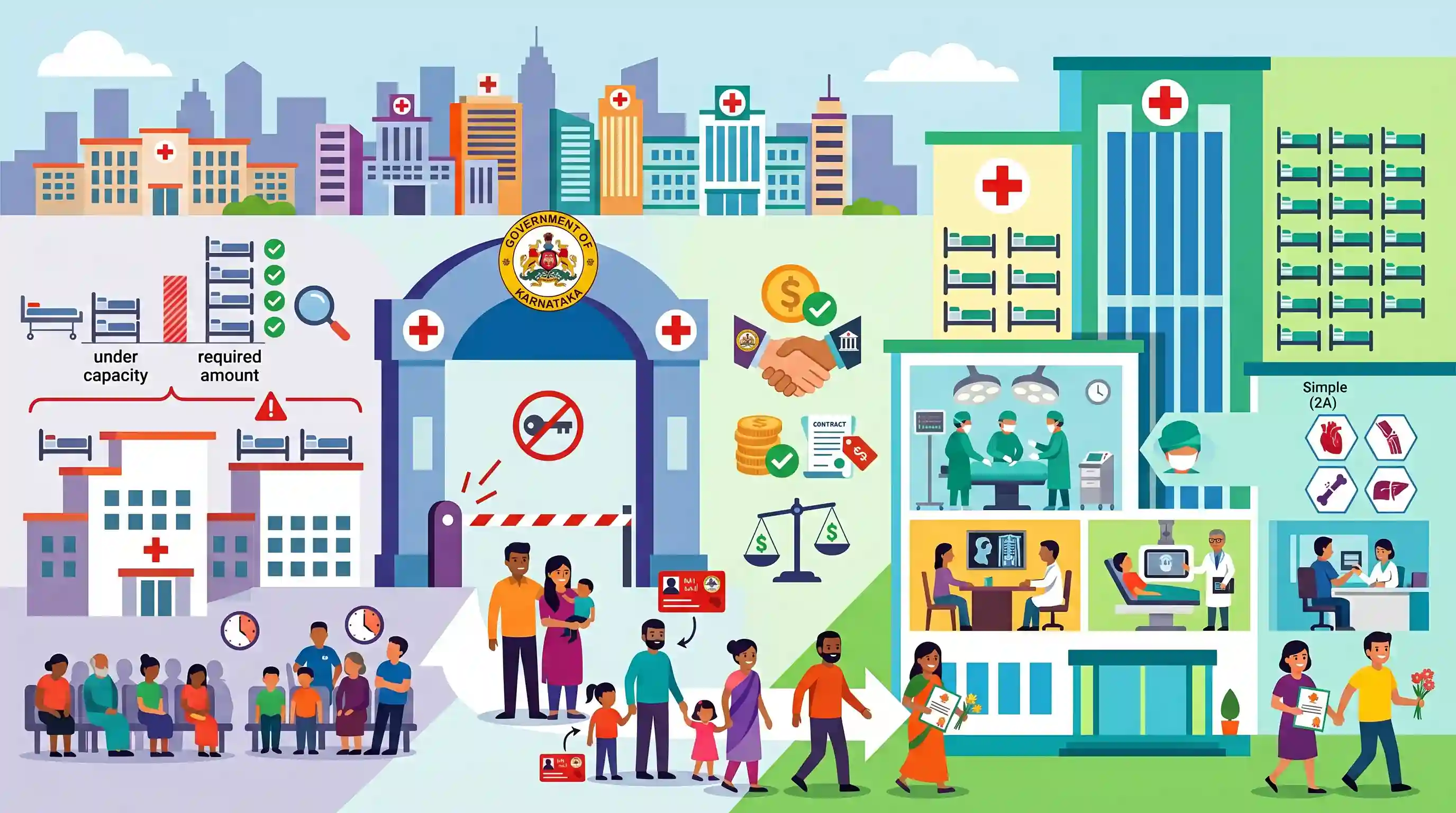
The Karnataka government has waived the mandatory referral requirement for the Ayushman Bharat Arogya Karnataka (AB-Ark) scheme at four private medical college hospitals in Greater Bengaluru. Driven by a shortfall of government hospital beds—10,000 beds available versus the 13,000 required by Indian Public Health Standards (IPHS)—the one-year pilot allows BPL families direct access to simple secondary (2A) procedures. Treatments will be provided at government-notified package rates, leveraging private medical infrastructure (which holds 22,000 beds) to advance universal health coverage and reduce patient delays without adding financial burden to the State.
Key Points
- Karnataka government waived the mandatory government hospital referral requirement for the AB-Ark scheme at four private medical colleges in Bengaluru.
- The policy addresses a bed shortage: Greater Bengaluru has 10,000 government beds against the IPHS norm of 13,000, while the private sector has 22,000 beds.
- The one-year pilot allows direct access to simple secondary (2A) procedures for BPL families, which were previously only permitted in government hospitals.
- Treatments will be provided at government-fixed package rates, meaning no additional financial burden on the State exchequer.
- The initiative serves as a model for public-private collaboration to achieve Universal Health Coverage (UHC) and reduce treatment delays.
Important Terms
Ayushman Bharat Arogya Karnataka (AB-Ark)

A co-branded health insurance scheme merging Karnataka's original health initiative with the national PM-JAY, providing cashless treatment up to ₹5 lakh per family annually for secondary and tertiary care.
UPSC context
GS Paper II (Social Justice/Health). Relevant for questions on state-center cooperative federalism and implementation of integrated welfare schemes.
Ayushman Bharat Pradhan Mantri Jan Arogya Yojana (AB-PMJAY)
The world’s largest government-funded health assurance program providing ₹5 lakh annual coverage per family for secondary and tertiary hospitalization to over 12 crore poor and vulnerable families.
UPSC context
GS Paper II (Government Policies). A core reference for health security, poverty alleviation, and public health infrastructure discussions.
Indian Public Health Standards (IPHS)
Uniform quality benchmarks for infrastructure, human resources, and services across various levels of public healthcare facilities (PHCs to District Hospitals) to ensure minimum essential service delivery.
UPSC context
GS Paper II (Health/Governance). Vital for evaluating health infrastructure gaps and government accountability in meeting quality care standards.
National Medical Commission (NMC)
India’s apex statutory regulator for medical education and professionals, established in 2020 to replace the Medical Council of India (MCI) and oversee ethical standards and institutional accreditation.
UPSC context
GS Paper II (Statutory/Regulatory Bodies). Key for analysis of governance reforms in medical education and healthcare quality regulation.
Universal Health Coverage (UHC)
A policy framework ensuring all individuals have access to the full spectrum of quality health services they need without suffering financial hardship.
UPSC context
GS Paper II (Social Justice). The overarching goal of major health schemes and a frequent topic in developmental economics and social sector interventions.
Referral Requirement
A structured procedure where patients are transferred from primary/secondary facilities to higher-level hospitals for specialized treatment, often a mandatory requirement for availing insurance benefits under government schemes.
UPSC context
GS Paper II (Public Service Delivery). Tests understanding of operational hurdles and administrative reforms meant to improve ease of access to healthcare.
Prelims Trap
Ayushman Bharat PM-JAY provides cashless coverage of ₹5 lakh per family annually for primary, secondary, and tertiary care.
PM-JAY covers ONLY secondary and tertiary hospitalization. The primary healthcare component of Ayushman Bharat is delivered through Health and Wellness Centres (Ayushman Arogya Mandirs), not insurance.
Static Concepts Connected
What are the two core pillars of the Ayushman Bharat health initiative?
- Primary Care: Delivered through Ayushman Arogya Mandirs (HWCs), which provide comprehensive primary healthcare, free essential drugs, diagnostics, and maternal/child services.
- Secondary & Tertiary: Delivered via PM-JAY, providing cashless health insurance cover of ₹5 lakh per vulnerable family per year specifically for hospitalization.
What are the Indian Public Health Standards (IPHS) for healthcare facilities?
- Uniform Benchmarks: Set by the Union Health Ministry, providing standard reference protocols for infrastructure, human resources, and service delivery across public health facilities.
- Bed Density Norm: The revised 2022 IPHS guidelines mandate a minimum essential requirement of 1 hospital bed per 1,000 population at the district level.
- NHM Linkage: IPHS acts as the foundational benchmark for assessing facility gaps and channeling funds for upgradation under the National Health Mission (NHM).
Cross-Topic Patterns
Strategic Purchasing & OOPE Reduction
Waiving referrals and paying private hospitals via government-fixed package rates is a form of 'strategic purchasing'—a tool to reduce India's high Out-of-Pocket Expenditure (OOPE) without immediately building state infrastructure.
Urban Health Infrastructure Gaps
Bengaluru's severe shortfall of public beds (10,000 vs 13,000 IPHS norm) underscores why the 15th Finance Commission recommended specific tied health grants for Urban Local Bodies to upgrade city-level facilities.

Expect a 2026 Prelims question on PM-JAY testing the exact coverage scope (excluding primary care) and the role of IPHS bed-density norms.
Linked PYQs · 3
Linked PYQs · 3
- 2015MainsGS2
Public health system has limitations in providing universal health coverage. Do you think that the private sector could help in bridging the gap? What other viable alternatives would you suggest?
- 2018MainsGS2
Appropriate local community-level healthcare intervention is a prerequisite to achieve 'Health for All' in India. Explain.
- 2021MainsGS2
“Besides being a moral imperative of a Welfare State, primary health structure is a necessary precondition for sustainable development.” Analyze.
