Religious Authority and Political Tensions in Punjab Governance
Source:Indian Express ↗
Why It Matters
Understanding the dynamics between state governments and powerful religious institutions is crucial for GS2 (Governance/Polity), especially concerning secularism and vote-bank politics. Additionally, the weaponization of AI deepfakes to trigger religious sacrilege issues directly ties into GS3 internal security and cyber threats.
Summary
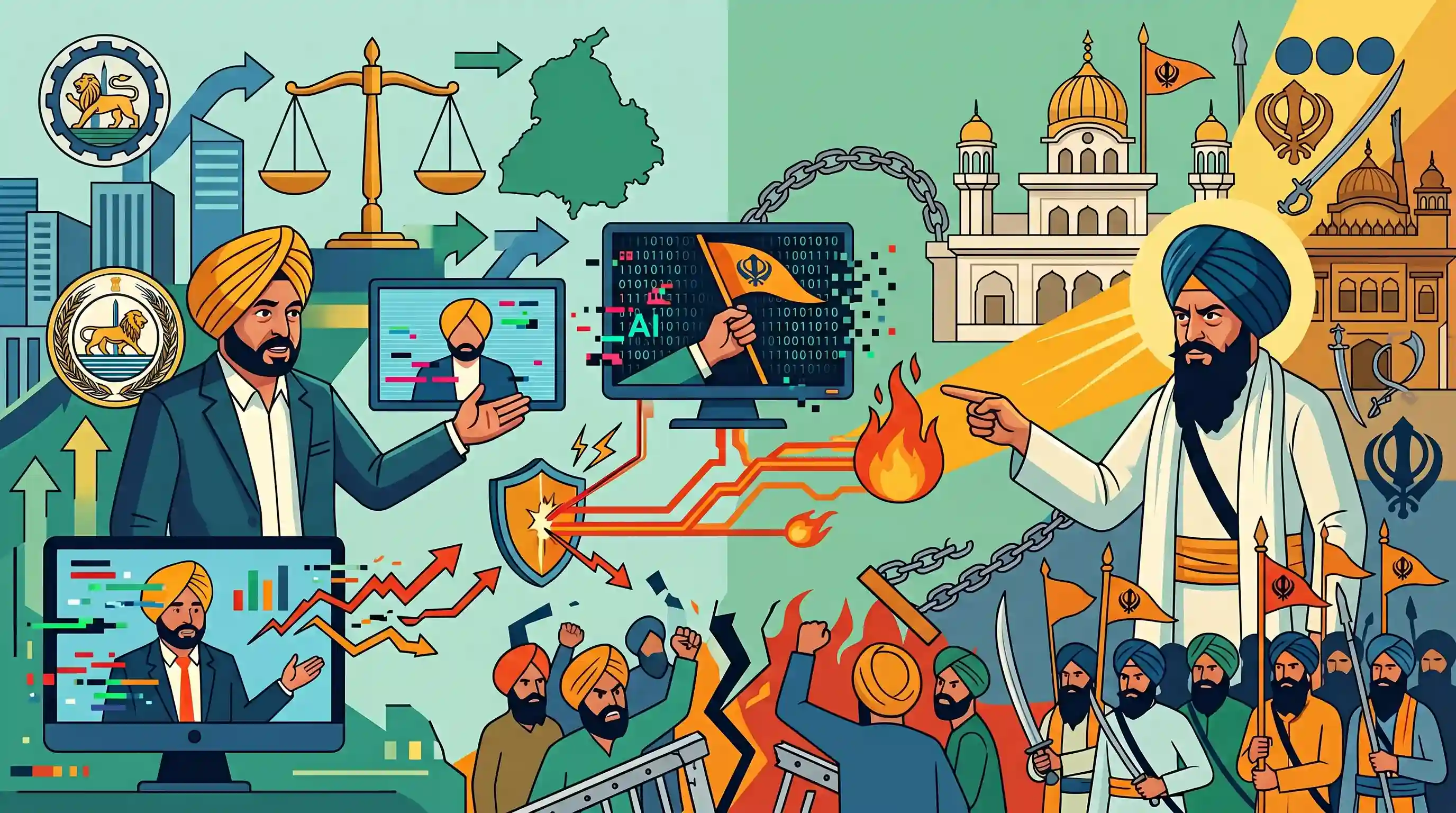
The escalating conflict between Punjab Chief Minister Bhagwant Mann and the Akal Takht Jathedar underscores the complex interplay of religion and politics in the state. Sparked by a controversial video that the Chief Minister dismissed as an AI deepfake, the Jathedar labeled Mann a 'Guru dokhi' (anti-Guru). This incident highlights the enduring political influence of the Akal Takht, the highest temporal seat of Sikhs, and the Shiromani Gurdwara Parbandhak Committee (SGPC). It also brings attention to the volatile nature of sacrilege allegations in Punjab politics and the emerging internal security threats posed by AI-driven disinformation aimed at inciting religious tensions.
Key Points
- The Akal Takht, the highest temporal seat of Sikhs founded by Guru Hargobind Sahib, holds profound religious and political authority in Punjab, with the Jathedar wielding power to declare leaders 'tankhaiya' (guilty of religious misconduct) or excommunicate them.
- Punjab CM Bhagwant Mann faced backlash from the Akal Takht Jathedar, who labeled him 'Guru dokhi' (anti-Guru) over an alleged sacrilege video.
- Mann dismissed the controversial video as an AI-generated deepfake, highlighting the modern intersection of cyber threats, disinformation, and religious sensitivities.
- Sacrilege remains a highly volatile political issue in Punjab, previously destabilizing the SAD-BJP government over the 2015 Bargari incidents, and continues to strain relations between the state government and the SGPC.
Important Terms
Akal Takht

The highest temporal seat of Sikhism, established in 1606 by Guru Hargobind. It represents the principle of "Miri-Piri," balancing spiritual authority with worldly governance and justice.
UPSC context
GS Paper I/II; tests knowledge of religious-political institutions and the intersection of faith and state governance.
Shiromani Gurdwara Parbandhak Committee (SGPC)
An elected statutory body formed in 1920 and legalized by the 1925 Act. It manages historical Gurdwaras and is often described as the "Parliament of Sikhs."
UPSC context
GS Paper II (Statutory Bodies); examines religious administration and the relationship between community-led institutions and the state.
Sikh Gurdwaras (Amendment) Bill, 2023
Legislation passed by the Punjab Assembly to mandate free-to-air telecast of Gurbani. It challenged SGPC authority and raised constitutional questions regarding state interference in religious management.
UPSC context
GS Paper II (Polity); highlights legal disputes over legislative competence and the constitutional boundaries of secularism.
Shiromani Akali Dal (SAD)
A centrist-right political party founded in 1920. Originally the task force of the SGPC, it remains a principal advocate for Sikh political and religious identity.
UPSC context
GS Paper I/II; relevant for understanding the Gurdwara Reform Movement and identity-based political mobilization.
Aam Aadmi Party (AAP)
A contemporary political party emphasizing anti-corruption and welfare. As Punjab's ruling party, it faces friction with traditional Sikh institutions over governance and religious sacrilege issues.
UPSC context
GS Paper II (Polity); relevant for analyzing electoral dynamics and the challenges of secular governance in religiously sensitive states.
Prelims Trap
"The Akal Takht was founded by Guru Gobind Singh."
Aspirants often attribute major martial or temporal Sikh institutions to the 10th Guru, but Akal Takht and 'Miri-Piri' were established by the 6th Guru, Guru Hargobind.
Static Concepts Connected
What is the doctrine of Miri-Piri and who introduced it?
- Miri-Piri Doctrine: Signifies the foundational synthesis and unity of temporal (political/material) and spiritual authority in Sikhism.
- Guru Hargobind: Introduced by the 6th Sikh Guru, marking a strategic and martial shift in the Sikh tradition to defend the faith.
- Akal Takht: The physical manifestation of this doctrine, established in 1606 as the highest temporal seat of the Sikhs.
How does the SGPC derive its regulatory and administrative authority?
- Statutory Body: It is a statutory body governed by the Sikh Gurdwaras Act of 1925, a pre-independence legislation.
- Akali Movement: The 1925 Act was the direct result of the non-violent Gurdwara Reform Movement to oust corrupt Mahants.
- Democratic Setup: Members are elected directly by eligible Sikh voters, functioning effectively as a democratic "parliament of Sikhs."
Cross-Topic Patterns
AI Deepfakes & Communal Violence
Weaponizing synthetic media to target religious sensitivities demonstrates how emerging cyber threats directly challenge local law-and-order machinery and secular harmony.
Statutory Control of Religion
SGPC's statutory mandate under the 1925 Act illustrates India’s 'principled distance' secularism, where the State structurally regulates religious institution governance instead of enforcing strict separation.

Expect a GS-3 Mains question linking AI-generated synthetic media (deepfakes) to the exacerbation of communal faultlines and public order.
Linked PYQs · 4
Linked PYQs · 4
- 2024MainsGS2
Discuss India as a secular state and compare with the secular principles of the US constitution.
- 2023MainsGS3
Introduce the concept of Artificial Intelligence (AI). How does Al help clinical diagnosis? Do you perceive any threat to privacy of the individual in the use of Al in healthcare?
- 2016MainsGS3
Use of Internet and social media by non-state actors for subversive activities is a major security concern. How have these been misused in the recent past? Suggest effective guidelines to curb the above threat.
- 2020MainsGS3
Discuss different types of cyber crimes and measures required to be taken to fight the menace.
