Unilateral Economic Sanctions and Extraterritorial Application of Laws
Source:The Hindu ↗
Why It Matters
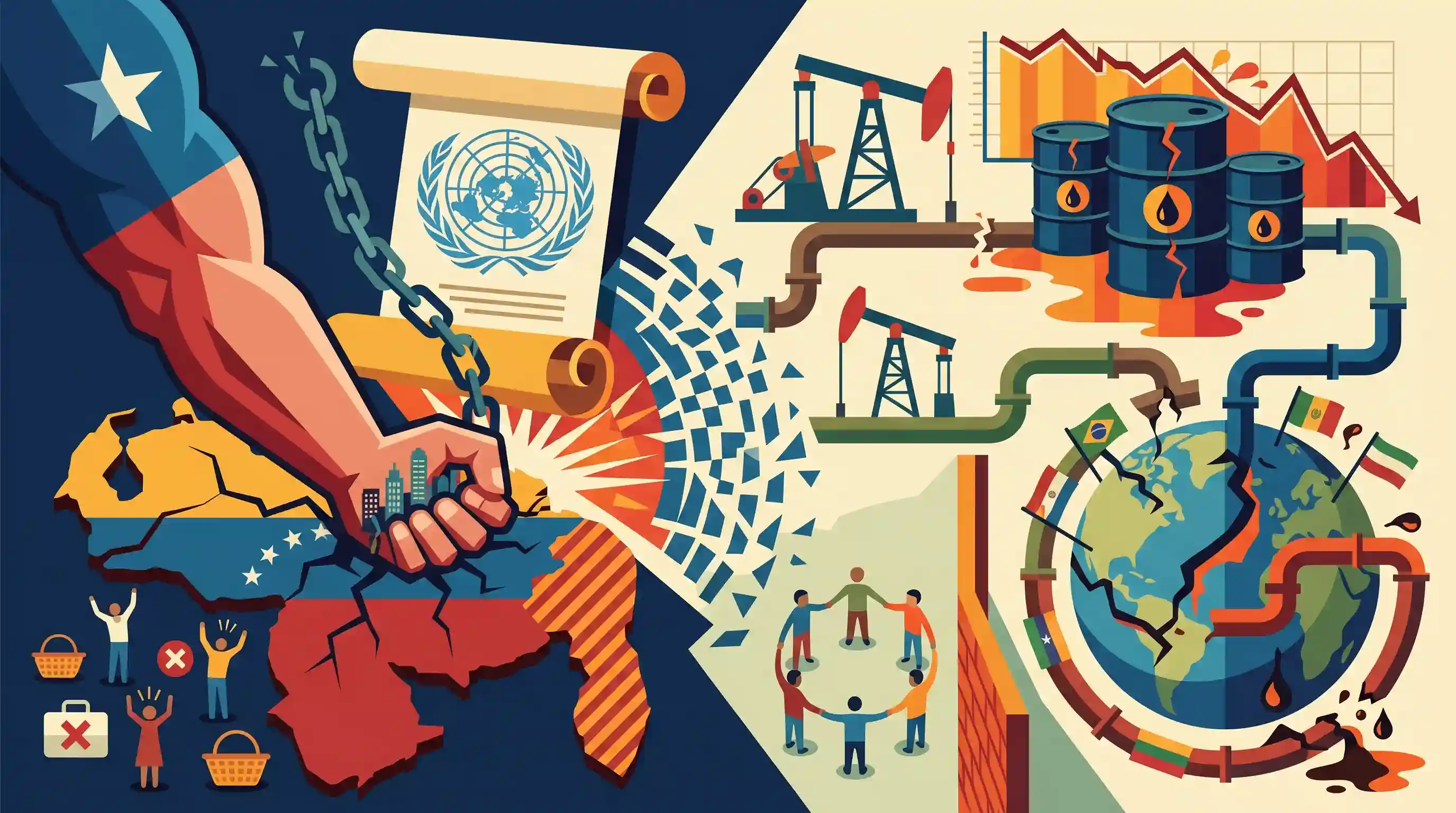
Unilateral sanctions represent a significant challenge to the international legal order. Understanding their mechanism and impact is crucial for analyzing global geopolitics, state sovereignty issues, and energy security ramifications for India.
Summary
The article critiques the unilateral economic sanctions and coercive measures taken by the United States against Venezuela, arguing that they violate international law and the UN Charter. It highlights how extraterritorial overreach infringes upon Venezuelan sovereignty, causes humanitarian distress, and disrupts global energy markets, demonstrating the dangers of unilateralism over multilateralism.
Key Points
- Unilateral coercive measures imposed by the US on Venezuela bypass the United Nations framework, challenging established international law.
- Such sanctions act as an extraterritorial application of domestic US law, violating the principles of state sovereignty and non-intervention.
- The resulting economic distress in Venezuela precipitates severe humanitarian consequences and forces migration.
- Unilateral sanctions impact global energy security and oil markets, which indirectly affects large energy-importing nations like India.
Important Terms
UN Charter

The foundational 1945 treaty of the United Nations establishing global legal principles, including sovereign equality, non-intervention in domestic affairs, and the prohibition of the illegal use of force.
UPSC context
GS Paper 2: International Institutions. Tests understanding of the legal framework governing global peace and state relations.
Unilateral Sanctions
Economic or political penalties imposed by a single country against another without UN Security Council authorization, often used to force policy changes or regime transitions.
UPSC context
GS Paper 2: Effect of policies of developed countries on India's interests, particularly regarding energy imports.
Sovereignty
The supreme and independent authority of a state to govern its territory and internal affairs without external interference, a core principle of the Westphalian international system.
UPSC context
GS Paper 2: Constitution and International Relations. Fundamental to the Preamble and the principle of non-interference.
Extraterritoriality
The extension of a state's legal authority beyond its borders, often through "secondary sanctions" that penalize third-party nations or companies for trading with a sanctioned state.
UPSC context
GS Paper 2: International Relations. Relevant for understanding legal overreach and its impact on India's strategic autonomy.
Multilateralism
A collaborative diplomatic approach involving three or more states working through international organizations and shared norms to address global challenges and maintain international order.
UPSC context
GS Paper 2: International Relations. Key to India's foreign policy goal of "reformed multilateralism" in global governance.
International Law
The body of rules, treaties, and customs that govern relations between sovereign states and international actors, providing a framework for global stability and cooperation.
UPSC context
GS Paper 2: International Relations. Core framework for evaluating the legality of state actions and global order.
Prelims Trap
"Unilateral Coercive Measures (UCMs) are economic sanctions authorized under Chapter VII of the UN Charter."
UCMs are unilateral actions bypassing the UN. Only UN Security Council sanctions under Chapter VII are globally binding; UCMs lack international legal backing and often violate state sovereignty.
Static Concepts Connected
What is the difference between Primary and Secondary Sanctions?
- Primary Sanctions: Prohibit citizens and companies of the sanctioning country from doing business directly with the targeted nation.
- Secondary Sanctions: Extraterritorial application of domestic law that penalizes third-party nations (like India) or foreign entities for trading with the sanctioned state.
- Legal Standing: Only UN Security Council sanctions are universally binding under the UN Charter; unilateral secondary sanctions are broadly considered violations of international law.
Why is Venezuelan crude significant for India's energy security?
- Largest Reserves: Venezuela holds the world's largest proven oil reserves (over 300 billion barrels), offering a crucial diversification alternative to Middle Eastern oil dependence.
- Heavy Crude Processing: Many complex Indian refineries (e.g., Reliance, Nayara) are specifically designed with high Nelson Complexity Indices to process heavy, sour crude, which Venezuela produces abundantly.
Cross-Topic Patterns
Secondary Sanctions drive De-dollarization
Weaponization of the US dollar through secondary sanctions accelerates BRICS and SCO initiatives to establish alternative financial architectures and local currency settlement mechanisms.
Strategic Autonomy in Energy Sourcing
India's navigation of sanctioned oil (whether Russian, Iranian, or Venezuelan) highlights the tension between US extraterritorial laws and India's pursuit of strategic autonomy in energy security.

Expect a 2026 multi-statement Prelims question linking US extraterritorial sanctions (UCMs) to BRICS de-dollarization efforts.
Linked PYQs · 3
Linked PYQs · 3
- 2025MainsGS2
"Energy security constitutes the dominant kingpin of India's foreign policy, and is linked with India's overarching influence in Middle Eastern countries.” How would you integrate energy security with India's foreign policy trajectories in the coming years?
- 2018MainsGS3
How would the recent phenomena of protectionism and currency manipulations in world trade affect macroeconomic stability of India?
- 2025MainsGS3
What are the challenges before the Indian economy when the world is moving away from free trade and multilateralism to protectionism and bilateralism? How can these challenges be met?
