United States maximum pressure strategy and Middle East geopolitics
Source:Indian Express ↗
Why It Matters
US-Iran relations are central to Middle Eastern stability. For UPSC aspirants, understanding this dynamic is crucial because it directly impacts India's energy security, its diaspora in the Gulf, and strategic investments like the Chabahar port.
Summary
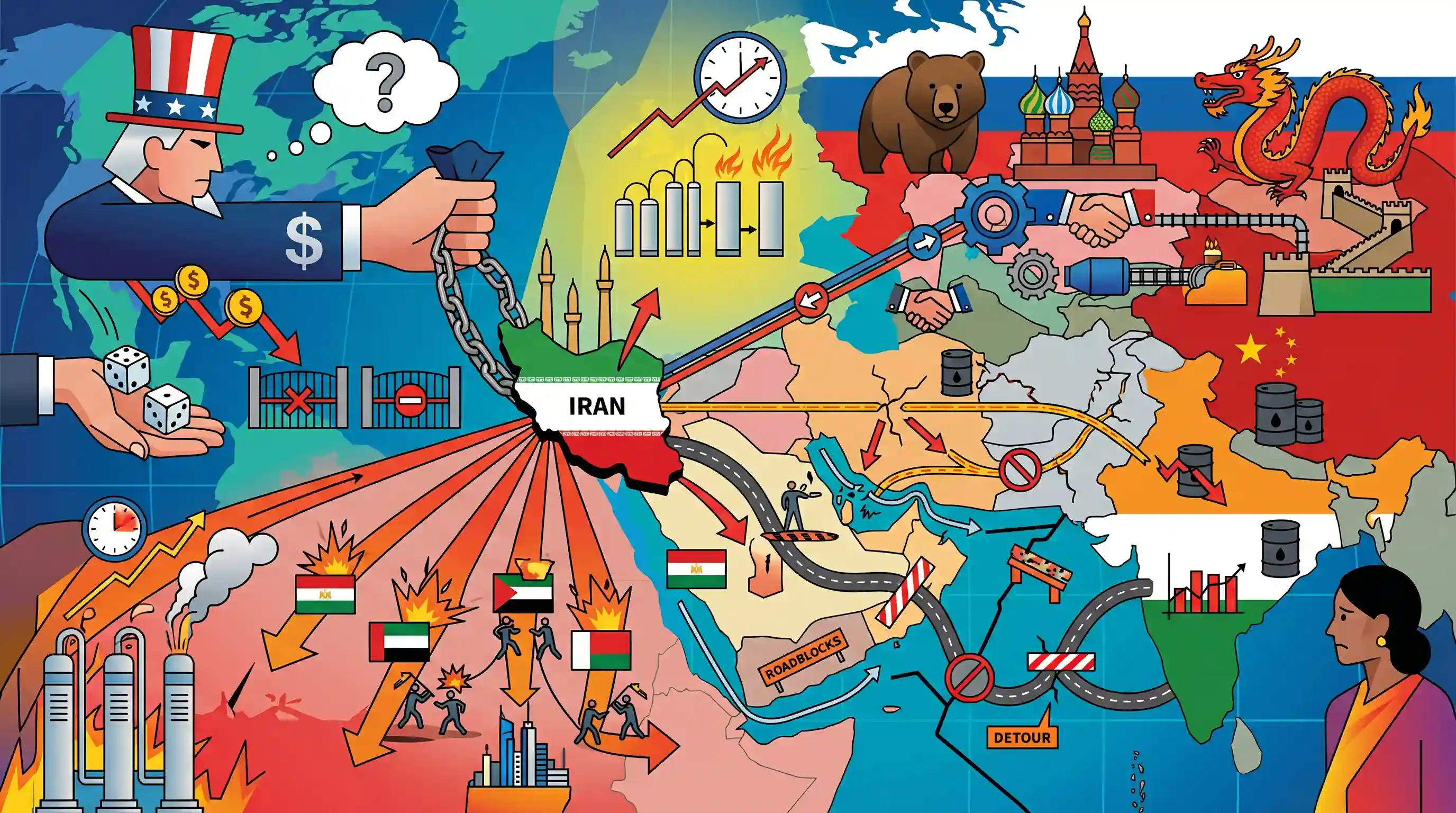
The article critiques the United States' strategy of applying relentless economic and diplomatic pressure on Iran without a clear, actionable long-term plan. It argues that this 'maximum pressure' gamble is counterproductive, as it fails to force Iranian concessions and instead accelerates Tehran's nuclear program. Furthermore, the absence of viable diplomatic off-ramps pushes Iran to strengthen its strategic ties with Russia and China while escalating proxy conflicts in the Middle East. For global stakeholders like India, this enduring instability threatens energy security and complicates regional connectivity initiatives.
Key Points
- The US's reliance on a 'maximum pressure' sanctions campaign against Iran lacks a coherent strategic endgame or diplomatic off-ramp.
- Rather than capitulating to economic coercion, Iran has responded by accelerating its nuclear enrichment activities closer to weapons-grade levels.
- The lack of a structured plan risks escalating regional conflicts across the Middle East, mobilizing Iran-backed proxy networks.
- This US policy inadvertently deepens Tehran's strategic and military alliances with global adversaries like Russia and China.
- For India, the ongoing US-Iran friction complicates energy security considerations and strategic connectivity projects such as the Chabahar Port.
Important Terms
JCPOA (Joint Comprehensive Plan of Action)

A 2015 landmark agreement where Iran agreed to limit its nuclear enrichment activities and allow international inspections in exchange for the lifting of economic sanctions.
UPSC context
GS-II (Global Agreements). Critical for analyzing West Asian stability and the impact of the deal’s collapse on India’s energy security.
Maximum Pressure Campaign
A U.S. foreign policy strategy initiated in 2018 using severe economic sanctions and diplomatic isolation to force Iran into renegotiating its nuclear and regional policies.
UPSC context
GS-II (Policies of Developed Countries). Tests understanding of how U.S. sanctions impact secondary nations like India, affecting oil trade and connectivity.
IAEA (International Atomic Energy Agency)
An autonomous UN-affiliated watchdog that promotes peaceful nuclear energy use and verifies state compliance with non-proliferation commitments through inspections and monitoring.
UPSC context
GS-II (International Institutions). Tests knowledge of global nuclear governance and verification mechanisms essential for preventing regional arms races.
Strait of Hormuz
A critical maritime chokepoint connecting the Persian Gulf to the Gulf of Oman, handling over 20% of global oil shipments and frequently serving as a flashpoint.
UPSC context
GS-I/II (Geography/Security). Essential for understanding maritime security threats, global energy supply chains, and the Indian Navy’s regional role.
Chabahar Port
A strategic Iranian deep-water port on the Gulf of Oman, developed with Indian investment to secure a trade route to Afghanistan and Central Asia bypassing Pakistan.
UPSC context
GS-II (Bilateral Relations). A key project for India’s regional connectivity and its response to China’s presence in Gwadar, Pakistan.
Strategic Autonomy
A foreign policy doctrine where a country maintains independent decision-making to protect national interests while balancing competing relationships with major global powers.
UPSC context
GS-II (Foreign Policy). Fundamental concept in India’s multi-alignment strategy, especially regarding its refusal to join blocks in West Asia.
Prelims Trap
India completely halted its Chabahar Port operations and investments due to US secondary sanctions.
While India halted Iranian oil imports in 2019, Chabahar historically received a narrow US waiver for Afghan reconstruction, allowing India to continue development.
Static Concepts Connected
What distinguishes civilian from weapons-grade uranium enrichment?
- LEU (Civilian): Low-Enriched Uranium (LEU) contains 3-5% U-235, which is sufficient to sustain reactions for commercial nuclear power plants.
- HEU (Weapons-grade): Highly Enriched Uranium (HEU) requires concentrating the U-235 isotope to 90% or higher, the threshold necessary for a nuclear weapon.
- Breakout Time: Iran enriching to 60% marks a critical technical threshold. From 60%, the effort required to reach 90% is drastically reduced.
How do US secondary sanctions operate against third-party countries?
- Mechanism: While primary sanctions block US entities, secondary sanctions threaten foreign nations and banks with exclusion from the US financial system if they trade with the sanctioned country.
- SRE Waivers: The Significant Reduction Exceptions (SRE) were temporary waivers allowing countries like India to buy Iranian oil. Their 2019 expiry forced India to zero out imports.
- IFCA Threat: The Iran Freedom and Counter-Proliferation Act (IFCA) empowers the US to sanction entities investing in Iranian energy, shipping, or shipbuilding sectors.
Cross-Topic Patterns
Secondary Sanctions & De-dollarization
US economic coercion on Iran has accelerated alternative payment networks. India's push for internationalized Rupee trade (Special Vostro accounts) is heavily driven by the need to bypass such geopolitical blockades.
Connectivity geopolitics: INSTC vs IMEC
Sanctions on Iran bottleneck India's access to the International North-South Transport Corridor (INSTC). The US-backed IMEC serves as a strategic alternative, reshaping India's Middle East connectivity options.

Expect a 2026 GS-2 Mains question linking US 'maximum pressure' on Iran to the deepening Russia-China-Iran axis and India's INSTC delays.
Linked PYQs · 3
Linked PYQs · 3
- 2018MainsGS2
In what ways would the ongoing US-Iran Nuclear Pact Controversy affect the national interest of India? How should India respond to this situation?
- 2012MainsGS2
How have the US sanctions against Iran affected India's bilateral relations with Iran?
- 2025MainsGS2
"Energy security constitutes the dominant kingpin of India's foreign policy, and is linked with India's overarching influence in Middle Eastern countries.” How would you integrate energy security with India's foreign policy trajectories in the coming years?
