US 30-Day Waiver for India Russian Oil Imports
Source:Indian Express ↗
Why It Matters
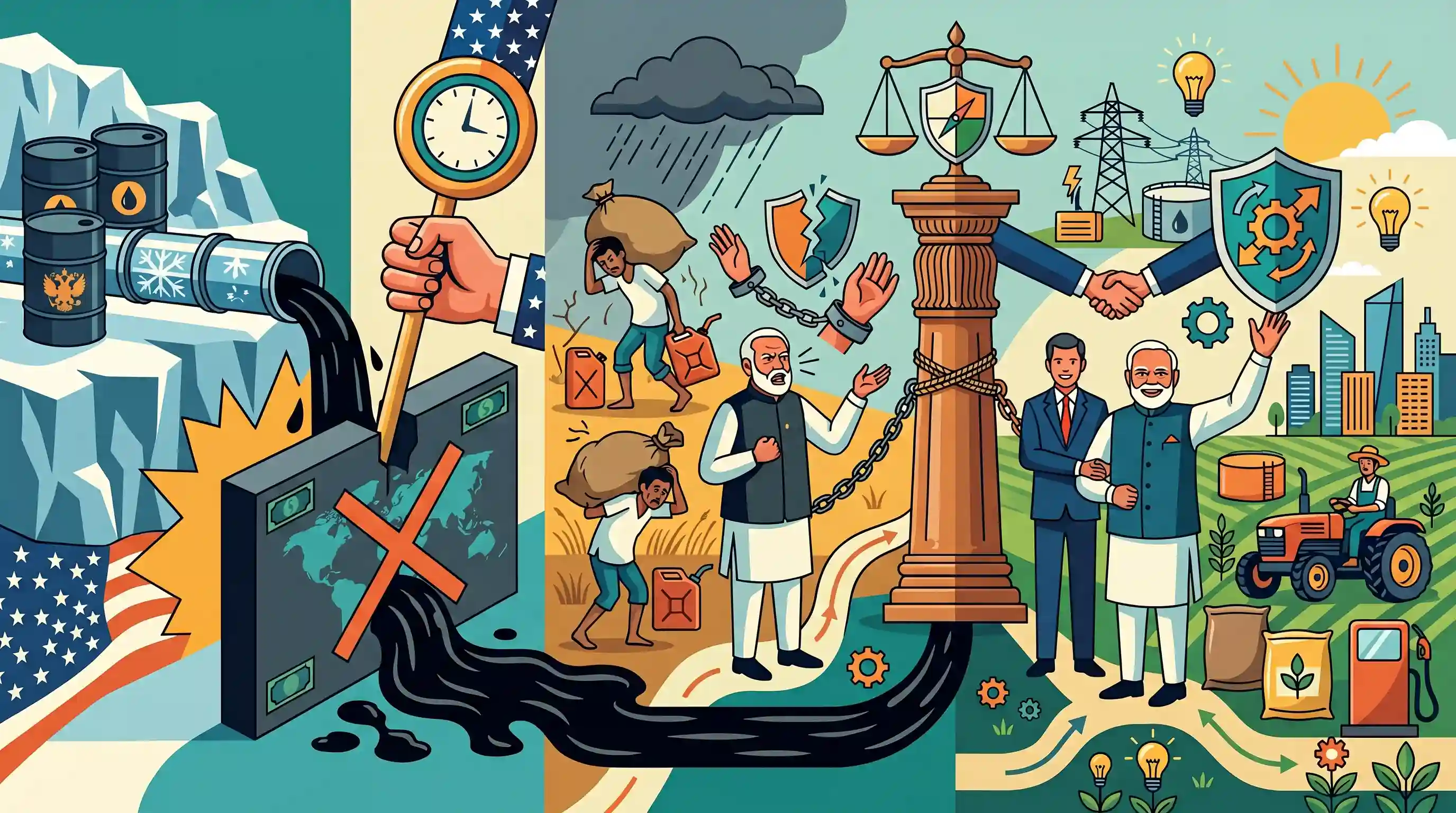
The article illustrates the core dilemma of India's foreign policy: balancing strategic autonomy and energy security against the economic and diplomatic pressures exerted by major global powers like the United States. It highlights how international trade mechanisms and geopolitical conflicts directly influence India's domestic economy, particularly fuel and agricultural costs.
Summary
The article discusses the domestic political controversy surrounding the US granting India a 30-day waiver to import Russian oil, accompanied by an exemption from a 10% global tariff imposed under the US Trade Act of 1974. The opposition Congress party has condemned the arrangement, describing it as 'American blackmail' and accusing the Modi government of compromising India's strategic autonomy to avoid US trade sanctions. Opposition leaders argue that restricting access to cheaper Russian crude will lead to higher fuel and fertilizer costs, heavily burdening farmers. In contrast, the BJP has hailed the waiver as a diplomatic success that secures India's short-term energy needs while managing crucial trade ties with the United States.
Key Points
- The US granted India a 30-day waiver to continue importing Russian oil and exempted it from a 10% global tariff under Section 122 of the US Trade Act of 1974.
- The Congress party, led by Jairam Ramesh and Rahul Gandhi, criticized the deal as 'American blackmail' and a surrender of India's strategic autonomy.
- The opposition warned that curbing cheap Russian crude imports will increase fuel and fertilizer prices, negatively impacting poor farmers.
- Russian Deputy PM Alexander Novak noted that India's dependence on Russian oil has grown, accounting for over 40% of its total crude imports.
- The BJP defended the agreement as a diplomatic victory that effectively balances trade relations with the US and India's immediate energy security needs.
Important Terms
Strategic Autonomy

A foreign policy doctrine where a state makes sovereign decisions based on national interest without being constrained by external pressures or formal alliance obligations.
UPSC context
GS Paper 2 (Foreign Policy). Tests India's 'multi-alignment' approach and balancing ties between competing powers like the US and Russia.
Section 122 of the Trade Act of 1974
A US provision allowing the President to impose temporary (up to 150 days) import surcharges of up to 15% to address serious balance-of-payments deficits.
UPSC context
GS Paper 2/3 (International Trade). Relevant for understanding US trade laws that act as non-tariff barriers and impact Indian exports.
Energy Security
The uninterrupted availability of energy sources at an affordable price, vital for a nation's economic growth and stability.
UPSC context
GS Paper 3 (Energy/Infrastructure). Focuses on India's import dependency, diversification of energy sources, and the impact of global volatility.
US Supreme Court (SCOTUS)
The highest judicial body in the US. Its 2026 ruling restricted the President’s tariff-making authority under IEEPA, triggering the use of Section 122 instead.
UPSC context
GS Paper 2 (Comparative Constitutions). Relevant when its legal interpretations of executive power significantly alter international trade and diplomatic landscapes.
Indian National Congress (INC)
India’s principal opposition party. It critiques the government’s foreign policy as 'American blackmail,' arguing that trade concessions compromise India's sovereignty.
UPSC context
GS Paper 2 (Polity/Parliamentary Affairs). Tests understanding of the opposition's role in scrutinizing executive foreign policy decisions.
Bharatiya Janata Party (BJP)
India's ruling party since 2014. It frames oil waivers and trade exemptions as diplomatic successes that balance national energy needs with key strategic partnerships.
UPSC context
GS Paper 2 (Polity). Relevant for identifying the policy priorities and diplomatic narrative of the current Union Government.
Prelims Trap
The 30-day waiver for continuing Russian oil imports was granted to India under CAATSA.
This waiver involves Section 122 of the US Trade Act of 1974 (trade tariffs), not CAATSA, which specifically targets significant transactions with Russian defense and intelligence sectors.
Static Concepts Connected
How do global crude oil price shocks impact India's macroeconomic stability?
- Current Account Deficit: Costlier imports widen the CAD and pressure the Rupee to depreciate against the Dollar.
- Imported Inflation: Higher fuel prices create cascading effects on transport and manufacturing, driving up core inflation.
- Fiscal Deficit Burden: If the government absorbs the price shock via tax cuts or fertilizer subsidies, the fiscal deficit widens.
What defines 'Strategic Autonomy' in contemporary Indian Foreign Policy?
- Independent Decision-Making: Exercising independent foreign policy choices based on national interest rather than aligning with formal military blocs.
- Multi-alignment: Simultaneously partnering with conflicting powers (e.g., US for trade/tech, Russia for energy/defense) through issue-based coalitions.
- De-risking Dependencies: Diversifying dependencies in critical sectors like defense and energy to prevent coercion by a single superpower.
Cross-Topic Patterns
Crude constraints & fertilizer subsidy burdens
Curtailed access to discounted Russian crude directly inflates the cost of petrochemical-derived fertilizers, risking a surge in the Centre's agricultural subsidy bill and higher retail inflation.
Weaponization of trade vs WTO norms
The US using domestic laws like the Trade Act of 1974 to impose tariffs and extract geopolitical concessions highlights the increasing weaponization of trade, challenging WTO's multilateral framework.

Expect a 2026 Mains question analyzing the weaponization of US domestic trade laws to restrict India's strategic autonomy & energy security.
Linked PYQs · 3
Linked PYQs · 3
- 2019MainsGS2
‘What introduces friction into the ties between India and the United States is that Washington is still unable to find for India a position in its global strategy, which would satisfy India's national self-esteem and ambitions.’ Explain with suitable examples.
- 2025MainsGS2
"Energy security constitutes the dominant kingpin of India's foreign policy, and is linked with India's overarching influence in Middle Eastern countries.” How would you integrate energy security with India's foreign policy trajectories in the coming years?
- 2017MainsGS2
The question of India's Energy Security constitutes the most important part of India's economic progress. Analyze India's energy policy cooperation with West Asian countries.
