American ideological divide over civic versus ethnic nationalism
Source:Indian Express ↗
Why It Matters
This article provides a highly sophisticated intellectual framework analyzing the friction between civic/constitutional identity and ethno-religious majoritarianism. It masterfully bridges macroeconomic realities (globalization, neoliberalism) with sociological backlash (the rise of ethnic nationalism), offering high-level conceptual tools useful for Essay, GS1 (Social Issues), GS2 (Polity and Comparative Constitutions), and GS4 (Ethics).
Summary
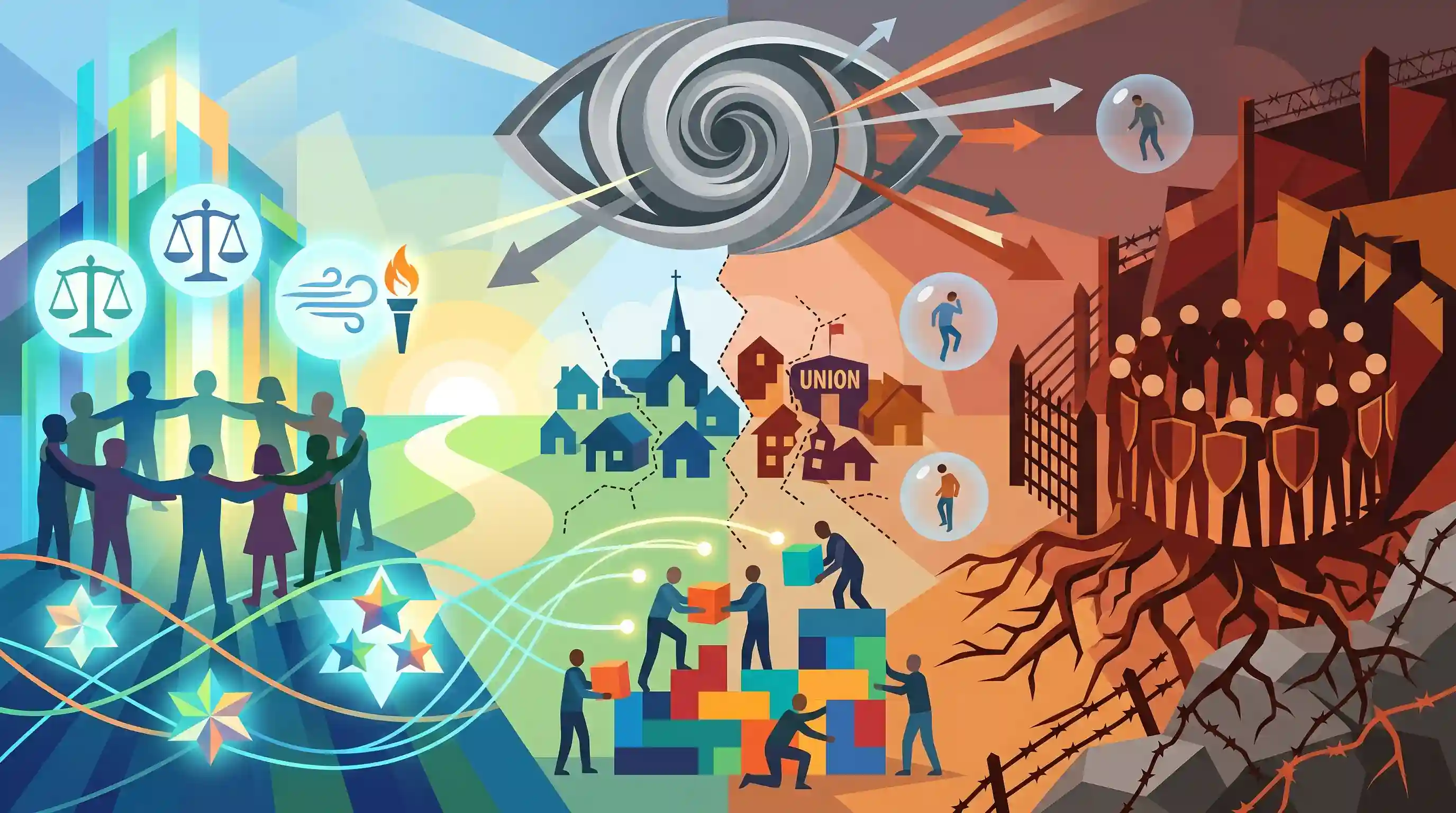
As the United States approaches its 250th anniversary, the nation is embroiled in an ideological battle over national identity. Siddharth Gautam Khare argues that America’s foundational 'creedal nationalism'—which decouples citizenship from race, ancestry, or religion in favor of universal principles of equality and liberty—is being threatened by a rising 'blood-and-soil' ethnic nationalism. This shift is deeply linked to the failures of neoliberalism and hyper-individualistic liberalism. By prioritizing globalized markets over local communities, modern liberalism has eroded the traditional institutions of belonging (such as unions, churches, and local networks), creating a vacuum that grievance politics and exclusionary nationalism have filled. To safeguard democratic futures, the author argues that societies must reconstruct a civic identity where 'the creed is the culture,' balancing individual legal rights with a shared moral culture and resilient local structures of social cohesion.
Key Points
- Context of American Independence at 250 (July 4, 2026): Discusses the deep political and ideological struggle in the US between 'creedal nationalism' (an inclusive, civic identity built on shared principles and constitutional ideals) and 'ethnic nationalism' (a 'blood-and-soil' identity based on ancestry, race, or religion).
- The Rise of Ancestry-Based Politics: Highlights how modern political rhetoric (such as JD Vance's comments on heritage and Trump's executive orders targeting birthright citizenship) signals a shift toward ethnic nationalism, accompanied by xenophobic and religious backlash against non-white public figures.
- Neoliberalism as a Catalyst for Tribalism: Argues that unchecked liberalism, globalization, and neoliberal economic policies have dismantled traditional social structures (churches, unions, and local communities). The resulting hyper-individualism and economic insecurity leave a social vacuum that grievance-driven ethnic nationalism exploits.
- The 'Creed is the Culture' Solution: Proposes that a sustainable democracy cannot survive solely on abstract, individualistic legal rights. Instead, it must construct a unique, non-ethnic civic nationalism that champions the universal founding principles of human equality and natural rights, while intentionally rebuilding local networks of belonging and moral cohesion.
Important Terms
US Declaration of Independence (1776)

Foundational 1776 document declaring the thirteen American colonies' independence from British rule. It outlines universal, inalienable rights like life, liberty, and the pursuit of happiness.
UPSC context
GS Paper 2/World History; tests understanding of global democratic ideals and comparative anti-colonial declarations like Purna Swaraj.
14th Amendment of the US Constitution
An 1868 constitutional amendment that established birthright citizenship and the "Equal Protection Clause," laying the legal foundation for a non-racial, civic national identity in the US.
UPSC context
GS Paper 2; tests comparative constitutional law regarding Article 14 (Equal Protection of Laws) and citizenship frameworks.
Claremont Institute
An influential conservative American think tank founded in 1979, dedicated to defending the principles of the American Founding but increasingly associated with modern nationalism.
UPSC context
GS Paper 2 (Political Theory); tests understanding of how political think tanks shape constitutional interpretation, civic nationalism, and public policy.
Supreme Court of the United States
The apex federal court in the United States, holding ultimate authority in interpreting constitutional law and exercising judicial review under "due process of law."
UPSC context
GS Paper 2; tests comparison of judicial systems, specifically US "due process" versus India's "procedure established by law."
Prelims Trap
India and the United States both unconditionally guarantee birthright citizenship (jus soli) to any individual born on their sovereign territory.
While the US 14th Amendment guarantees absolute birthright citizenship (jus soli), India systematically moved away from absolute jus soli via the 1986 and 2003 Citizenship Act amendments to prevent illegal migration.
Static Concepts Connected
What are 'Jus Soli' and 'Jus Sanguinis', and how has India's citizenship law evolved between them?
- Jus Soli: Citizenship by birth on the territory, regardless of parental nationality. This was India's primary mode from 1950 to 1987.
- Jus Sanguinis: Citizenship determined by the nationality or bloodline of the parents.
- Indian Shift: The Citizenship (Amendment) Acts of 1986 and 2003 introduced strict parental citizenship requirements to curb illegal migration, shifting India toward a hybrid jus sanguinis model.
How does Jürgen Habermas's 'Constitutional Patriotism' apply to highly pluralistic democracies?
- Definition: An idea where civic solidarity is anchored in shared constitutional values, procedures, and human rights rather than shared ethnic ancestry or language.
- Democratic Utility: It allows deeply diverse, multi-ethnic, and multi-religious societies to maintain political cohesion without requiring cultural assimilation.
- Indian Application: In India, this is mirrored in the Preamble's commitment to Justice, Liberty, Equality, and Fraternity as the supreme unifying bond of the republic.
Cross-Topic Patterns
Neoliberalism & regional identity politics
Economic dislocations from market-driven reforms can erode community safety nets, forcing individuals to retreat into defensive ethnic, regional, or "sons-of-the-soil" political mobilizations.
Constitutional Patriotism & Basic Structure
The Basic Structure doctrine functions as India's supreme constitutional creed, safeguarding civic secularism and federalism against shifts toward majoritarian-ethnic nationalism.

GS2 questions in 2026 may challenge candidates to contrast pure civic constitutional patriotism with regional 'sons-of-the-soil' legislations.
Linked PYQs · 4
Linked PYQs · 4
- 2023MainsGS1
Discuss the impact of post-liberal economy on ethnic identity and communalism.
- 2017MainsGS4
Without commonly shared and widely entrenched moral values and obligations, neither the law, nor democratic government, nor even the market economy will function properly. What do you understand by this statement? Explain with illustration in the contemporary times.
- 2022MainsGS1
Are tolerance, assimilation and pluralism the key elements in the making of an Indian form of secularism? Justify your answer.
- 2020MainsGS1
Is diversity and pluralism in India under threat due to globalisation ? Justify your answer.
