Karnataka Panchayat Raj Amendment and Local Electoral Reforms
Source:The Hindu ↗
Why It Matters
This development directly intersects with key constitutional and governance issues: first, the debate surrounding electoral trust (EVMs vs. ballot papers) and the autonomy of state election machinery under Article 243K; and second, the delicate balance between security of tenure and administrative accountability in police institutions, heavily tied to the Supreme Court's directives in the Prakash Singh case.
Summary
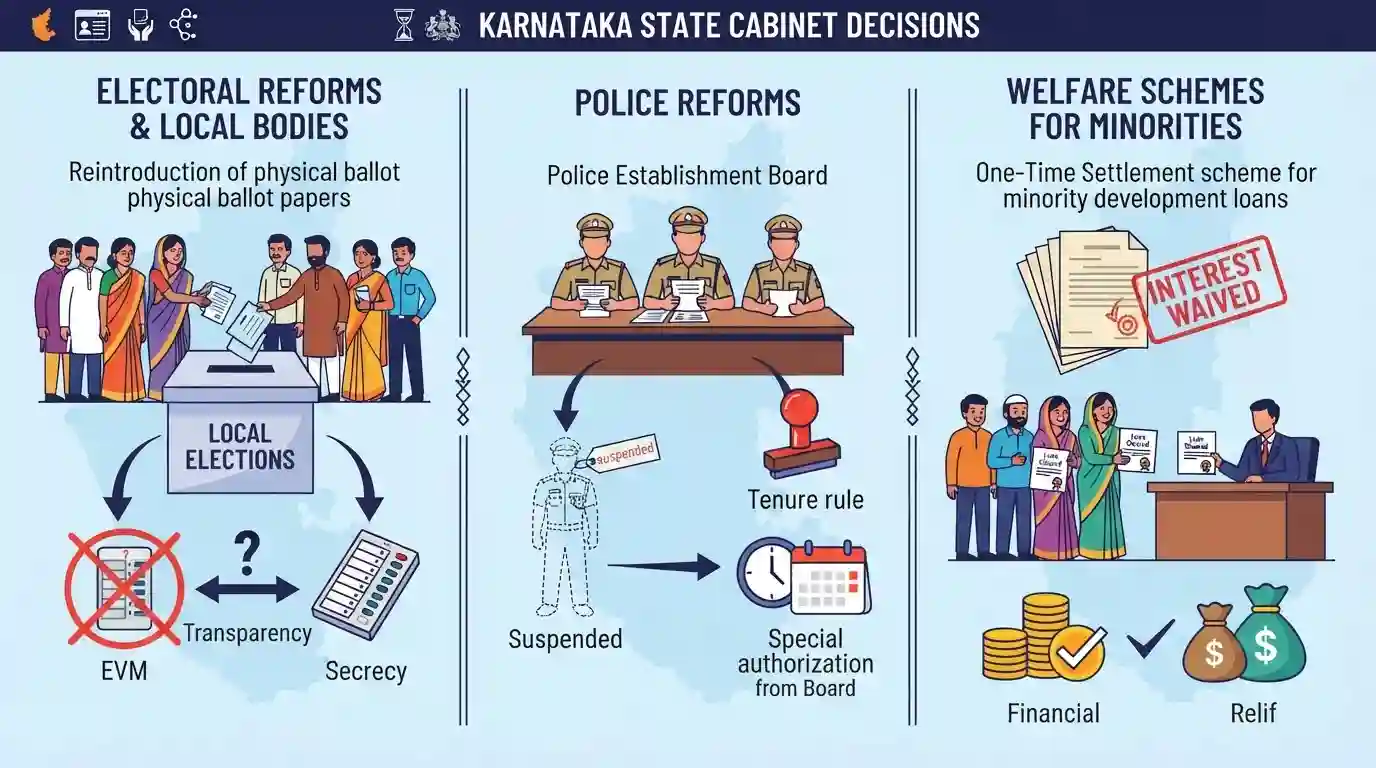
In February 2026, the Karnataka State Cabinet approved key legislative amendments and policy decisions, notably proposing the reintroduction of physical ballot papers in local body elections to ensure secrecy and transparency, allowing the Police Establishment Board to transfer suspended police personnel despite the statutory two-year tenure rule, and announcing an interest-waived One-Time Settlement scheme for historical minority development loans.
Key Points
- Electoral Reform: The Karnataka Cabinet approved the Karnataka Gram Swaraj and Panchayat Raj (Amendment) Bill, 2026, to reintroduce traditional ballot papers and drop Electronic Voting Machines (EVMs) in local body elections, citing a need for enhanced transparency and secrecy.
- Police Administrative Reform: The cabinet approved the Karnataka Police (Amendment) Bill, 2026, empowering the Police Establishment Board (PEB) to transfer police personnel suspended for misconduct, gross negligence, or dereliction of duty. Previously, a statutory two-year minimum tenure rule legally restricted the transfer of such officials during their suspension.
- Welfare & Financial Relief: A One-Time Settlement (OTS) scheme was introduced for beneficiaries of loans disbursed by the Karnataka Minorities Development Corporation between 2013 and 2019 (totaling around ₹800 crore), offering an interest waiver if the principal amount is settled.
Important Terms
Karnataka Gram Swaraj and Panchayat Raj (Amendment) Act, 2026

A state legislation reverting local body elections from Electronic Voting Machines (EVMs) to physical ballot papers to ensure voting secrecy, voter privacy, and public trust.
UPSC context
GS Paper II (Polity): Panchayati Raj Institutions, electoral reforms, and credibility of voting mechanisms.
Karnataka Police (Amendment) Act, 2026
A state legislation empowering the Police Establishment Board to transfer police personnel up to the rank of Deputy Superintendent of Police (DySP) for misconduct or negligence, bypassing the statutory two-year minimum tenure rule.
UPSC context
GS Paper II (Governance) & GS IV (Ethics): Police reforms, civil services accountability, and administrative transfers.
Police Establishment Board
A departmental body of senior police officers, mandated by the Supreme Court’s Prakash Singh judgment, responsible for deciding postings, transfers, promotions, and other service-related matters of police officers.
UPSC context
GS Paper II (Polity): Civil services reforms, administrative autonomy, and landmark Prakash Singh directives.
One-Time Settlement (OTS) scheme
A financial resolution mechanism allowing borrowers to settle default or outstanding loans by paying the principal amount under concessional terms, such as a complete or partial waiver of accumulated interest.
UPSC context
GS Paper III (Economy): Non-Performing Assets (NPAs), debt recovery mechanisms, and welfare loan management.
Karnataka Minorities Development Corporation
A state-owned corporation established to facilitate economic development, financial self-reliance, and educational advancement for religious minority communities through various subsidised credit and welfare schemes.
UPSC context
GS Paper II (Social Justice): Welfare schemes for vulnerable sections and targeted socio-economic planning.
Prelims Trap
The State Election Commission holds absolute, sovereign power to decide voting methods like EVMs or ballots, independent of State Legislative laws.
Under Article 243K(4), the powers of the SEC are subject to any law made by the State Legislature. The State Legislature has the constitutional authority to pass laws governing voting methodologies, which the SEC must implement.
Static Concepts Connected
What are the key directives of the Supreme Court in the Prakash Singh Case (2006)?
- Police Establishment Board: To insulate police from political pressure, recommend promotions, and decide transfers of officers below the rank of Deputy Superintendent of Police.
- Minimum Tenure: Mandates a minimum two-year tenure for key operational field officers, including the DGP, SPs, and Station House Officers, to prevent arbitrary political transfers.
- State Security Commission: To evaluate police performance, shield the force from unwarranted political influence, and draft broad policy guidelines.
How is legislative power divided under Article 243K (Panchayat Elections)?
- SEC Authority: Vests the superintendence, direction, and control of the preparation of electoral rolls and conduct of local elections in the State Election Commission (SEC).
- Legislative Primacy: Explicitly allows the State Legislature to make laws on all matters relating to or in connection with elections to the Panchayats.
- Removal Safeguards: The SEC is an independent body; the State Election Commissioner can only be removed in the same manner and on like grounds as a High Court Judge.
Cross-Topic Patterns
Police reforms vs executive discretion
Balancing the Supreme Court's Prakash Singh directives on fixed tenure with the executive's statutory need to penalize or transfer delinquent officers demonstrates the tension between administrative reform and state policing power.
Electoral technology and federal divergence
While the ECI advances digital voting technology, state legislatures utilizing Article 243K to revert to paper ballots highlights a distinct regulatory divergence in India's dual electoral systems.

Article 243K vs Article 324: Expect questions testing the legislative limits of State Assemblies over State Election Commissions in 2026.
Linked PYQs · 2
Linked PYQs · 2
- 2018MainsGS2
In the light of recent controversy regarding the use of Electronic Voting Machines (EVM), what are the challenges before the Election Commission of India to ensure the trustworthiness of elections in India?
- 2011PrelimsGS1
The Constitution (Seventy-Third Amendment) Act, 1992, which aims at promoting the Panchayati Raj Institutions in the country, provides for which of the following? 1. Constitution of District Planning Committees. 2. State Election Commissions to conduct all panchayat elections. 3. Establishment of State Finance Commissions. Select the correct answer using the codes given below:
