Supreme Court Directs States to Amend Discriminatory Leprosy Laws
Source:The Hindu ↗
Why It Matters
The issue highlights the intersection of public health, human rights, and constitutional law. It is crucial for UPSC aspirants as it demonstrates the judiciary's proactive role in pushing the legislature to eliminate systemic discrimination and uphold the fundamental rights of marginalized health communities.
Summary
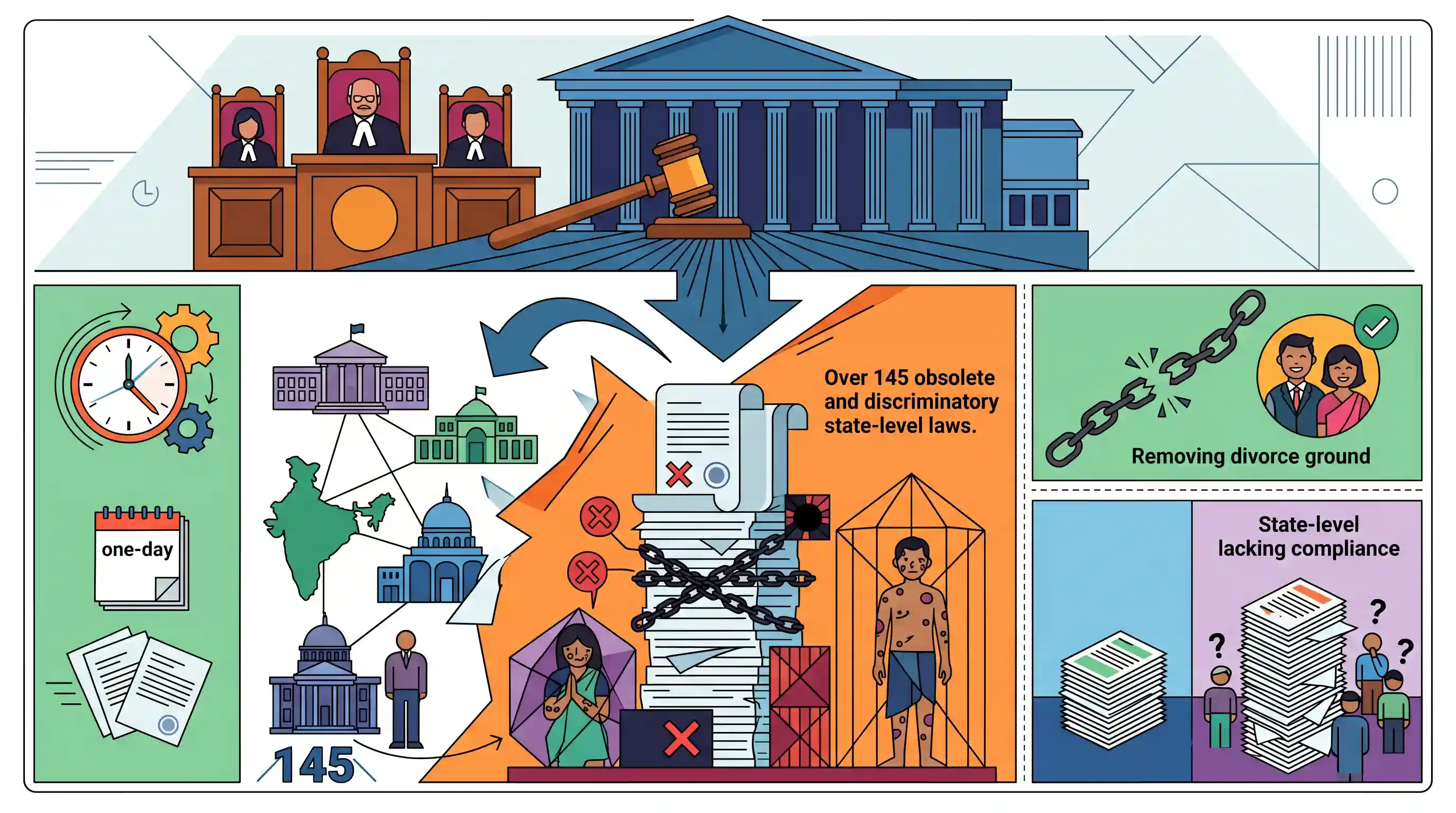
The Supreme Court has mandated State governments to expeditiously amend or repeal over 145 obsolete and discriminatory state-level laws targeting individuals affected by leprosy. Suggesting extraordinary measures like promulgating ordinances or convening special one-day legislative sessions, the bench comprising Justices Surya Kant and Joymalya Bagchi underscored the urgency of protecting the fundamental rights and dignity of this vulnerable group. While Parliament had previously passed the Personal Laws (Amendment) Act, 2019 to remove leprosy as a ground for divorce, State-level compliance in other statutory domains remains severely lacking.
Key Points
- The Supreme Court directed State governments to immediately amend or repeal over 145 laws that discriminate against individuals affected by leprosy.
- The Court suggested that States should consider convening a special one-day Assembly session or promulgating ordinances to fast-track the removal of these provisions.
- The Personal Laws (Amendment) Act, 2019 successfully removed leprosy as a legal ground for divorce, but many outdated State legislations still retain discriminatory language and restrictions.
- Retaining such laws violates the fundamental rights and basic human dignity of leprosy patients, emphasizing the need for legislative synchronization with modern human rights standards.
Important Terms
Personal Laws (Amendment) Act, 2019

A 2019 landmark legislation that omitted "leprosy" as a ground for divorce across five personal laws, including the Hindu Marriage Act, to eliminate matrimonial discrimination against affected individuals.
UPSC context
GS Paper II: Social Justice; tests knowledge of legislative reforms protecting the dignity of vulnerable sections and fundamental rights.
Federation of Leprosy Organisation (FOLO)
A prominent advocacy group that filed a 2010 PIL in the Supreme Court, successfully challenging over 100 archaic laws that discriminated against leprosy patients.
UPSC context
GS Paper II: Role of civil society/NGOs; highlights the impact of PILs and advocacy in driving legal change.
Vidhi Centre for Legal Policy
An independent legal think-tank that provided research assistance for the Law Commission’s 256th report and filed writ petitions to identify and repeal discriminatory provisions in Central/State laws.
UPSC context
GS Paper II: Statutory/Regulatory bodies; relevant for understanding the role of legal research in policy formulation.
Law Commission Report No. 256
A 2015 report titled "Eliminating Discrimination Against Persons Affected by Leprosy," which recommended repealing the 1898 Lepers Act and drafting a model law to safeguard rights.
UPSC context
GS Paper II: Governance; tests ability to link Law Commission recommendations with subsequent legislative and judicial actions.
Multi-Drug Therapy (MDT)
A highly effective treatment introduced in 1981 that makes leprosy patients non-infectious quickly and cures them completely, forming the scientific basis for repealing "incurable" disease laws.
UPSC context
GS Paper II/III: Issues relating to health; relevant for understanding how medical advancements drive changes in social justice policies.
Indian Lepers Act, 1898
A colonial-era statute enacted to forcibly segregate leprosy patients; its eventual repeal symbolizes the shift from "criminalizing" disease to a rights-based healthcare approach.
UPSC context
GS Paper I/II: Historical underpinnings of laws; illustrates the evolution of legal philosophy toward marginalized groups in India.
Prelims Trap
"India officially eradicated leprosy in the year 2005."
India achieved "elimination as a public health problem" (prevalence <1 per 10,000) in 2005, not eradication. It still accounts for >50% of new global cases.
Static Concepts Connected
What are the clinical characteristics of Leprosy (Hansen's disease)?
- Pathogen: Caused by the slow-growing bacterium Mycobacterium leprae, primarily affecting peripheral nerves, skin, and the respiratory tract.
- Transmission: Spreads via respiratory droplets, but is not highly infectious; it requires prolonged close contact with an untreated person.
- Curability: Fully curable with Multi-Drug Therapy (MDT). Patients become completely non-infectious shortly after beginning the medication regime.
What are the conditions for a Governor's Ordinance-making power (Article 213)?
- Prerequisite: The state legislative assembly (or either house in a bicameral legislature) must not be in session.
- Urgency: The Governor must be satisfied that circumstances exist which render immediate action necessary.
- Lifespan: It ceases to operate six weeks after the reassembly of the state legislature, unless approved earlier.
Cross-Topic Patterns
Colonial Science vs Article 21 Jurisprudence
Retaining discriminatory laws based on outdated medical beliefs directly violates the Right to Human Dignity, linking public health advancements with the expanding jurisprudence of Article 21.
Judicial Activism & Separation of Powers
The Supreme Court's suggestion to states to promulgate ordinances or convene special 1-day sessions tests the sensitive boundary between judicial review and legislative prerogative.

Expect a mixed Polity-Science question linking Article 21 (right to dignity) with the biological facts and elimination status of Leprosy.
Linked PYQs · 3
Linked PYQs · 3
- 2023MainsGS2
“Development and welfare schemes for the vulnerable, by its nature, are discriminatory in approach.” Do you agree? Give reasons for your answer.
- 2020MainsGS2
In order to enhance the prospects of social development, sound and adequate health care policies are needed particularly in the fields of geriatric and maternal health care. Discuss.
- 2014PrelimsGS1
Consider the following diseases: 1. Diphtheria 2. Chickenpox 3. Smallpox Which of the above diseases has/have been eradicated in India?
