Ambedkar Vision and Economic Inequality Among Dalit Women
Source:Indian Express ↗
Why It Matters
This issue sits at the intersection of GS-1 (Society: caste, gender, social empowerment) and GS-3 (Economy: inclusive growth). It is critical for analyzing the limitations of economic growth in eradicating deeply entrenched social inequalities, an essential theme for Mains essays and answers.
Summary
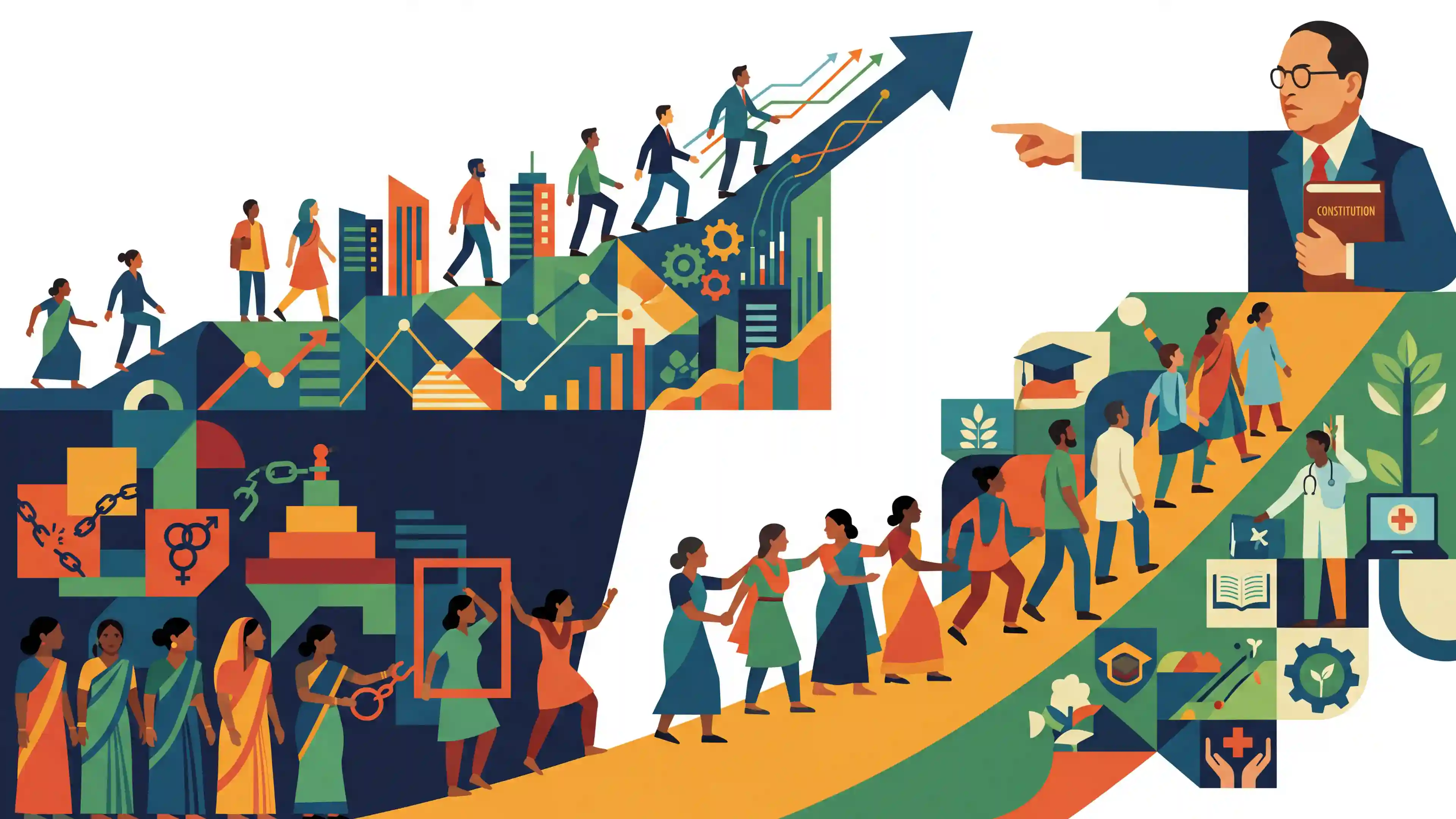
The article critiques how India's current trajectory of economic growth continues to bypass marginalized groups, specifically focusing on the plight of Dalit women. It argues that the intersection of caste and gender discrimination perpetuates stark economic inequality, contrary to Dr. B.R. Ambedkar's vision of achieving true social and economic democracy. Rather than dismantling entrenched hierarchies, the contemporary economic surge often leaves Dalit women behind, highlighting the persistent limitations of trickle-down economics and the need for intersectional approaches to inclusive growth.
Key Points
- Dr. B.R. Ambedkar advocated for an egalitarian society built on the foundational pillars of both social and economic democracy, alongside political rights.
- Despite India's macroeconomic surge, the benefits of growth often fail to trickle down to marginalized communities, specifically Dalit women.
- Dalit women face intersectional discrimination stemming from both entrenched caste hierarchies and patriarchal gender norms.
- Without targeted interventions, pure economic growth reinforces existing structural inequalities rather than dismantling them.
- Achieving genuine inclusive growth requires policies that specifically address the unique socioeconomic vulnerabilities of Dalit women to fulfill Ambedkar's constitutional vision.
Prelims Trap
"Dr. B.R. Ambedkar believed that political democracy alone would naturally lead to the dismantling of caste and economic inequalities."
Ambedkar explicitly warned in his final Constituent Assembly speech that political democracy ('one man, one vote') would be in peril without social and economic democracy.
Static Concepts Connected
What did Ambedkar mean by 'Social Democracy'?
- Liberty, Equality, Fraternity: He viewed these not as separate items but as a trinity; divorcing one from the other defeats the very purpose of democracy.
- Beyond Political Rights: It means a way of life that recognizes these principles, preventing the dominance of one class over another, beyond mere political voting rights.
- Economic Dimension: He advocated for 'State Socialism' in agriculture and key industries to prevent the economic exploitation of marginalized communities.
What constitutes the 'Feminisation of Poverty'?
- Disproportionate Burden: The phenomenon where women experience poverty at disproportionately higher rates compared to men, largely due to structural inequalities.
- Informal Sector: A high concentration of marginalized women in low-wage, informal, and unorganized sectors lacking social security or labor protections.
- Intersectional Vulnerability: Poverty is exacerbated by compounding factors like caste (e.g., Dalit women), lack of land/asset ownership, and restrictive patriarchal norms.
Cross-Topic Patterns
Caste + Gender + Poverty Nexus
The "triple burden" on Dalit women connects GS1 (Society) with GS2 (Vulnerable Sections) and GS3 (Inclusive Growth). Expect questions linking macroeconomic policy failures to specific demographic vulnerabilities.
Ambedkar vs. Gandhi Economic Visions
While Gandhi favored village republics and trusteeship, Ambedkar favored state-led industrialization and viewed traditional villages as sites of entrenched caste hierarchy and exploitation.

Mains 2026 will likely test the 'triple burden' of Dalit women, merging GS1 intersectionality with GS3 inclusive growth failures.
Linked PYQs · 4
Linked PYQs · 4
- 2015MainsGS1
Debate the issue of whether and how contemporary movements for assertion of Dalit identity work towards annihilation of caste.
- 2015MainsGS1
Mahatma Gandhi and Dr. B.R. Ambedkar, despite having divergent approaches and strategies, had a common goal of amelioration of the downtrodden. Elucidate.
- 2020MainsGS3
Explain intra-generational and inter-generational issues of equity from the perspective of inclusive growth and sustainable development.
- 2019MainsGS3
It is argued that the strategy of inclusive growth is intended to meet the objectives of inclusiveness and sustainability together. Comment on this statement.
