Nation Observes Mahaparinirvan Diwas to Honor Dr B R Ambedkar
Source:The Hindu ↗
Why It Matters
Dr. B.R. Ambedkar's ideological contributions and role in drafting the Constitution are foundational to India's republic. His approach to caste annihilation and social empowerment remains highly relevant to UPSC questions concerning social justice, constitutionalism, and the legacy of national leaders.
Summary
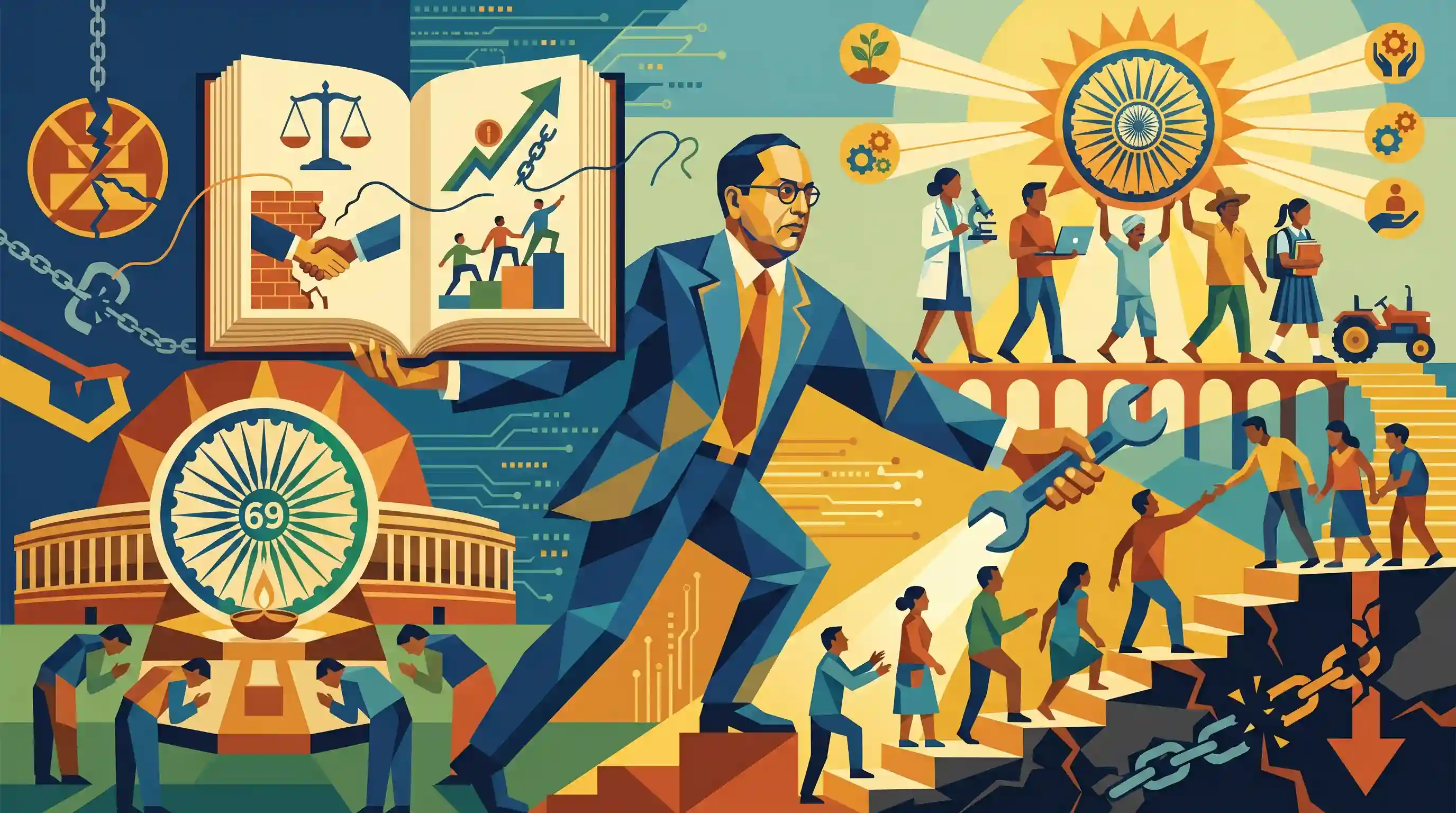
Political leaders across the spectrum paid homage to Dr. B.R. Ambedkar on Mahaparinirvan Diwas, marking his 69th death anniversary on December 6. Tributes at the Prerna Sthal in Parliament House underscored his pivotal role as the architect of the Indian Constitution and his unwavering commitment to social justice, equality, and human dignity. The occasion served as a reaffirmation of his visionary ideals, which continue to guide the nation's democratic framework and its ongoing efforts to uplift oppressed and marginalized communities.
Key Points
- December 6 is observed as Mahaparinirvan Diwas to mark the death anniversary of Dr. B.R. Ambedkar.
- The 69th death anniversary saw political leaders across party lines paying floral tributes at his statue at Prerna Sthal in the Parliament House premises.
- Dr. Ambedkar was remembered for his monumental role as the chief architect of the Indian Constitution.
- Leaders highlighted his lifelong struggle for liberty, equality, justice, and human dignity, emphasizing his enduring legacy in empowering marginalized communities and strengthening democratic values.
Important Terms
Mahaparinirvan Diwas

Observed annually on December 6, it marks the death anniversary of Dr. B.R. Ambedkar. The term 'Mahaparinirvan' refers to the Buddhist concept of ultimate liberation from the cycle of rebirth.
UPSC context
GS Paper 1 (Modern Indian History) and GS Paper 2 (Polity); tests knowledge of significant personalities and their socio-religious contributions.
Architect of the Indian Constitution
A title honoring Dr. B.R. Ambedkar for his role as Chairman of the Drafting Committee. He integrated diverse views to frame the nation's supreme legal document emphasizing justice and equality.
UPSC context
GS Paper 2 (Indian Constitution: Historical Underpinnings); tests understanding of the evolution and guiding philosophy of India’s democratic framework.
Social Justice
A principle ensuring fair distribution of wealth, opportunities, and privileges. In India, it focuses on mitigating suffering for the poor, Dalits, and marginalized groups through legal and policy interventions.
UPSC context
GS Paper 2 (Social Justice and Governance); critical for questions on welfare schemes, vulnerable sections, and constitutional safeguards.
Dalit Empowerment
The socio-political and economic upliftment of the community formerly called 'untouchables.' It involves securing rights to education, employment, and political representation to end historical caste-based discrimination.
UPSC context
GS Paper 1 (Indian Society) and GS Paper 2 (Social Justice); relevant for themes on social movements and social empowerment.
Chaitya Bhoomi
The memorial site located in Dadar, Mumbai, where Dr. B.R. Ambedkar’s last rites were performed. It serves as a major pilgrimage site for followers during Mahaparinirvan Diwas.
UPSC context
GS Paper 1 (Modern Indian History and Culture); associated with Ambedkar’s legacy and the neo-Buddhist movement in India.
Drafting Committee
The specific group within the Constituent Assembly, led by Dr. B.R. Ambedkar, tasked with preparing the draft of the Constitution of India. It processed various committee reports and public feedback.
UPSC context
GS Paper 2 (Indian Constitution); foundational for understanding the legislative history and structural evolution of the Indian state.
Prelims Trap
"Both Dr. B.R. Ambedkar and Mahatma Gandhi campaigned for the complete destruction of the Varna system."
Gandhi opposed untouchability but defended the idealized Varna system as a functional division of labor. Ambedkar argued untouchability could not end without annihilating Varna itself.
Static Concepts Connected
What were the key Marathi journals launched by Dr. B.R. Ambedkar?
- Mooknayak (1920): Meaning 'Leader of the Voiceless', it was launched to articulate Dalit grievances, significantly aided by financial support from Shahu Maharaj of Kolhapur.
- Bahishkrit Bharat (1927): Meaning 'Excluded India', started during the Mahad Satyagraha phase to mobilize the Depressed Classes and demand structural rights.
How did Gandhi and Ambedkar fundamentally differ on caste reform?
- Moral vs Structural: Gandhi sought reform via a moral 'change of heart' within Hinduism. Ambedkar argued the system was inherently unjust and demanded legal/political dismantling.
- Views on Varna: Gandhi initially defended Varna as a cooperative division of labor. Ambedkar viewed the annihilation of the Varna hierarchy as the only path to equality.
Cross-Topic Patterns
Navayana Buddhism & Dalit emancipation
Ambedkar's 1956 mass conversion at Deekshabhoomi links ancient Buddhist tenets (Parinirvana) to modern socio-political liberation, creating overlap between Ancient History and Modern political thought.
Prerna Sthal & Parliament redesign
The relocation of Ambedkar's and Gandhi's statues to the newly inaugurated Prerna Sthal merges historical iconography with contemporary infrastructure projects (Central Vista).

Expect a comparative Mains GS1 question or multi-statement Prelims item contrasting Ambedkar's structuralism with Gandhi's moralism.
Linked PYQs · 4
Linked PYQs · 4
- 2015MainsGS1
Mahatma Gandhi and Dr. B.R. Ambedkar, despite having divergent approaches and strategies, had a common goal of amelioration of the downtrodden. Elucidate.
- 2015MainsGS1
Debate the issue of whether and how contemporary movements for assertion of Dalit identity work towards annihilation of caste.
- 2024MainsGS1
Despite comprehensive policies for equity and social justice, underprivileged sections are not yet getting the full benefits of affirmative action envisaged by the Constitution. Comment.
- 2023PrelimsGS1
Consider the following statements in respect of the Constitution Day: Statement-I: The Constitution Day is celebrated on 26th November every year to promote constitutional values among citizens. Statement-II: On 26th November, 1949, the Constituent Assembly of India set up a Drafting Committee under the Chairmanship of Dr. B. R. Ambedkar to prepare a Draft Constitution of India. Which one of the following is correct in respect of the above statements?
