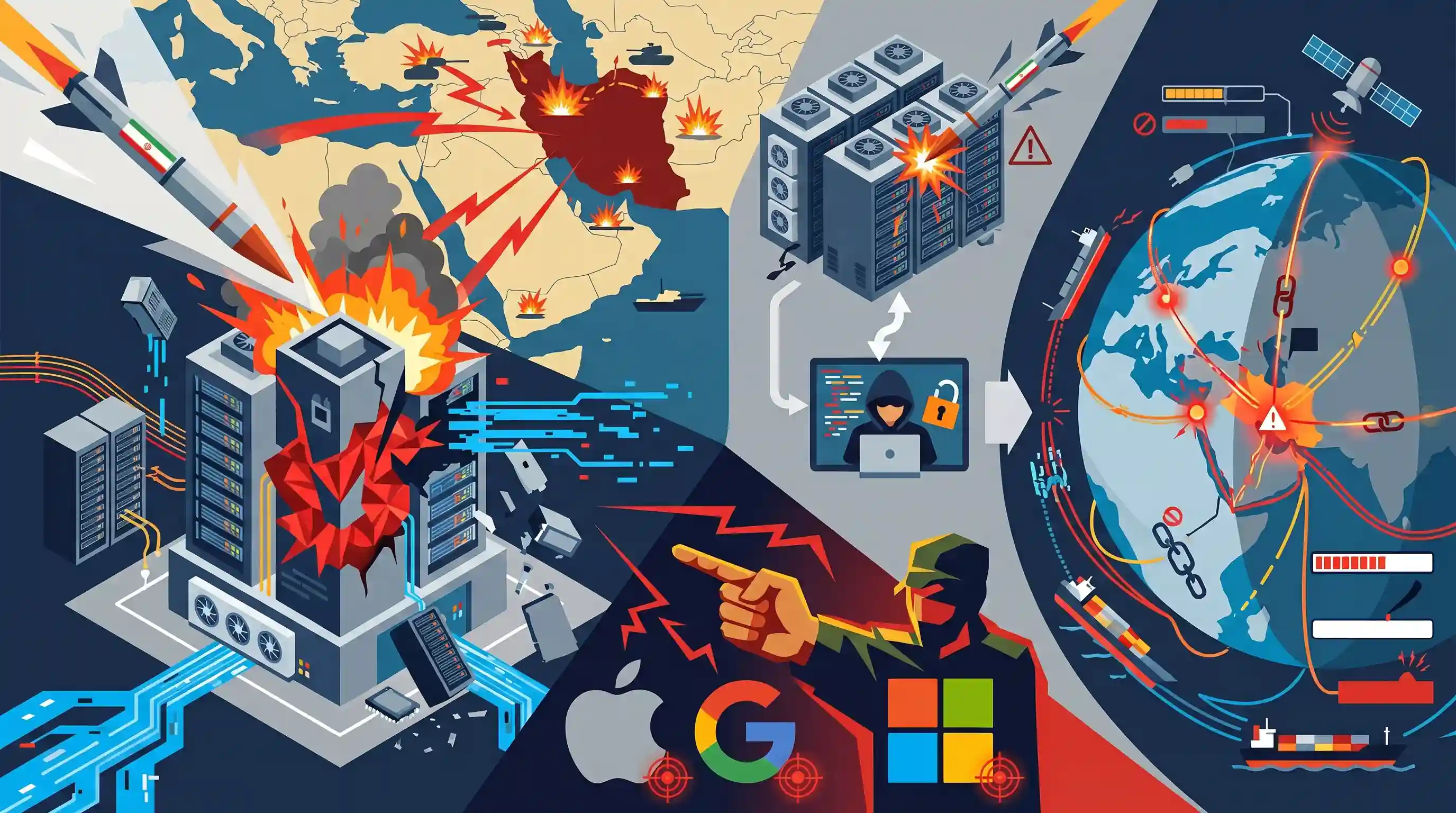
Middle East strikes damage cloud infrastructure in Bahrain
Source:The Hindu ↗
Why It Matters
The targeting of global cloud infrastructure in a kinetic military strike demonstrates how critical digital assets are becoming frontline targets in geopolitical conflicts. For India, this underscores the vital importance of securing its own growing physical data center infrastructure against not just cyber threats, but also conventional security risks, as data becomes a core component of national sovereignty and economic stability.
Summary
An Iranian strike in Bahrain has reportedly caused damage to an Amazon Web Services (AWS) cloud computing facility. This kinetic attack on digital infrastructure occurred amid the ongoing wider conflict in the Middle East. Furthermore, Iran's Revolutionary Guards have issued explicit threats against other major U.S. technology firms in the region, such as Apple, Google, and Microsoft. The incident highlights the growing physical vulnerability of critical global technology infrastructure, such as data centers, to geopolitical conflicts and state-sponsored military actions, extending the threat landscape beyond traditional cyberattacks.
Key Points
- An Iranian military strike reportedly damaged Amazon's cloud computing operations (AWS) in Bahrain amid the broader Middle Eastern conflict.
- Iran's Revolutionary Guards have issued threats to target other major U.S. technology companies operating in the region, including Microsoft, Google, and Apple.
- The attack marks a significant escalation where state actors are increasingly targeting physical digital infrastructure (data centers) in addition to conventional cyber warfare.
- This incident highlights the vulnerability of global cloud infrastructure and supply chains to regional geopolitical conflicts.
Important Terms
Islamic Revolutionary Guard Corps (IRGC)

An elite branch of the Iranian Armed Forces established in 1979 to protect the Islamic revolution. It operates independently of the regular military, managing its own ground, naval, and aerospace forces.
UPSC context
GS Paper II (International Relations); essential for understanding West Asian security, regional proxy warfare, and Iran's strategic posture in the Persian Gulf.
Amazon Web Services (AWS)
The cloud computing subsidiary of Amazon providing on-demand IT infrastructure. It hosts a significant portion of global digital services, making it a critical node for international business and governance.
UPSC context
GS Paper III (Security & Infrastructure); relevant for topics on digital sovereignty, cloud security, and the risks of centralized global digital infrastructure.
Critical Information Infrastructure (CII)
Under India’s IT Act 2000, those computer resources whose destruction would have a debilitating impact on national security, economy, public health, or safety. Examples include banking, telecom, and energy sectors.
UPSC context
GS Paper III (Internal Security); a core concept in cybersecurity, focusing on the protection of essential digital assets from state-sponsored kinetic or cyberattacks.
Bahrain Interior Ministry
The government body responsible for internal security, public safety, and law enforcement in the Kingdom of Bahrain, which hosts key regional digital and military assets.
UPSC context
GS Paper II (International Relations); important for India's 'Act West' policy and regional maritime security cooperation in the Persian Gulf.
Hybrid Warfare
A modern military strategy combining conventional military force (kinetic) with unconventional tools like cyberattacks, disinformation, and economic pressure to achieve political or strategic objectives.
UPSC context
GS Paper III (Security); relevant for analyzing contemporary conflicts where physical strikes on digital infrastructure blur the lines between traditional and cyber warfare.
Prelims Trap
CERT-In is the designated national nodal agency for the protection of Critical Information Infrastructure (CII) in India.
Aspirants confuse CERT-In with NCIIPC. Under the IT Act 2000, NCIIPC protects Critical Information Infrastructure (CII), while CERT-In handles broader cyber incident response.
Static Concepts Connected
What is Critical Information Infrastructure (CII) and who protects it?
- Legal Definition: Section 70 of the IT Act defines CII as computer resources whose destruction debilitates national security, economy, public health, or safety.
- Nodal Agency: The National Critical Information Infrastructure Protection Centre (NCIIPC), established under Section 70A, is India's nodal agency tasked with protecting these strategic assets.
What constitutes Hybrid Warfare and Grey Zone tactics?
- Hybrid Warfare: Blending conventional kinetic strikes with non-conventional targets—like bombing digital data centers—to cause systemic economic, civilian, or informational disruption.
- Grey Zone Tactics: Coercive statecraft, such as Iran's IRGC targeting multinational tech companies, that achieves strategic goals while remaining below the threshold of formalized conventional war.
Cross-Topic Patterns
Data Sovereignty & Localisation
Kinetic destruction of offshore cloud hubs like Bahrain's AWS strengthens India's rationale for strict data localization, ensuring critical domestic data isn't paralyzed by foreign conflicts.
Bahrain's Strategic Chokepoint
Hosting the US Navy's 5th Fleet and major tech hubs makes Bahrain a prime physical and digital target in US-Iran geopolitical skirmishes.

Prelims 2026 will likely test the exact statutory mandate of NCIIPC vs CERT-In amid rising hybrid attacks on physical cyber-infrastructure.
Linked PYQs · 3
Linked PYQs · 3
- 2017MainsGS3
Discuss the potential threats of Cyber attack and the security framework to prevent it.
- 2021MainsGS3
Keeping in view India's internal security, analyse the impact of cross-border cyber attacks. Also discuss defensive measures against these sophisticated attacks.
- 2025MainsGS2
"Energy security constitutes the dominant kingpin of India's foreign policy, and is linked with India's overarching influence in Middle Eastern countries.” How would you integrate energy security with India's foreign policy trajectories in the coming years?
