Amazon Commits Massive Investment for India AI Cloud Infrastructure
Source:Indian Express ↗
Why It Matters
Massive investments in AI and digital infrastructure by global tech giants highlight India's critical role in the global tech ecosystem. However, this also requires policymakers to address data sovereignty, digital monopolies, and the social security of the gig workers facilitating e-commerce growth.
Summary
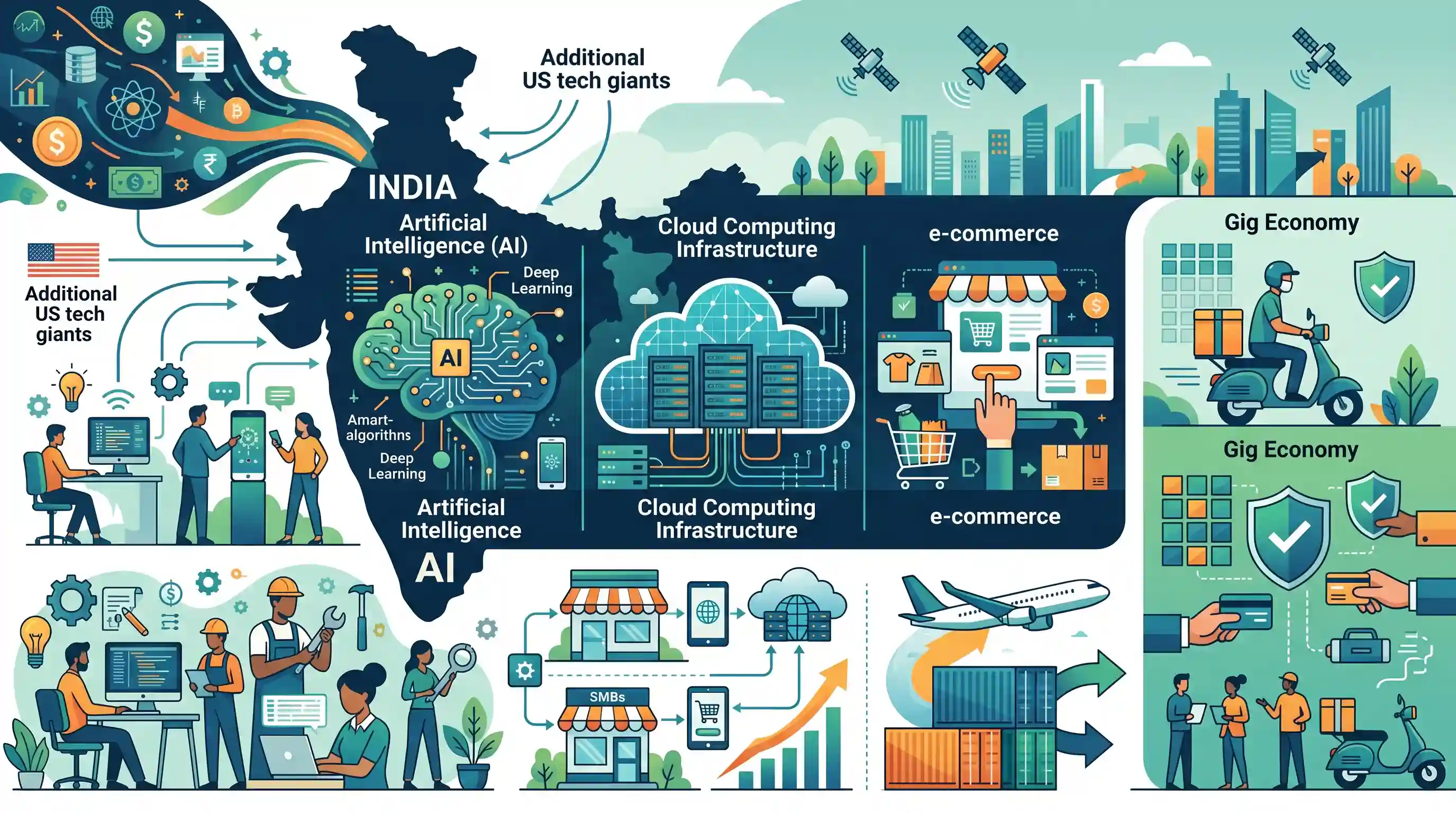
Amazon has pledged to invest $48 billion in India by 2030, with a major focus on artificial intelligence, cloud computing infrastructure, and e-commerce. Amazon CEO Andy Jassy highlighted that this capital infusion will create highly skilled jobs, help digitize millions of small and medium businesses, and facilitate exports. The move is part of a broader trend of US tech giants, including Google and Microsoft, ramping up investments in India's AI and data center capabilities. Additionally, Amazon launched the 'Sammaan' program to offer structured benefits to its delivery associates, a notable development for social security in India's rapidly expanding gig economy.
Key Points
- Amazon commits a massive $48 billion investment in India by 2030, heavily targeting artificial intelligence and cloud infrastructure.
- The investment aligns with India's push for digital transformation, seeking to digitize millions of small and medium businesses (SMBs) and boost exports.
- Major US tech companies, including Google and Microsoft, are similarly aggressively investing in Indian AI infrastructure and data centers.
- Amazon announced the 'Sammaan' program, designed to provide various benefits and welfare measures to its delivery associates, highlighting the increasing focus on the gig economy workforce.
Important Terms
Sammaan program

A welfare initiative for Amazon India's delivery associates, offering education scholarships, health/life insurance, and facilitated access to government social security and financial inclusion schemes.
UPSC context
GS III (Economy/Employment); tests knowledge of social security for gig workers and private-sector welfare models.
Gig Economy
A labor market where temporary, flexible jobs are common and organizations hire independent contractors or freelancers via digital platforms rather than full-time employees.
UPSC context
GS III (Economy/Labour); critical for discussing labor reforms and social security for platform-based workers.
Foreign Direct Investment (FDI)
Investment by a foreign entity into domestic business interests, providing capital for infrastructure, technology, and operations while signaling long-term economic commitment.
UPSC context
GS III (Economy); central to topics on capital inflows, ease of doing business, and sectoral investment policies.
Cloud Infrastructure
The hardware and software components—including servers, storage, and data centers—required to support cloud computing services and large-scale data processing.
UPSC context
GS III (Science & Tech/Infrastructure); relates to Digital India, data localization, and the backbone of AI development.
MSME (Micro, Small and Medium Enterprises)
Small-scale businesses categorized by specific investment and turnover limits; they are critical for India's GDP, employment, and grassroots industrialization.
UPSC context
GS III (Economy/Industry); focuses on digitizing the unorganized sector and their role in economic growth.
AI Infrastructure
The specialized hardware (e.g., GPUs, custom AI chips) and data facilities needed to train, run, and scale artificial intelligence models.
UPSC context
GS III (Science & Tech); relevant for National AI Strategy, technological sovereignty, and advanced computing.
Prelims Trap
"The Code on Social Security 2020 legally classifies gig and platform workers as formal 'employees' entitled to EPF."
The Code recognizes them for specific welfare funds but explicitly avoids classifying them as "employees" to maintain the flexible, non-standard nature of platform work and limit strict labor liabilities.
Static Concepts Connected
What is the FDI policy for the e-commerce sector in India?
- Marketplace model: 100% FDI under the automatic route is permitted for e-commerce entities acting merely as facilitators between buyers and sellers.
- Inventory model: FDI is strictly prohibited in models where the e-commerce platform owns the inventory of goods and sells them directly to consumers.
- Vendor neutrality: Marketplace entities cannot exercise ownership or control over the inventory they sell, ensuring a level playing field for vendors.
How does the Code on Social Security 2020 distinguish non-traditional workers?
- Gig worker: A person performing work or participating in a work arrangement and earning from it outside a traditional employer-employee relationship.
- Platform worker: A worker whose working arrangement and client matching are facilitated through an online algorithmic software platform.
- Welfare funding: The Code mandates the creation of a Social Security Fund financed by contributions from aggregators (1-2% of their turnover).
Cross-Topic Patterns
AI Compute FDI + IndiaAI Mission
Private hyper-scale cloud investments complement the government's ₹10,372 crore IndiaAI Mission, which aims to build "sovereign compute capacity" (10,000+ GPUs) to reduce domestic startup reliance on foreign-controlled infrastructure.
Gig Economy Welfare: Corporate vs State Laws
Amazon's welfare rollout echoes rising legislative pressure on platforms, notably the Rajasthan Platform Based Gig Workers Act 2023, which pioneered a transaction-based welfare fee over relying on voluntary corporate programs.

Expect a multi-statement question interlinking AI data center FDI, sovereign compute under the IndiaAI Mission, and gig worker classifications.
Linked PYQs · 5
Linked PYQs · 5
- 2023MainsGS3
What is the status of digitalization in the Indian economy? Examine the problems faced in this regard and suggest improvements.
- 2021MainsGS3
“Investment in infrastructure is essential for more rapid and inclusive economic growth.” Discuss in the light of India's experience.
- 2023MainsGS3
Introduce the concept of Artificial Intelligence (AI). How does Al help clinical diagnosis? Do you perceive any threat to privacy of the individual in the use of Al in healthcare?
- 2015MainsGS3
Discuss the advantages and security implications of cloud hosting of servers vis-a-vis in-house machine-based hosting for government businesses.
- 2021MainsGS1
Examine the role of 'Gig Economy' in the process of empowerment of women in India.
