Amaravati infrastructure project costs rise by 25 percent
Source:times-of-india ↗
Why It Matters
Highlights the financial repercussions of policy discontinuity on large-scale public infrastructure projects, the role of institutional financing (World Bank, HUDCO, NABARD) in urban development, and the efficacy of land pooling schemes as an alternative to traditional land acquisition.
Summary
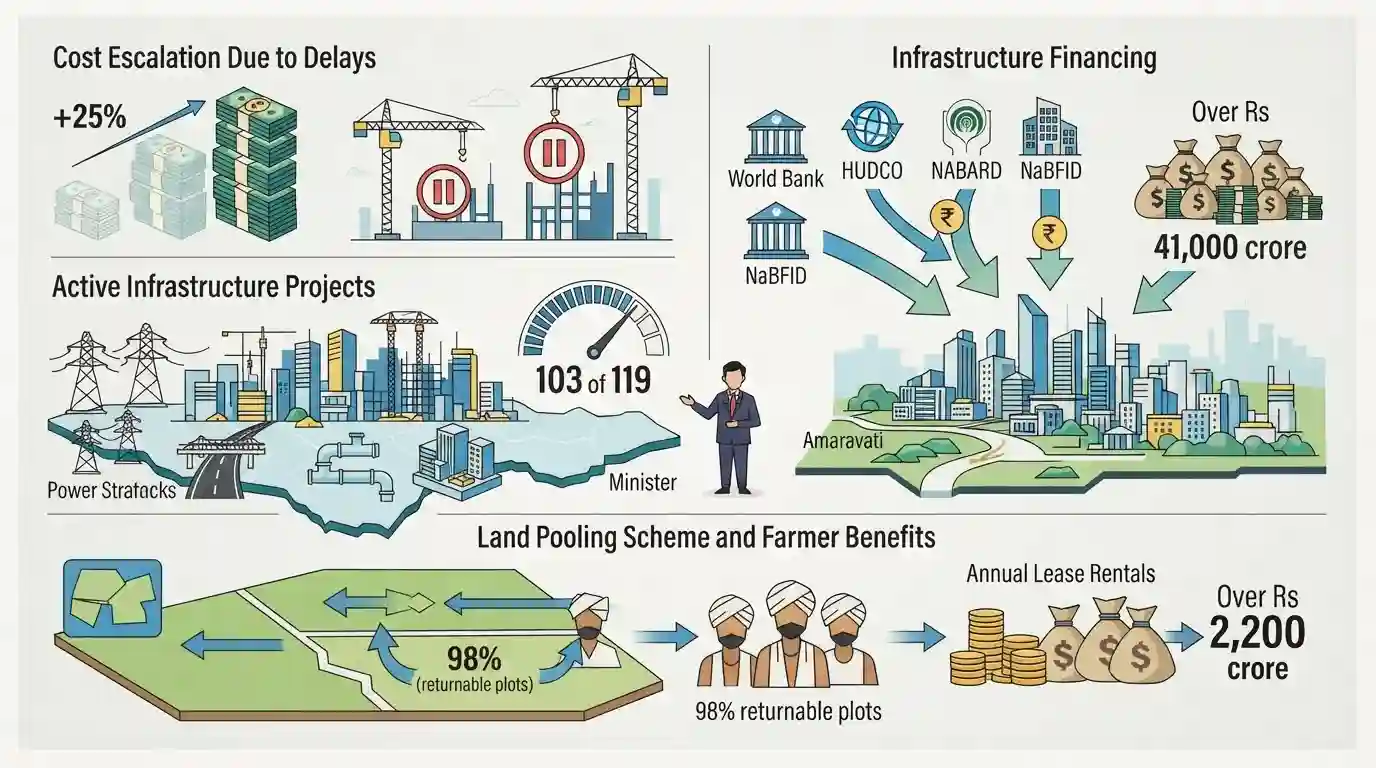
The development of Amaravati as the capital of Andhra Pradesh has experienced a 25% cost escalation due to project delays caused by the previous state government. Municipal Administration and Urban Development Minister P Narayana stated that 103 out of 119 major infrastructure projects are currently underway. To finance this large-scale urban development, the state government has secured over Rs 41,000 crore in loans from institutions such as the World Bank, HUDCO, NABARD, and NaBFID. Furthermore, the Land Pooling Scheme (LPS) has been pivotal in land acquisition, with 98% of returnable plots already allotted to farmers who have received over Rs 2,200 crore in annual lease rentals since 2014.
Key Points
- Amaravati's infrastructure project costs have increased by roughly 25% due to prolonged work halts under the previous state administration.
- The state has secured loans amounting to Rs 41,187.70 crore from major financial institutions including the World Bank, HUDCO, NABARD, and NaBFID to fund the capital's development.
- Out of 119 proposed major infrastructure projects initially estimated at Rs 66,802 crore, 103 are currently under execution with an estimated cost of Rs 58,093 crore.
- Under the Land Pooling Scheme (LPS), 98% of returnable plots have been allotted to 30,173 farmers, and the government has disbursed Rs 2,248.02 crore as annual lease rentals since 2014.
Important Terms
Land Pooling Scheme (LPS)

A land procurement model where farmers voluntarily surrender agricultural land to the government for urban development, receiving reconstituted developed plots, annuity payments, and social benefits in return.
UPSC context
Crucial for APPSC Paper-III (AP Economy), testing knowledge of Amaravati's capital construction, urban planning, and unique land acquisition models.
NaBFID
The National Bank for Financing Infrastructure and Development is a specialized Indian DFI established to support long-term infrastructure financing, including critical funding for Amaravati's urban development.
UPSC context
Important for APPSC Paper-III (Economy), illustrating institutional infrastructure financing models and state-level borrowing for greenfield capital development.
HUDCO
The Housing and Urban Development Corporation is a central public sector enterprise providing long-term finance for housing and urban infrastructure projects, acting as a major lender for Amaravati.
UPSC context
Relevant for APPSC Paper-III, testing awareness of urban infrastructure financing sources, state debt, and municipal development partnerships.
NABARD
The National Bank for Agriculture and Rural Development is India's apex institution for rural credit, which also extends financial assistance to state governments for various semi-urban and infrastructure projects.
UPSC context
Relevant for APPSC Economy section, assessing understanding of infrastructure funding, state borrowing, and institutional credit frameworks.
World Bank
An international financial institution that provides major loans and grants to governments for capital projects, acting as a key multilateral funder for the first phase of Amaravati's infrastructure development.
UPSC context
Significant for APPSC Paper-III (Economy) regarding multilateral financial assistance, external debt, and international funding for state-level mega-projects.
Prelims Trap
Amaravati's land was entirely acquired through the compulsory land acquisition mechanism under the Central LARR Act 2013.
Amaravati predominantly used a voluntary Land Pooling Scheme (LPS) where farmers receive developed returnable plots and annual lease rentals, avoiding compulsory one-time acquisition.
Static Concepts Connected
How does the Land Pooling Scheme (LPS) differ from traditional Land Acquisition?
- Voluntary mechanism: Landowners voluntarily surrender their land to an urban development agency rather than facing compulsory government acquisition.
- Compensation structure: Instead of a one-time cash payout, owners get a proportionate share of the developed land and annual annuity/lease rentals.
- Reduced litigation: It largely bypasses the strict social impact assessment, consent requirements, and litigation delays common under the LARR Act 2013.
What is NaBFID's role in Indian infrastructure financing?
- Statutory DFI: Established in 2021 via an Act of Parliament to act as the principal statutory Development Financial Institution (DFI) for long-term infrastructure finance.
- Addressing ALM: It solves the Asset-Liability Mismatch (ALM) that commercial banks face when funding long-gestation, capital-intensive infrastructure projects.
Cross-Topic Patterns
LPS + AP Reorganisation Act
Amaravati's development traces back to the AP Reorganisation Act 2014, which mandated central support for the new capital, making the state-led LPS a pivotal governance innovation.
State infrastructure borrowing + Article 293
Mobilizing Rs 41,000+ crore from DFIs and multilaterals tests the limits of state borrowing and guarantees, directly regulated by the Centre under Article 293 of the Constitution.

Expect APPSC questions contrasting the Land Pooling Scheme with LARR Act 2013, or identifying NaBFID's statutory status in state funding.
Linked PYQs · 3
Linked PYQs · 3
- 2024APPSC_PRELIMSGS1
In connection with the Urban Infrastructure Development Fund (UIDF), which of the following statement/statements is/are valid? I. The fund will be established through reserved bonds taken from the G-Sec market. II. The fund is to be exclusively availed by private agencies to create urban infrastructure in Tier 2 and Tier 3 cities. III. Eligible activities for UIDF shall be connected to the Missions and Programmes of the Ministry of Housing | Urban Affairs (MoHUA). IV. The fund will be collectively managed by a cluster of Municipal Cooperative Banks. Select the correct answer using the codes given below:
- 2024APPSC_PRELIMSGS1
Which of the following statement/statements is/are valid regarding the National Infrastructure Pipeline (NIP)? I. NIP includes only economic infrastructure projects but not social infrastructure projects. II. NIP is aimed to focus on key greenfield projects alone. Brownfield projects are excluded from the NIP's coverage. III. NIP aims to offer investment opportunities in India's infrastructure sector, and to attract investments into India. IV. India Investment Grid (IIG) as a platform has ceased to facilitate the NIP and instead 'Invest India' is presently facilitating NIP. Select the correct answer using the codes given below:
- 2023APPSC_PRELIMSGS1
Polavaram Project is a
