Undavalli Caves: Capital landmarks illuminated for Independence Day
Source:The Hindu ↗
Why It Matters
The mention of the historic Undavalli Caves highlights the significance of rock-cut architecture (transitioning from Buddhist to Hindu shrines) in regional history, a key area in the Art and Culture syllabus. Additionally, landmarks like the Prakasam Barrage underscore the geographical importance of the Krishna River basin to Andhra Pradesh's economy and administration.
Summary
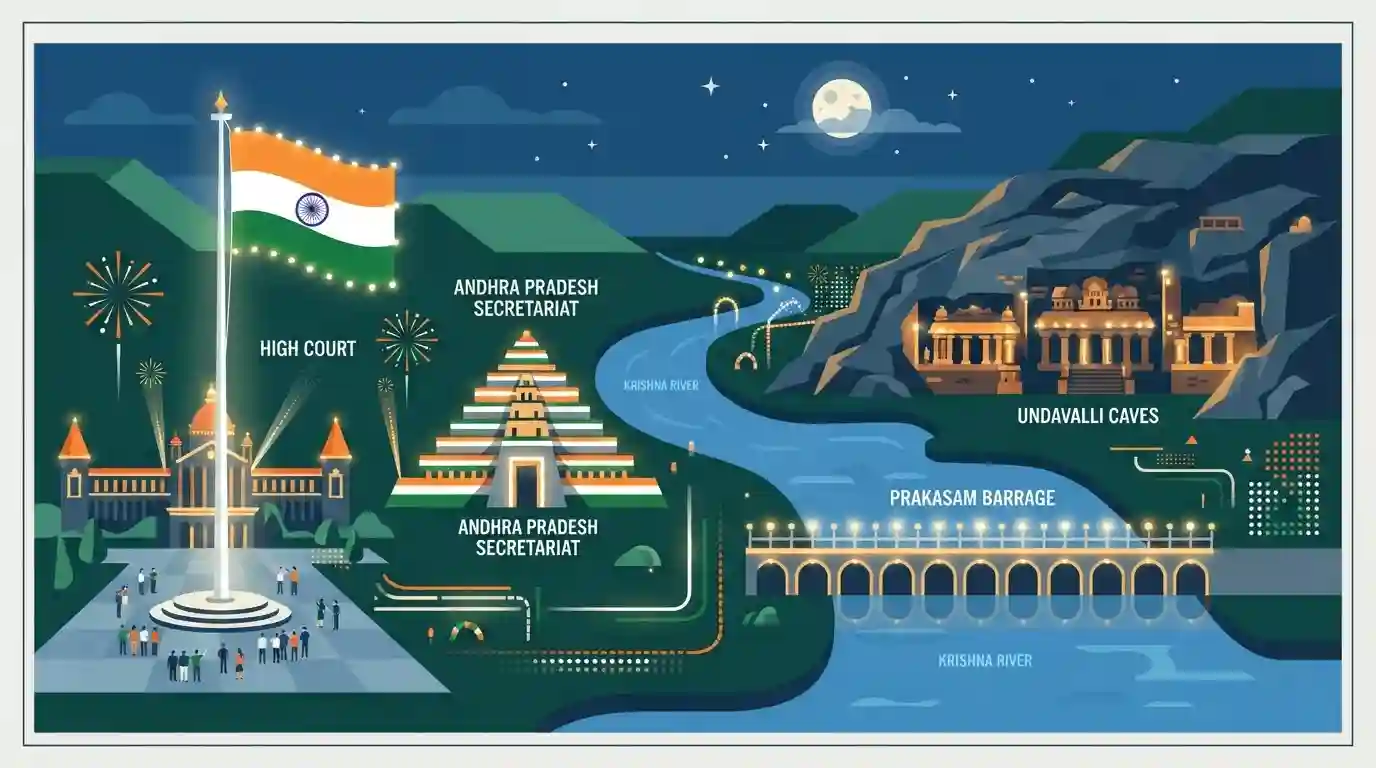
Amaravati and its surrounding historic and administrative landmarks, including the Secretariat, High Court, Prakasam Barrage, and the rock-cut Undavalli Caves, have been elaborately illuminated to mark India's 80th Independence Day celebrations. Flag hoisting events are scheduled across major government institutions.
Key Points
- The capital region of Amaravati is illuminated for the 80th Independence Day celebrations, with the main venue at Nelapadu Grounds.
- Prominent landmarks, including the Andhra Pradesh Secretariat, Assembly, and the High Court in Nelapadu, have been specially decorated with tricolor lighting.
- Historic sites such as the rock-cut Undavalli Caves in Guntur district and the Prakasam Barrage in Vijayawada were also illuminated.
- Separate flag-hoisting ceremonies are scheduled across key administrative and judicial institutions led by top state officials.
Important Terms
State Legislative Assembly

The directly elected lower house of an Indian state legislature. Dictated by Article 170, it typically features 60 to 500 members and wields primary legislative and financial authority over state subjects.
UPSC context
GS-2 (Polity). Evaluates knowledge of Articles 168-172, composition limits, passage of Money Bills, and executive accountability mechanisms.
Legislative Council
The permanent upper house in bicameral state legislatures. Article 169 empowers Parliament to create or abolish it via ordinary law, provided the state's Legislative Assembly first passes a special majority resolution.
UPSC context
GS-2 (Polity). Heavily tested on the constitutional process for its creation/abolition (Article 169) and its limited legislative powers.
Andhra Pradesh High Court
The apex judicial body for Andhra Pradesh, mandated by Article 214 of the Constitution. A distinct High Court was established at Amaravati following the state's 2014 bifurcation.
UPSC context
GS-2 (Polity). Covers the constitutional mandate for state judiciaries, jurisdictional powers, and the systemic reorganization of judicial institutions.
Andhra Pradesh Secretariat
The chief administrative headquarters of the state government, located in Amaravati. It houses the offices of cabinet ministers and the bureaucracy, serving as the central hub for policy formulation.
UPSC context
GS-2 (Governance). Relevant to topics concerning state administrative frameworks, executive functioning, and the pivotal role of the state bureaucracy.
Prelims Trap
Undavalli Caves were built exclusively as Hindu temples by the Satavahana dynasty.
They originated as Buddhist and Jain monastic cells in the 4th-5th centuries before being converted into Hindu temples, primarily under Vishnukundina patronage.
Static Concepts Connected
What are the key architectural and historical features of the Undavalli Caves?
- Origins: They were initially excavated as Buddhist or Jain monastic cells from a solid sandstone hillside in the 4th-5th century AD.
- Patronage: They were later patronised by the Vishnukundina dynasty and converted into elaborate Hindu cave temples.
- Key Deity: The caves are famous for a massive, monolithic granite statue of Lord Vishnu in a reclining posture (Anantha Padmanabha Swamy).
What are the defining characteristics of the Amaravati School of Art?
- Material used: Unlike the red sandstone of Mathura, Amaravati sculptures predominantly used white marble and greenish-white limestone.
- Patronage: It was extensively patronised by the Satavahana and Ikshvaku dynasties in the lower Krishna-Godavari valley.
- Narrative style: The art is highly narrative, focusing on dynamic relief sculptures that depict scenes from the Buddha's life and Jataka tales.
Cross-Topic Patterns
Historic capitals and modern administration
Amaravati’s development as AP's modern capital mirrors its ancient prominence as Dhanyakataka under the Satavahanas, linking contemporary political geography directly with ancient history.
Krishna River basin infrastructure
The illumination of Prakasam Barrage highlights crucial peninsular irrigation structures. UPSC frequently tests these coastal barrages alongside the drainage basins of east-flowing rivers like Krishna and Godavari.

Expect a Prelims match-the-pair question linking lesser-known rock-cut caves (Undavalli, Udayagiri) with their patron dynasties.
Linked PYQs · 3
Linked PYQs · 3
- 2024APPSC_PRELIMSGS1
Consider the following art and architectural forms : I. Rock-cut elephant at Dhauli in Orissa II. Yakshi figure from Didarganj near Patna III. Great Stupa at Sanchi in Madhya Pradesh IV. 80-pillared hall at Kumrahar near Patna Which of the above art and architectural forms belong to the Mauryan period ?
- 2024APPSC_PRELIMSGS1
Within India, Ganga river basin has the largest catchment area. After that, following is the correct sequence in the decreasing order:
- 2019APPSC_PRELIMSGS1
Which one of the following pairs is not correctly matched ? Dam/Lake / River
