Amaravati Capital Project: Revival of AP Permanent Administrative Hub
Source:drishtiias ↗
Why It Matters
Directly relates to Andhra Pradesh state administration, regional development, and the implementation of statutory provisions concerning state capitals and governance following the bifurcation under the AP Reorganisation Act.
Summary
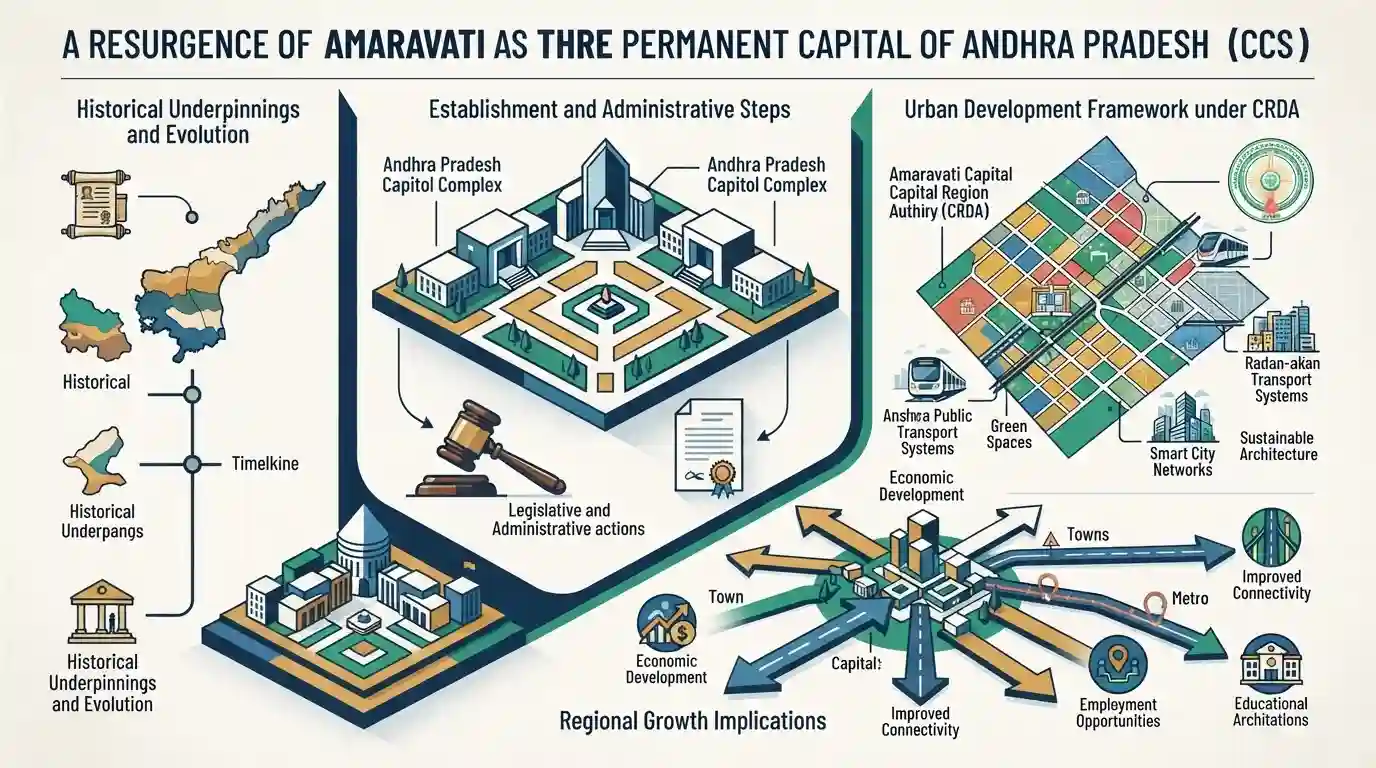
The article discusses the resurgence and establishment of Amaravati as the permanent capital of Andhra Pradesh, highlighting the administrative steps, urban development framework under CRDA, and regional growth implications.
Key Points
- Amaravati is designated as the permanent capital of Andhra Pradesh, reviving the grand capital city project originally conceived.
- The decision involves infrastructural development, funding mechanisms, and administrative consolidation in the designated capital region.
- Legal, environmental, and socio-economic considerations surrounding land pooling and urban planning in Amaravati remain crucial for governance.
Important Terms
Andhra Pradesh Reorganisation Act 2014

A central parliamentary legislation enacted in 2014 that bifurcated the state of Andhra Pradesh and provided for a temporary common capital before a new state capital was established.
UPSC context
Important for APPSC Group 1 & 2 (Indian Polity & AP History/Reorganisation), testing federal provisions, state bifurcation, and legislative amendments.
Capital Region Development Authority (CRDA)
A statutory planning and development body established to plan, coordinate, and execute the urban infrastructure and construction of Amaravati as the permanent capital of Andhra Pradesh.
UPSC context
Relevant for APPSC Governance and Administration, testing urban local bodies, metropolitan planning, and state developmental frameworks.
Andhra Pradesh Government
The executive branch of the state government responsible for policy implementation, administrative governance, and infrastructure development initiatives within Andhra Pradesh.
UPSC context
Crucial for APPSC polity exams covering state executive functions, policy formulation, and administrative machinery.
Static Concepts Connected
What are the constitutional provisions and parliamentary powers regarding the formation of new States and alteration of areas under the Indian Constitution?
- Parliamentary Power: Article 3 empowers Parliament to form new States, alter boundaries, areas, or names of existing States by a simple majority after presidential recommendation.
- State Legislature Role: The President must refer the Bill to the concerned State Legislature for expressing its views within a specified period, though Parliament is not bound by these views.
- Not Constitutional Amendment: Such legislation does not amount to a constitutional amendment under Article 368, requiring only ordinary legislative procedure.
Cross-Topic Patterns
Greenfield Capitals vs. Urban Local Bodies
The devolution of urban governance powers under the 74th Amendment Act is directly tested when greenfield capitals like Amaravati establish specialised authorities like the CRDA outside regular municipal frameworks.
Article 3 Reorganisation and Regional Imbalances
The 2014 bifurcation of Andhra Pradesh under Article 3 serves as a landmark case study for legislative asset-sharing, inter-state tribunals, and regional economic imbalances.

APPSC frequently asks multi-statement questions on the AP Reorganisation Act 2014 provisions and capital region statutory bodies like CRDA.
Linked PYQs · 2
Linked PYQs · 2
- 2023APPSC_PRELIMSGS1
Part V of the Andhra Pradesh Reorganisation Act deals with
- 2023APPSC_PRELIMSGS1
How many Schedules are there in the Andhra Pradesh Reorganisation Act?
