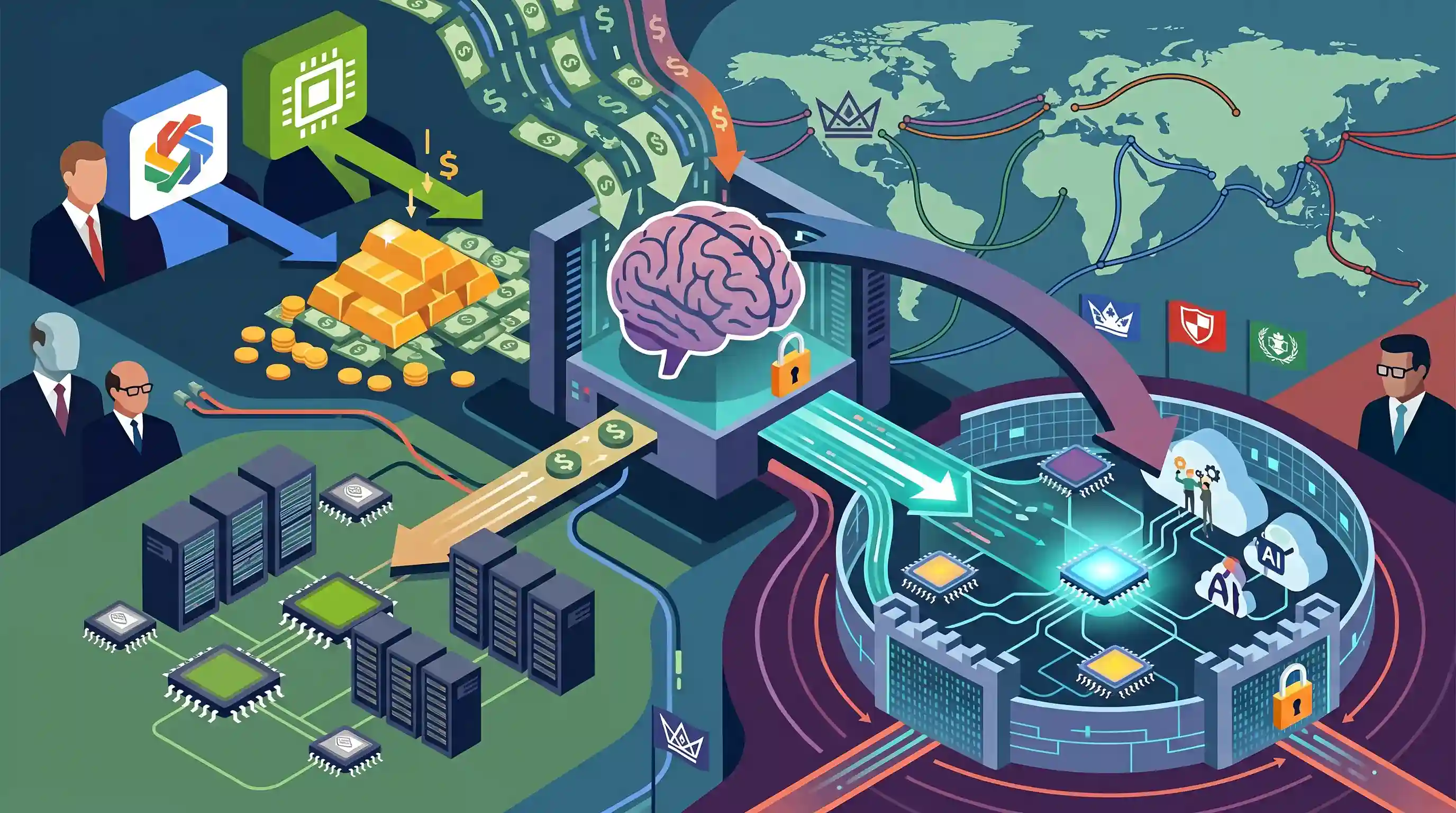
Alphabet and Nvidia investments in artificial intelligence startups
Source:The Hindu ↗
Why It Matters
Understanding the underlying hardware dynamics (GPUs vs. TPUs) and corporate investments driving Artificial Intelligence is crucial for grasping the geopolitical and economic dimensions of emerging technologies. It relates directly to India's own Semiconductor Mission and efforts to build indigenous compute capacity under the India AI Mission.
Summary
Alphabet and Nvidia have joined a massive funding round valuing Safe Superintelligence (SSI)—an AI startup founded by OpenAI co-founder Ilya Sutskever—at $32 billion. In a notable shift from the industry norm of exclusive reliance on Nvidia's Graphics Processing Units (GPUs), SSI plans to utilize Alphabet's Tensor Processing Units (TPUs) for its computing needs. This development underscores an escalating trend wherein leading cloud computing providers strategically invest in foundational AI developers. By doing so, they aim to lock these cutting-edge companies into their proprietary hardware and cloud ecosystems, thereby intensifying the global race for dominance in AI infrastructure and semiconductor technology.
Key Points
- Tech giants Alphabet and Nvidia are participating in a major funding round for Safe Superintelligence (SSI), a new AI startup co-founded by OpenAI's former chief scientist Ilya Sutskever.
- The investment values SSI at $32 billion, highlighting the massive capital requirements and investor appetite for foundational AI research.
- SSI is expected to heavily utilize Alphabet's custom AI chips, known as Tensor Processing Units (TPUs), to train its models, rather than relying exclusively on Nvidia's dominant GPUs.
- The deal reflects a strategic trend where major cloud infrastructure providers (like Google, Amazon, and Microsoft) invest directly in AI model builders to secure them as long-term customers for their proprietary computing hardware and cloud ecosystems.
Important Terms
Safe Superintelligence (SSI)

An AI startup co-founded by Ilya Sutskever focused exclusively on developing "superintelligence"—AI surpassing human cognitive abilities—while prioritizing technical safety and alignment with human values over commercial products.
UPSC context
Relevant for GS Paper III (S&T) regarding AI ethics, safety frameworks, and global competition in frontier technology development.
Alphabet
The parent company of Google and a major cloud provider. It strategically invests in AI startups to secure demand for its proprietary Tensor Processing Units (TPUs) and cloud ecosystem.
UPSC context
Relevant for GS Paper III (Economy/Infrastructure) regarding market monopolies, digital infrastructure, and foreign direct investment in emerging tech.
Nvidia
The world’s leading designer of Graphics Processing Units (GPUs). It dominates the AI hardware market but faces increasing competition as cloud giants develop proprietary chips.
UPSC context
Important for GS Paper III (S&T/Semiconductors) concerning India’s Semiconductor Mission and global supply chain dependencies for AI.
OpenAI
An AI research organization known for ChatGPT. Its former Chief Scientist co-founded SSI, highlighting an industry-wide debate between rapid commercialization and safety-first development.
UPSC context
Tests awareness of key global players in AI and the transition from non-profit to for-profit technological governance.
Tensor Processing Unit (TPU)
An AI-specific hardware accelerator developed by Google. Unlike general-purpose chips, it is optimized for "tensor" operations, which are the mathematical foundation of deep learning workloads.
UPSC context
Critical for GS Paper III (S&T) questions on advanced computing, semiconductor types, and indigenous technological capabilities.
Graphics Processing Unit (GPU)
A specialized processor designed for high-speed parallel computing. Originally for graphics, its ability to perform many simultaneous calculations has made it the standard for training large AI models.
UPSC context
Relevant for GS Paper III (Digital Infrastructure) and the National Supercomputing Mission.
Prelims Trap
"TPUs are generic, open-source microprocessors rapidly replacing traditional CPUs in modern personal computers."
TPUs are highly specialized Application-Specific Integrated Circuits (ASICs) proprietary to Google, designed exclusively for massive AI workloads in cloud data centers, not personal computing.
Static Concepts Connected
What is the difference between GPUs and TPUs in AI computing?
- GPU architecture: Versatile parallel processors initially designed for rendering 3D graphics, now widely adapted for heavy AI model training due to their massive parallelism (e.g., Nvidia).
- TPU architecture: Application-Specific Integrated Circuits (ASICs) designed exclusively by Google to accelerate specific deep learning and neural network tensor computations.
- Ecosystem lock-in: Major cloud providers use their proprietary hardware clusters (like TPUs) to create 'ecosystem lock-in', obligating AI startups to stay on their platforms.
What is the concept of Sovereign AI Infrastructure?
- Sovereign compute: Government-led development of domestic AI hardware ecosystems (e.g., the ₹10,372 crore IndiaAI Mission) to ensure national data sovereignty and security.
- Public utility model: Treating AI computing capacity (GPUs/TPUs) as a Digital Public Utility to prevent domestic innovation from being bottlenecked by foreign tech monopolies.
- Cultural alignment: Ensuring that foundational models developed domestically are culturally and ethically aligned with the local population, mitigating global AGI alignment risks.
Cross-Topic Patterns
Cloud monopolies vs India's DPI
Global hyperscalers locking startups into proprietary hardware contrasts sharply with India's open-protocol Digital Public Infrastructure approach, now expanding into the Sovereign IndiaAI Mission.
AGI and the Alignment Problem
The creation of "Safe Superintelligence" directly connects to GS3 and GS4 concerns regarding existential risks if Artificial General Intelligence acts outside human ethical frameworks.

Expect a prelims pair-matching question on AI hardware (TPU vs GPU vs NPU) or a GS3 Mains question on 'Sovereign AI vs Tech Monopolies'.
Linked PYQs · 3
Linked PYQs · 3
- 2020PrelimsGS1
With the present state of development, Artificial Intelligence can effectively do which of the following? 1. Bring down electricity consumption in industrial units 2. Create meaningful short stories and songs 3. Disease diagnosis 4. Text-to-Speech Conversion 5. Wireless transmission of electrical energy Select the correct answer using the code given below:
- 2023MainsGS3
Introduce the concept of Artificial Intelligence (AI). How does Al help clinical diagnosis? Do you perceive any threat to privacy of the individual in the use of Al in healthcare?
- 2025MainsGS3
India aims to become a semiconductor manufacturing hub. What are the challenges faced by the semiconductor industry in India? Mention the salient features of the India Semiconductor Mission.
