Allianz Risk Barometer 2026 Highlights Global Supply Chain Threats
Source:Indian Express ↗
Why It Matters
The interplay between global geopolitical conflicts, 'gray zone' warfare, and economic resilience highlights vital topics for GS2 and GS3. Understanding how international instability impacts supply chains, energy security, and business insurance prepares aspirants to answer questions on internal security threats (state vs. non-state actors) and global trade dynamics.
Summary
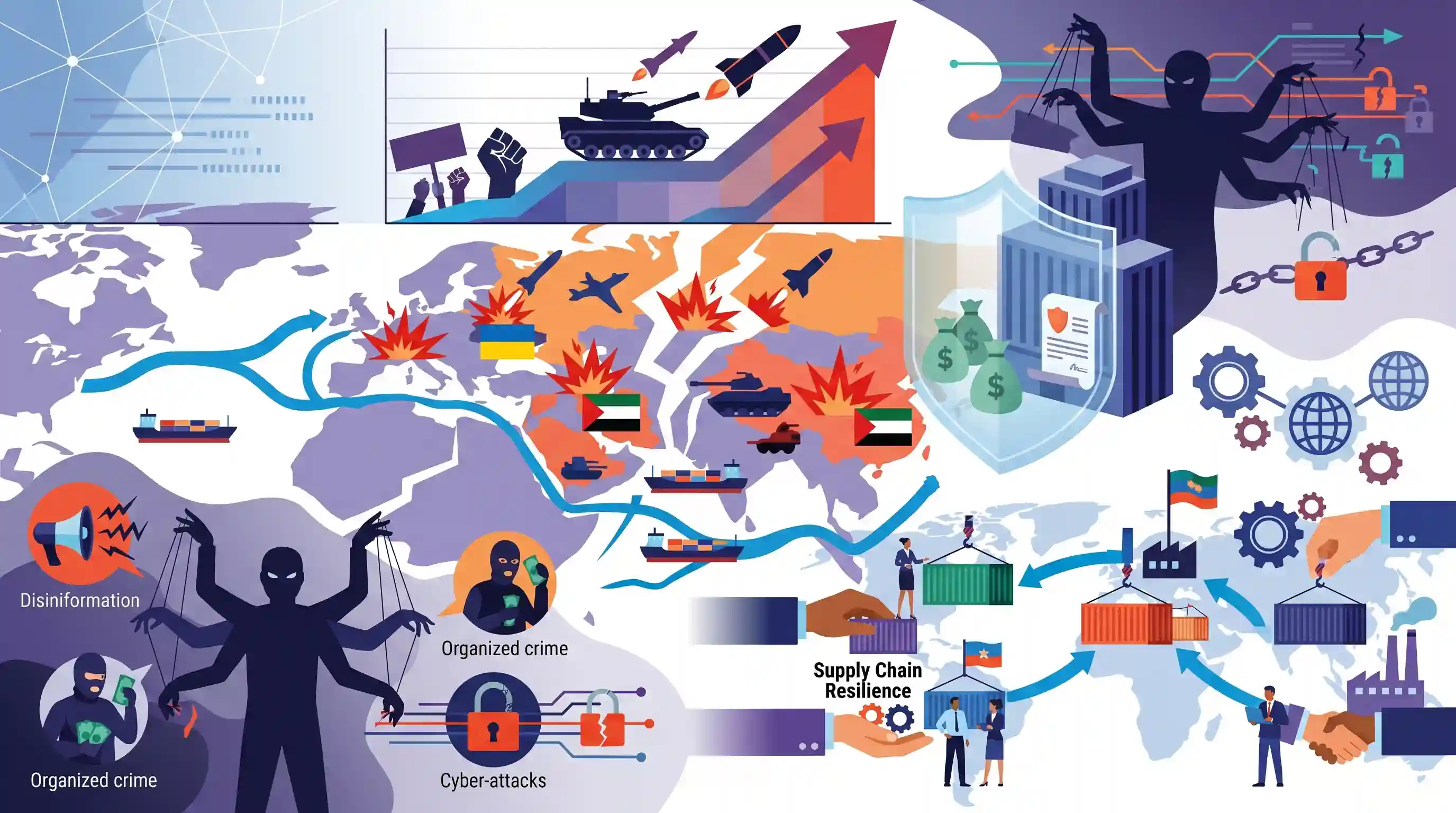
According to the Allianz Risk Barometer 2026, war has overtaken civil unrest as the top political violence risk for businesses. Escalating conflicts, such as the US-Iran clashes and the war in Ukraine, are heavily impacting global supply chains, increasing the demand for political violence and terrorism (PVT) insurance. Furthermore, threat actors are increasingly engaging in 'gray zone' warfare—leveraging disinformation, cyber-attacks, and organized crime—which blurs the distinction between state and non-state actors. In response, global businesses are prioritizing supply chain resilience through strategies like nearshoring and friendshoring to navigate an increasingly volatile geopolitical landscape.
Key Points
- The Allianz Risk Barometer 2026 reveals that war has surpassed civil unrest as the primary political violence risk for global businesses.
- Geopolitical tensions, particularly the US-Iran conflict and the war in Ukraine, are severely disrupting global trade, causing food and fuel price shocks, and straining supply chains.
- Threat actors increasingly use 'gray zone' tactics—combining cyber-attacks, criminal networks, and disinformation—which blurs the lines between state and non-state actors and undermines detection efforts.
- To mitigate supply chain risks stemming from global instability, companies are adopting strategies such as nearshoring, friendshoring, and broader supplier diversification.
- The political violence and terrorism (PVT) insurance market has taken a hit with severe losses concentrated in critical sectors like oil, gas, and transportation in West Asia.
Important Terms
Gray Zone Warfare

Coercive activities that fall between peace and war, leveraging cyber-attacks, disinformation, and economic pressure to achieve strategic goals without triggering full-scale military conflict.
UPSC context
GS Paper III (Internal Security); essential for understanding non-traditional threats and evolving defense strategies like those discussed at Raisina Dialogue.
Supply Chain Resilience
The capacity of a trade network to anticipate, adapt to, and recover from disruptions by diversifying supply risks across multiple nations rather than relying on one.
UPSC context
GS Paper III (Economy) and GS Paper II (IR); focuses on global trade stability and initiatives like SCRI.
Friendshoring
A trade strategy of relocating supply chains to countries that are politically and economically aligned to minimize vulnerabilities to geopolitical tensions or hostile actors.
UPSC context
GS Paper II (IR) and GS Paper III (Economy); relevant for studying blocks like IPEF and strategic autonomy.
Nearshoring
The practice of moving business operations or manufacturing to a nearby country to reduce transportation costs, improve delivery times, and mitigate logistical risks.
UPSC context
GS Paper III (Economy); discusses global manufacturing shifts and regional economic integration.
Non-State Actors
Groups or individuals that hold significant influence or carry out activities (including violence) independent of any state government, such as NGOs, corporations, or terrorist organizations.
UPSC context
GS Paper III (Internal Security); central to topics on insurgency, terrorism, and the blurring lines in modern conflict.
Allianz Risk Barometer
An annual global survey and report that identifies the most significant corporate risks, often used as a benchmark for geopolitical and economic instability.
UPSC context
GS Paper III (Economy); provides empirical data on global risks affecting international trade and investment.
Political Violence
The use of force by state or non-state entities to achieve political aims, encompassing war, civil unrest, terrorism, and strikes.
UPSC context
GS Paper III (Internal Security); tests understanding of factors impacting national stability and the investment climate.
Prelims Trap
"Friendshoring implies moving manufacturing operations back to a company’s home country."
Moving production back to the home country is 'reshoring'. 'Friendshoring' means shifting manufacturing to politically allied nations, which may or may not be geographically close.
Static Concepts Connected
What are the primary forms of supply-chain relocation?
- Reshoring: Moving manufacturing and production processes back to the company's domestic home country from overseas.
- Nearshoring: Relocating production to countries that are geographically closer to the home market to reduce transit times.
- Friendshoring: Sourcing from nations that share similar political and economic values to minimize geopolitical risks.
What characterizes 'Gray Zone' warfare in modern geopolitics?
- Sub-threshold operations: Coercive and aggressive actions that are designed to stay deliberately below the threshold of conventional armed conflict.
- Non-military tactics: Heavily relies on non-kinetic tools like cyber-attacks, economic coercion, disinformation campaigns, and proxy militias.
- Plausible deniability: Intentionally blurs the lines between state and non-state actors, making definitive legal attribution difficult.
Cross-Topic Patterns
Friendshoring & the Quad's SCRI
Supply chain relocation strategies directly tie into the Supply Chain Resilience Initiative (SCRI) launched by India, Japan, and Australia to counter China's regional dominance.
Gray Zone Warfare in GS3 Security
The blurring of state/non-state actors via economic and cyber coercion connects closely to GS3 themes of border management, cybersecurity, and proxy threats.

Expect Prelims matching-pairs on trade terms (friendshoring vs nearshoring) or a GS3 Mains question on Gray Zone tactics.
Linked PYQs · 4
Linked PYQs · 4
- 2021MainsGS3
Analyse the multidimensional challenges posed by external state and non-state actors, to the internal security of India. Also discuss measures required to be taken to combat these threats.
- 2016MainsGS3
Use of Internet and social media by non-state actors for subversive activities is a major security concern. How have these been misused in the recent past? Suggest effective guidelines to curb the above threat.
- 2025MainsGS2
"Energy security constitutes the dominant kingpin of India's foreign policy, and is linked with India's overarching influence in Middle Eastern countries.” How would you integrate energy security with India's foreign policy trajectories in the coming years?
- 2017MainsGS2
The question of India's Energy Security constitutes the most important part of India's economic progress. Analyze India's energy policy cooperation with West Asian countries.
