Maintenance recovery execution rules clarified by Allahabad High Court
Source:livelaw ↗
Why It Matters
This ruling underscores the judiciary's role in enforcing social justice and protecting women's rights. It is highly relevant for UPPSC GS Paper 2 as it touches upon the practical application of maintenance laws, the transition from CrPC to BNSS, the hierarchy and oversight mechanisms within the judiciary, and the enforcement of Supreme Court directives by subordinate courts.
Summary
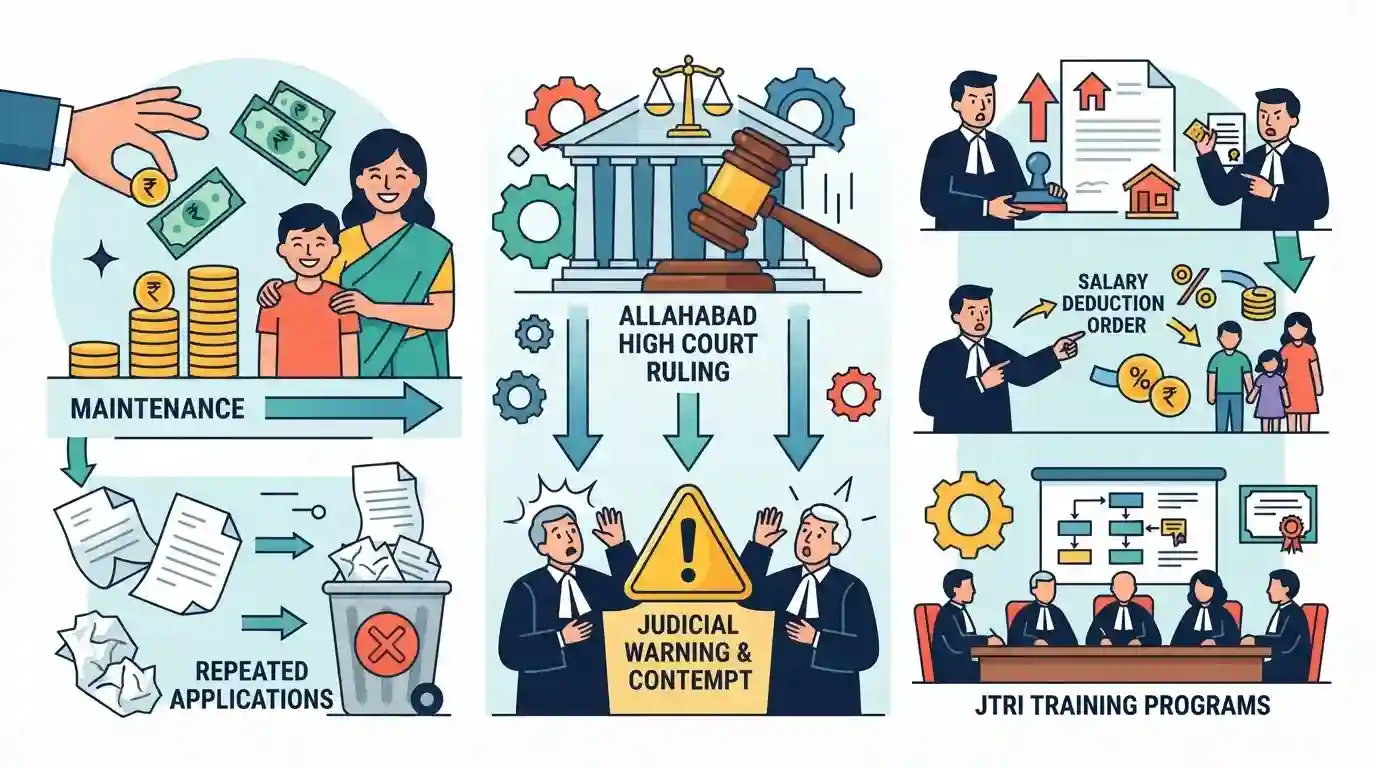
The Allahabad High Court has issued a significant ruling providing relief to women, stating they cannot be compelled to file successive execution applications to recover monthly maintenance from defaulting husbands under Section 125 of the CrPC (now Section 144 of the BNSS). The Court reprimanded Subordinate Judicial Officers and Family Courts for repeatedly ignoring Supreme Court guidelines on maintenance recovery, warning them of contempt of court. It directed magistrates to utilize effective recovery measures like property attachment and salary deductions, while ordering the Judicial Training and Research Institute (JTRI) to conduct training programs on matrimonial disputes for lower court judges.
Key Points
- The Allahabad High Court ruled that women seeking maintenance are not required to file separate execution applications for every default by their husbands.
- The Court clarified that the proviso to Section 125(3) CrPC (now Section 144(3) BNSS) merely restricts the claim for arrears to one year, but does not mandate successive filings for ongoing recovery.
- Family Court judges were sternly warned of contempt proceedings if they continue to ignore Supreme Court guidelines (e.g., *Rajnesh vs Neha*) on enforcing maintenance orders.
- Magistrates were directed to enforce orders efficiently through distress warrants, property attachment, salary deductions, and direct bank transfers.
- The Judicial Training and Research Institute (JTRI) was directed to organize specialized training programs for judicial officers on handling matrimonial and maintenance disputes.
Important Terms
Section 125 of Code of Criminal Procedure (CrPC)

A statutory provision in the former CrPC that mandated financial maintenance for neglected wives, children, and parents to prevent destitution and ensure sustenance regardless of religion.
UPSC context
GS Paper II (Social Justice/Vulnerable Sections); tests legal safety nets for women and dependents.
Section 144 of Bharatiya Nagarik Suraksha Sanhita (BNSS)
The contemporary provision under the BNSS, 2023 (replacing Section 125 CrPC) regulating legal obligations, interim relief, and enforcement of maintenance for dependent spouses, children, and parents.
UPSC context
GS Paper II (Polity/Judiciary); tests major legal reforms and procedural law transitions in India.
Family Courts Act, 1984
An Indian act that mandates state governments to establish specialized Family Courts for conciliation and prompt, non-adversarial resolution of matrimonial and family-related disputes.
UPSC context
GS Paper II (Judiciary/Alternative Dispute Resolution); tests statutory mechanisms for familial dispute settlement.
Gram Nyayalayas Act, 2008
A central legislation enacted to establish mobile village courts at the intermediate panchayat level, delivering affordable and speedy justice to rural populations.
UPSC context
GS Paper II (Decentralization/Subordinate Judiciary); tests grassroots justice delivery and legal empowerment.
Prelims Trap
The right to receive monthly maintenance under BNSS Section 144 lapses entirely if arrears are not claimed within one year.
The one-year limitation period restricts only the timeframe for recovering past unpaid arrears (via distress warrant), not the ongoing validity of the maintenance order itself or the right to claim ongoing future maintenance.
Static Concepts Connected
What are the core features of statutory maintenance under Section 144 of the BNSS?
- Secular Application: Applies universally across all religions, serving as a distinct statutory mechanism independent of personal laws.
- Scope of Beneficiaries: Covers wives (including divorced and un-remarried), minor children (legitimate/illegitimate), and parents unable to maintain themselves.
- Summary Nature: Designed as a swift, preventive remedy against vagrancy and destitution, rather than a full-dress trial of civil rights.
What guidelines did the Supreme Court lay down in the Rajnesh v. Neha (2020) case?
- Asset Disclosure: Mandated standard, comprehensive Affidavits of Assets and Liabilities from both spouses to prevent hiding income.
- Effective Date: Rules that maintenance must be granted from the date of application, preventing delays from disadvantaging claimants.
- Overlap Harmonization: Set principles to adjust maintenance amounts when claimed simultaneously under personal laws and domestic violence statutes.
Cross-Topic Patterns
Judicial Accountability and Subordinate Courts
Links judicial administration with gender justice. The Allahabad HC's warning exposes structural defiance and execution failures in India's lower judiciary despite clear Supreme Court directives.
Secular Social Justice vs Personal Laws
Examines statutory social security versus personal laws. Secular maintenance codes under BNSS act as constitutional safeguards under Article 21, overriding restrictive community-specific personal laws.

BNSS Sec 144 transition and execution bottlenecks in subordinate courts are likely areas for GS2 Mains analysis on gender justice.
Linked PYQs · 2
Linked PYQs · 2
- 2023UPPSC_PRELIMSGS1
Consider the following statements concerning the powers of the Supreme Court to issue certain writs to stop violation of Fundamental Rights – (1) The Supreme Court has power to issue writs like Habeas Corpus, Mandamus, Prohibition, Quo Warranto and Certiorari which is appropriate for the enforcement of Fundamental Rights. (2) Parliament may by law empower any other court to exercise within its jurisdiction the powers given to Supreme Court. Which of the above mentioned statement/statements is/are correct? Select the correct answer from the code given below –
- 2024UPPSC_PRELIMSGS1
Which one of the following is not a level in the three-tier Panchayati Raj recommended by Balwant Rai Mehta Committee ?
