Extraterritorial Jurisdiction and MP MLA Court Proceedings
Source:The Hindu ↗
Why It Matters
This case illustrates the practical challenges in applying extraterritorial jurisdiction for criminal complaints against public figures. It also sheds light on the interplay between freedom of expression, alleged hate speech, and the functioning of specialized MP-MLA courts designed to handle cases involving elected representatives.
Summary
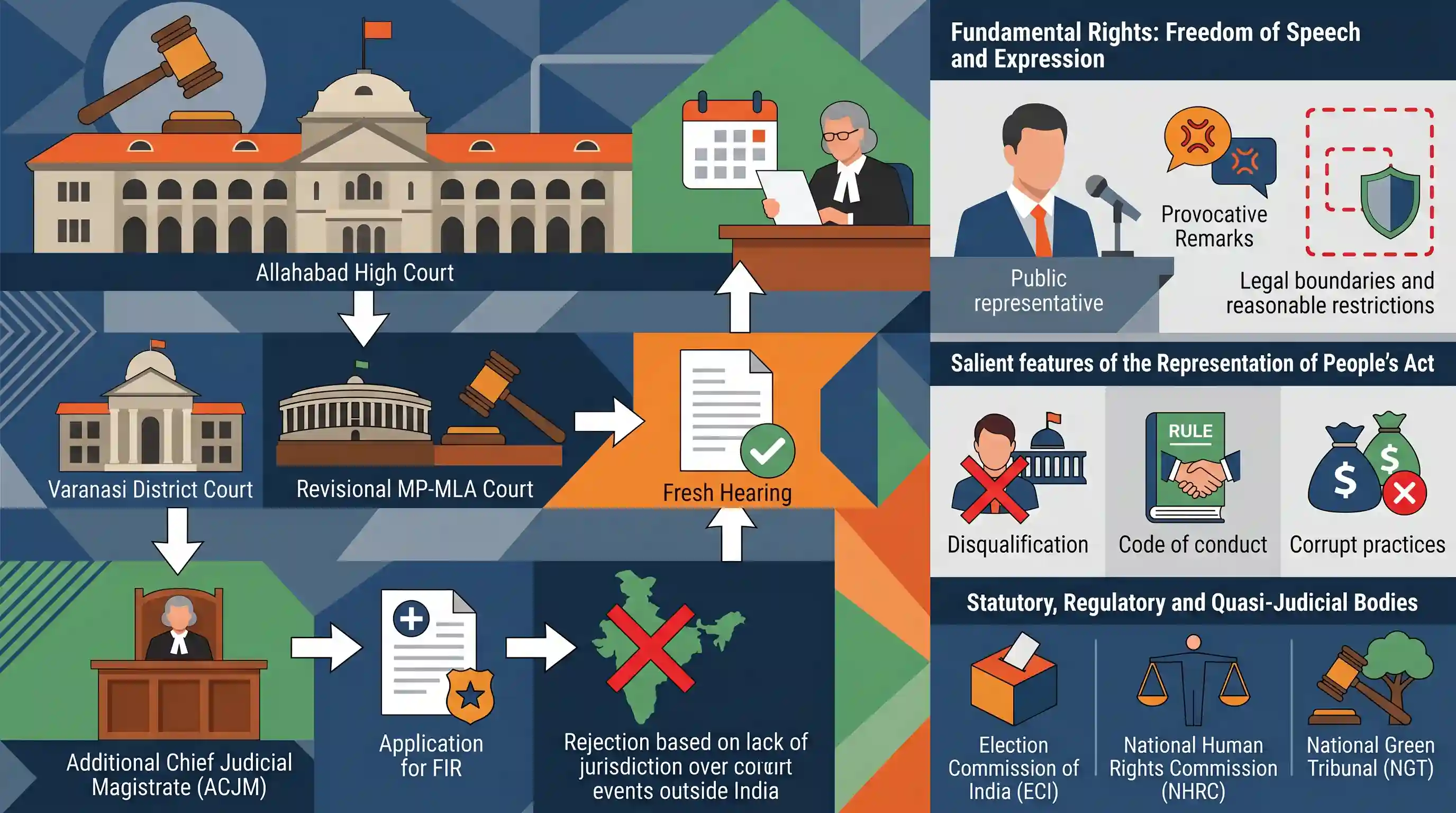
The Allahabad High Court is scheduled to hear a revision petition by Congress MP Rahul Gandhi challenging a Varanasi court's order. The case involves an application seeking an FIR against Gandhi for alleged provocative remarks made about Sikhs during a 2024 visit to America. While the Additional Chief Judicial Magistrate initially rejected the application citing a lack of jurisdiction over events outside India, a revisional MP-MLA court directed a fresh hearing. The issue highlights the complexities of extraterritorial jurisdiction in criminal law and the legal boundaries of statements made by public representatives abroad.
Key Points
- The Allahabad High Court will hear Congress MP Rahul Gandhi's criminal revision petition against a Varanasi court order concerning his 2024 remarks in America about Sikhs.
- A Varanasi resident sought an FIR, claiming the remarks were provocative, but the Additional Chief Judicial Magistrate (MP-MLA) initially rejected the plea due to lack of territorial jurisdiction.
- A revisional court later overturned the ACJM's decision, directing a fresh hearing, which prompted Gandhi to approach the High Court arguing the Varanasi court order is illegal and without jurisdiction.
- The legal dispute centers on the extraterritorial jurisdiction of Indian courts regarding alleged offenses (such as provocative speech) committed abroad by Indian citizens.
Important Terms
Allahabad High Court

The High Court for Uttar Pradesh, established in 1866; it is one of India's oldest High Courts and the largest by sanctioned judge strength (160), with its principal seat in Prayagraj.
UPSC context
GS Paper 2: Structure and functioning of the Judiciary; historical significance and its massive caseload impact.
Special MP-MLA Courts
Specially designated courts mandated by the Supreme Court in 2017 to fast-track criminal trials against elected representatives (MPs and MLAs) to curb the criminalization of politics.
UPSC context
GS Paper 2: Representation of People's Act, Electoral Reforms, and judicial monitoring of political criminalization.
Extraterritorial Jurisdiction
The legal authority of Indian courts to try offenses committed outside India by Indian citizens or on Indian-registered vessels, as governed by Sections 3 and 4 of the IPC/BNS.
UPSC context
GS Paper 2: Powers of the Judiciary and applicability of Indian criminal laws to global contexts.
Additional Chief Judicial Magistrate (ACJM)
A judicial officer appointed under Section 12 of the CrPC/BNSS to assist the Chief Judicial Magistrate in adjudicating criminal matters within a district.
UPSC context
GS Paper 2: Subordinate judiciary structure and criminal justice administration.
Revision Petition
A legal remedy under Sections 397-405 of the CrPC/BNSS that empowers a superior court to examine the legality and propriety of an order passed by a subordinate court.
UPSC context
GS Paper 2: Judicial remedies and the distinction between appeal and revision in criminal procedure.
Prelims Trap
Offenses committed by Indian citizens abroad can be directly tried by Indian courts based on extraterritorial jurisdiction.
While Indian criminal law applies globally to citizens, courts cannot proceed with an inquiry or trial for an offense committed abroad without the prior sanction of the Central Government.
Static Concepts Connected
How does Indian criminal law apply to offenses committed outside India?
- Citizen applicability: Under the BNS, Indian criminal law applies to any offense committed by an Indian citizen anywhere in the world.
- Trial sanction: Under the BNSS, offenses committed abroad cannot be inquired into or tried in India without the prior sanction of the Central Government.
- Cybercrime exception: The law also applies to anyone (citizen or foreigner) committing an offense targeting a computer resource located in India.
What is the mandate and origin of Special MP-MLA courts?
- Judicial origin: They were systematically established across states following Supreme Court directives in the Ashwini Kumar Upadhyay vs. Union of India case.
- Fast-track purpose: Their core mandate is to monitor and fast-track the disposal of criminal cases pending against sitting and former legislators.
- Standard hierarchy: They operate within the standard judicial hierarchy as Sessions or Magistrate courts, vested with specific subject-matter jurisdiction.
Cross-Topic Patterns
Article 19(2) + Foreign Relations
Remarks made by public figures abroad often test the Article 19(2) restriction regarding "friendly relations with foreign states" alongside domestic "public order" concerns.
MP-MLA Courts + Right to Equality
The creation of MP-MLA courts touches upon Article 14 debates regarding reasonable classification, balancing the need for legislative probity against creating separate legal tracks for politicians.

Expect a Prelims statement linking BNS extraterritoriality with the mandatory Central Government sanction required for trials under BNSS.
Linked PYQs · 2
Linked PYQs · 2
- 2014MainsGS2
What do you understand by the concept "freedom of speech and expression"? Does it cover hate speech also ? Why do the films in India stand on a slightly different plane from other forms of expression ? Discuss.
- 2020MainsGS2
There is a need for simplification of procedure for disqualification of persons found guilty of corrupt practices under the Representation of Peoples Act". Comment.
