Allahabad High Court orders CBI probe into police encounter
Source:indiatomorrow.net ↗
Why It Matters
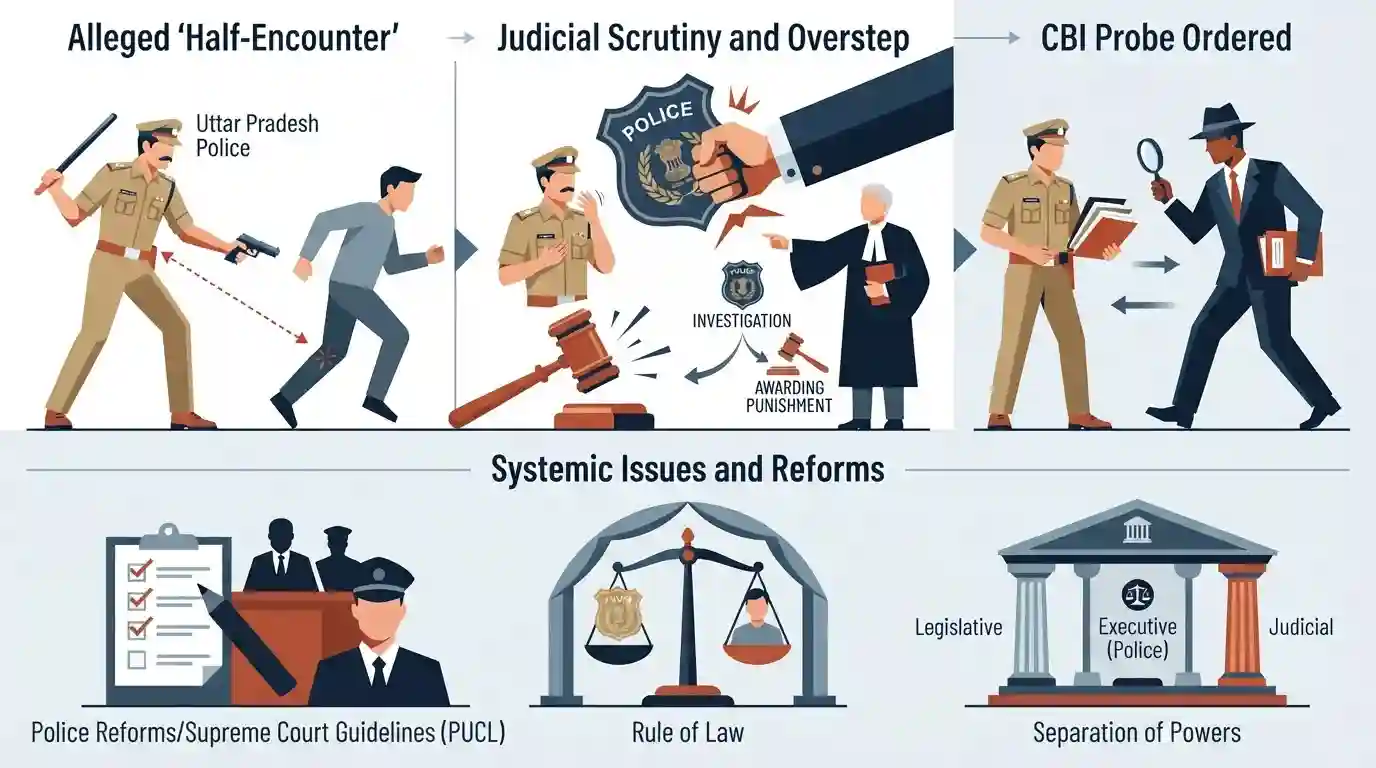
Extrajudicial actions by law enforcement violate the core constitutional principle of Separation of Powers (Article 50) and human rights. This development is highly relevant for UPPSC Polity and Governance sections, specifically concerning judicial oversight, the right to life (Article 21), and the Supreme Court's encounter guidelines.
Summary
The Allahabad High Court has directed the Central Bureau of Investigation (CBI) to probe an alleged 'half-encounter' by the Uttar Pradesh Police in Shravasti district, where an accused was shot in the leg. The division bench strongly criticized the police for overstepping their authority, asserting that the police's role is strictly to investigate, while awarding punishment is the exclusive domain of the judiciary. The court warned against the growing trend of orchestrated encounters aimed at pleasing superiors or securing promotions, and reiterated the need for strict compliance with the Supreme Court's guidelines on police encounters (PUCL case).
Key Points
- The Allahabad High Court ordered a CBI investigation into an alleged "half-encounter" in Shravasti, UP, expressing distrust in the state police's impartiality.
- A division bench condemned the police trend of shooting accused individuals in the legs, stating that awarding punishment is exclusively the judiciary's constitutional mandate.
- The court observed that staged encounters are often orchestrated to please political superiors, gain public applause, or secure out-of-turn promotions.
- The judgment emphasized strict adherence to the Supreme Court's 16-point guidelines laid down in the PUCL vs State of Maharashtra case regarding the investigation of police encounters.
- This judicial intervention highlights the critical importance of the Separation of Powers (Article 50) and the Rule of Law in upholding human rights against executive overreach.
Important Terms
PUCL vs State of Maharashtra (2014) Guidelines

A 2014 Supreme Court verdict that established 16-point mandatory guidelines to investigate police encounters. It requires prompt FIR registration, independent probes (CID/other stations), magisterial inquiries, and prohibits immediate out-of-turn promotions or gallantry awards for involved officers.
UPSC context
Tests General Studies Paper-II (Polity & Governance) concepts regarding the rule of law, police accountability, and judicial guidelines against extrajudicial killings.
Half-Encounter
A policing tactic reported in Uttar Pradesh where suspects are intentionally shot below the knee (often termed "Operation Langda") to incapacitate rather than kill. It is widely criticized by courts as extrajudicial punishment bypassing the judicial process.
UPSC context
Relevant for GS-II and GS-IV (Ethics), highlighting the separation of powers, human rights violations, and the ethical debate over "vigilante justice."
Allahabad High Court
The High Court having jurisdiction over Uttar Pradesh. In this context, its Lucknow bench ordered a CBI probe into a suspicious "half-encounter" in Shravasti, reiterating that punishing criminals is strictly a judicial domain, not a police function.
UPSC context
GS-II (Judiciary): Illustrates the role of constitutional courts in checking executive overreach and ensuring adherence to the rule of law.
Central Bureau of Investigation (CBI)
India's premier investigating agency, operating under the jurisdiction of the Ministry of Personnel, Public Grievances and Pensions. It is frequently tasked by high courts or the Supreme Court to impartially investigate complex cases or instances involving police misconduct.
UPSC context
GS-II (Statutory/Regulatory Bodies): Highlights the role of central agencies in ensuring independent probes when state machinery is compromised.
Separation of Powers
A core democratic principle dividing state power into the executive, legislature, and judiciary. High courts invoke it to remind the police (executive) that their mandate is investigation, while sentencing and punishment exclusively belong to the judiciary.
UPSC context
Core GS-II Polity concept. Tested in essay and mains questions on constitutional checks and balances and preventing arbitrary state action.
Prelims Trap
"The High Court requires the prior consent of the UP Government to order a CBI investigation into the state police."
While the CBI generally needs state consent under Section 6 of the DSPE Act, Constitutional Courts (Supreme Court and High Courts) can mandate a CBI probe without it.
Static Concepts Connected
What are the key judicial guidelines governing police encounters?
- PUCL Guidelines (2014): Mandates independent investigation (by CID or another police station), mandatory magisterial inquiry, and immediate FIR registration for any encounter death/injury.
- Prakash Singh (2006): Directed structural police reforms to insulate police from political pressure, including the establishment of Police Complaints Authorities at state and district levels.
How does the Constitution address executive overreach in criminal justice?
- Article 50 (DPSP): Directs the State to separate the judiciary from the executive in public services, ensuring that determining guilt and awarding punishment remains strictly a judicial domain.
- Article 21: Guarantees the Right to Life and Personal Liberty, establishing that the State cannot deprive a person of life except according to procedure established by law.
Cross-Topic Patterns
NHRC/SHRC statutory powers & State Police
Encounters often trigger parallel NHRC inquiries. For UPPSC, revise the composition, appointment committee, and investigative powers of the State Human Rights Commission (SHRC) under the Protection of Human Rights Act.
CBI jurisdiction vs State autonomy
Links directly to federalism debates. General consent withdrawal by states is legally bypassed when Constitutional Courts (SC or High Courts) directly mandate a CBI investigation.

Expect multi-statement questions testing CBI's non-statutory nature, state consent exceptions, and Article 50 Separation of Powers.
Linked PYQs · 3
Linked PYQs · 3
- 2023UPPSC_PRELIMSGS1
Consider the following statements concerning the powers of the Supreme Court to issue certain writs to stop violation of Fundamental Rights – (1) The Supreme Court has power to issue writs like Habeas Corpus, Mandamus, Prohibition, Quo Warranto and Certiorari which is appropriate for the enforcement of Fundamental Rights. (2) Parliament may by law empower any other court to exercise within its jurisdiction the powers given to Supreme Court. Which of the above mentioned statement/statements is/are correct? Select the correct answer from the code given below –
- 2021UPPSC_PRELIMSGS1
Which one of the following is NOT correctly matched? (Subject — Related Article)
- 2020UPPSC_PRELIMSGS1
Which of the following is not a correct match?
