Allahabad High Court Ruling on Mohammad Ali Jauhar Trust Petition
Source:The Hindu ↗
Why It Matters
Highlights the interplay between judicial processes, appellate authorities in urban development, and legal provisions specific to Uttar Pradesh (UP Urban Planning and Development Act, 1973), which is relevant for UPPSC GS questions on state administration and judiciary.
Summary
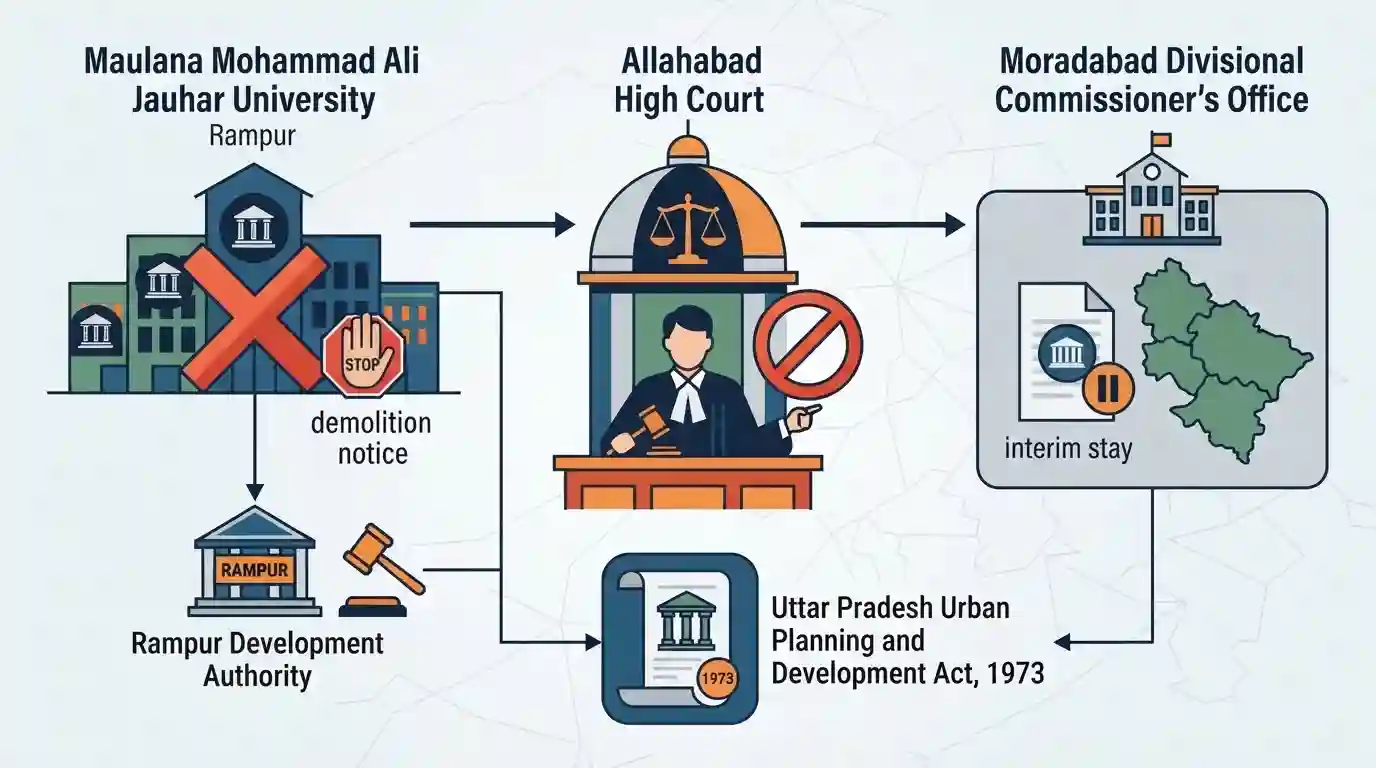
The Allahabad High Court has dismissed a petition filed by the Mohammad Ali Jauhar Trust against a demolition notice issued by the Rampur Development Authority for buildings of the Maulana Mohammad Ali Jauhar University. The court cited that an appeal is currently pending before the Moradabad Divisional Commissioner, who has already granted an interim stay on the demolition. The matter falls under the Uttar Pradesh Urban Planning and Development Act, 1973.
Key Points
- The Allahabad High Court dismissed the writ petition of Mohammad Ali Jauhar Trust challenging a demolition notice for the Maulana Mohammad Ali Jauhar University buildings.
- The petition was deemed not maintainable because an interim stay had already been granted by the appellate authority, the Moradabad Divisional Commissioner.
- The demolition notice was initially issued by the Rampur Development Authority (RDA) under Section 27(1) of the Uttar Pradesh Urban Planning and Development Act, 1973.
- The trust is headed by former Uttar Pradesh minister and Samajwadi Party leader Azam Khan.
Important Terms
Allahabad High Court

One of India's oldest High Courts, established in 1866 under the Indian High Courts Act 1861, possessing jurisdiction over the state of Uttar Pradesh with seats in Prayagraj and Lucknow.
UPSC context
GS Paper II (Indian Judiciary): Tests the structural hierarchy, writ jurisdiction, and historical evolution of India's judicial system.
Uttar Pradesh Urban Planning and Development Act, 1973
A state-level legislation that empowers the Uttar Pradesh government to declare development areas, establish local development authorities, enforce land-use zoning, and address unauthorized construction or demolition.
UPSC context
GS Paper II (State Governance & Local Bodies): Relevant for issues concerning urban planning, state legislations, and municipal governance.
Rampur Development Authority (RDA)
A statutory body constituted under the Uttar Pradesh Urban Planning and Development Act, 1973, responsible for planned spatial growth, infrastructure, and zoning regulations in the Rampur district.
UPSC context
GS Paper II (Statutory Bodies): Tests the role, delegation of powers, and performance of urban planning bodies in state governance.
Maulana Mohammad Ali Jauhar University
A private university located in Rampur, Uttar Pradesh, founded in 2006 by the Mohammad Ali Jauhar Trust, which has been at the center of complex land acquisition and legal disputes.
UPSC context
GS Paper II (Governance): Illustrates the intersection of private educational institutions, administrative oversight, and statutory regulatory compliance.
Mohammad Ali Jauhar Trust
A non-governmental trust founded by Samajwadi Party leader Azam Khan, which administers the Maulana Mohammad Ali Jauhar University and has faced extensive state scrutiny over land use and building regulations.
UPSC context
GS Paper II (NGOs & Trusts): Represents issues regarding the regulation of civil society organizations, public trusts, and public-private lands.
Prelims Trap
High Courts are constitutionally barred from issuing writs if an alternative statutory remedy is available.
The 'exhaustion of alternative remedies' is a self-imposed rule of discretion by courts, not a constitutional bar. Exceptions exist for fundamental rights violations or natural justice breaches.
Static Concepts Connected
What is the Doctrine of Alternative Remedy under Article 226?
- Self-imposed rule: It is a rule of discretion, not law. High Courts generally decline writs if an efficacious statutory remedy (e.g., an appellate tribunal) is already available.
- Key exceptions: Writs can still be issued despite alternative remedies if fundamental rights are violated, principles of natural justice are breached, or the act is ultra vires.
What were Maulana Mohammad Ali Jauhar's key contributions to the freedom struggle?
- Khilafat Movement: He was a central architect of the Khilafat Movement (1919) alongside his brother Shaukat Ali (famously known as the 'Ali brothers').
- INC & Muslim League: He served as the President of the Indian National Congress in 1923 (Kakinada session) and was also a founding member of the All India Muslim League.
- Educational role: He was one of the founding members of Jamia Millia Islamia, significantly contributing to nationalist education that opposed British control.
Cross-Topic Patterns
74th CAA vs Parastatal Bodies
While the 74th CAA envisions urban planning under elected Urban Local Bodies (12th Schedule), states routinely bypass them using unelected, state-controlled parastatal 'Development Authorities' for town planning.
Institutions & History Personalities
UPSC frequently tests the historical background of personalities whose namesake institutions appear in prominent news and legal battles (e.g., the Ali brothers' role in the 1920s nationalist movement).

Expect a Prelims question comparing the discretionary nature of Art 226 with Art 32, or a modern history question on the Ali brothers.
Linked PYQs · 2
Linked PYQs · 2
- 2023UPPSC_PRELIMSGS1
Consider the following statements concerning the powers of the Supreme Court to issue certain writs to stop violation of Fundamental Rights – (1) The Supreme Court has power to issue writs like Habeas Corpus, Mandamus, Prohibition, Quo Warranto and Certiorari which is appropriate for the enforcement of Fundamental Rights. (2) Parliament may by law empower any other court to exercise within its jurisdiction the powers given to Supreme Court. Which of the above mentioned statement/statements is/are correct? Select the correct answer from the code given below –
- 2013UPPSC_PRELIMSGS1
Which one of the following statements about the Supreme Court of India is correct?
