POCSO Act Misuse: Allahabad High Court Acquittal in Property Case
Source:Indian Express ↗
Why It Matters
It brings forth the dichotomy of protective legislations: the necessity of the POCSO Act to protect children versus its potential weaponization. It is highly relevant for GS-2 (Governance, Social Justice, and Judiciary), offering an excellent case study on the impact of judicial delays and the misuse of stringent laws on human rights.
Summary
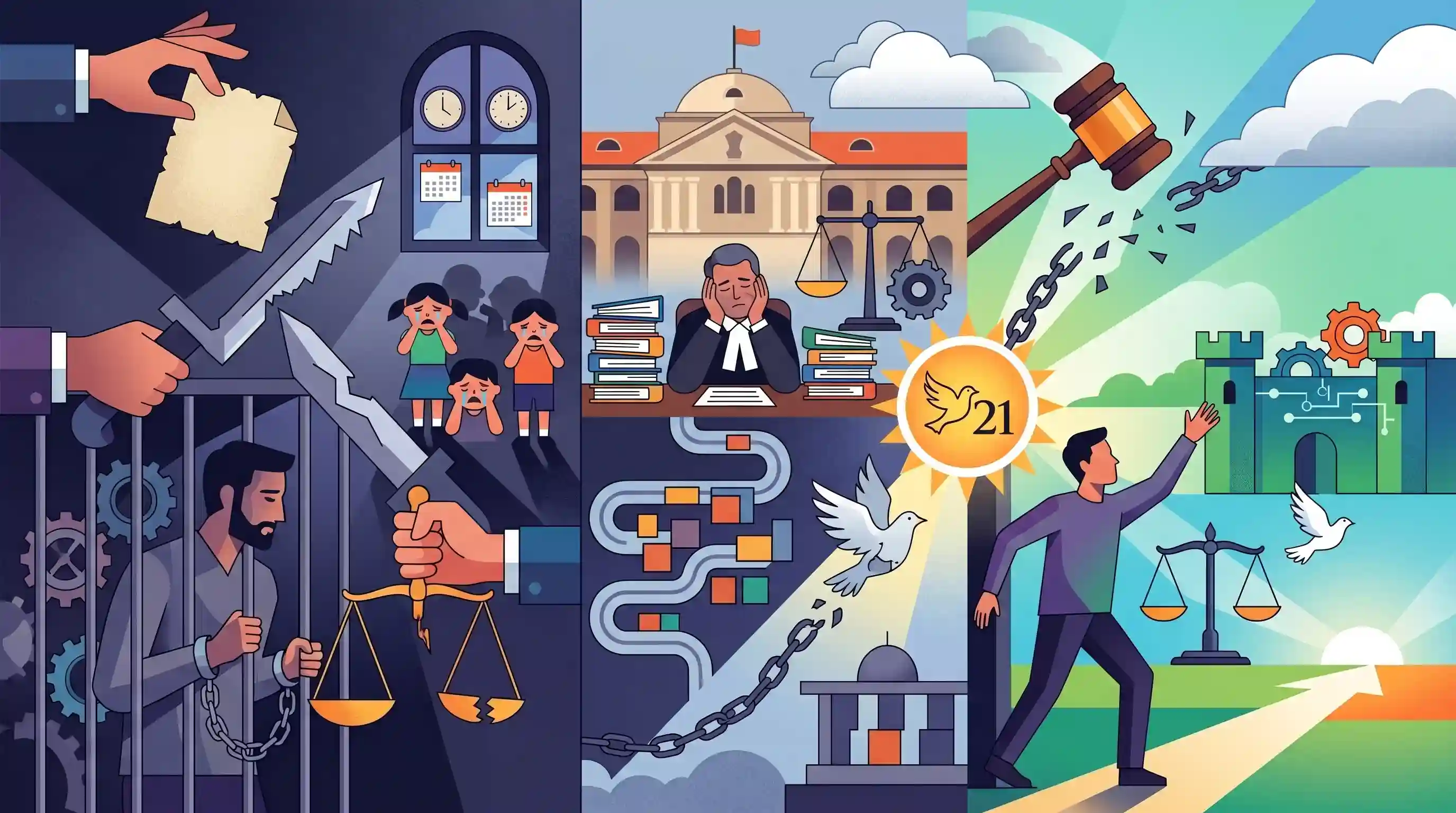
The Allahabad High Court acquitted a man who spent nine years in jail after being falsely implicated under the Protection of Children from Sexual Offences (POCSO) Act, noting that the charges were fabricated to facilitate a property grab. The court strongly condemned the growing misuse of stringent protective laws, intended to safeguard vulnerable populations, as tools for settling personal vendettas and civil disputes. The case also highlights significant flaws in the criminal justice system, particularly the chronic judicial delays that lead to prolonged pre-trial incarceration and severe violations of an individual's right to life and liberty under Article 21. The ruling points to an urgent need for institutional safeguards to prevent the weaponization of the POCSO Act while ensuring the swift dispensation of justice.
Key Points
- The Allahabad High Court acquitted a man who spent 9 years in prison under the POCSO Act, concluding the case was fabricated to illegally acquire his property.
- The court flagged the growing and alarming trend of misusing stringent, protective laws like the POCSO Act to settle personal or civil disputes.
- The nine-year incarceration of an innocent individual underscores severe systemic issues regarding judicial delays and the plight of under-trials, violating the right to personal liberty under Article 21.
- The judgment emphasizes the need for procedural safeguards to prevent the malicious weaponization of child protection legislations without diluting their original intent.
Important Terms
Protection of Children from Sexual Offences (POCSO) Act, 2012

2012 legislation providing a comprehensive framework to protect minors (<18) from sexual abuse and harassment. It features gender-neutral provisions and mandates Special Courts for trial.
UPSC context
GS Paper II: Social Justice and laws for vulnerable sections (children); focus on legislative safeguards and misuse.
Article 21
A fundamental right guaranteeing that no person shall be deprived of life or personal liberty except according to a fair, just, and reasonable procedure established by law.
UPSC context
GS Paper II: Indian Constitution and Fundamental Rights; tests interpretations of "liberty" and "due process."
Malicious Prosecution
Wrongful initiation of criminal proceedings against a person with malicious intent and without reasonable cause, causing damages to their reputation or liberty.
UPSC context
GS Paper II: Criminal Justice System and Judiciary; relates to legal accountability and rights of the falsely accused.
Right to Speedy Trial
An implicit fundamental right under Article 21 (Hussainara Khatoon case) ensuring that an accused is tried without undue delay, protecting them from prolonged pre-trial incarceration.
UPSC context
GS Paper II: Fundamental Rights and Judiciary; addresses judicial efficiency and undertrial rights.
Undertrial Prisoners
Individuals held in judicial custody while awaiting the conclusion of their legal trial; they constitute approximately 76% of India's total prison population as per NCRB.
UPSC context
GS Paper II: Governance, Social Justice, and Prisons; highlights challenges in the criminal justice system.
Criminal Justice System Reforms
Structural overhauls (e.g., Malimath Committee) of police, courts, and prison laws to address issues like pendency, low conviction rates, and the protection of victims' rights.
UPSC context
GS Paper II: Governance and Judiciary; focuses on institutional efficiency and legal overhaul.
Prelims Trap
The POCSO Act provides absolute immunity to complainants, meaning false malicious complaints cannot be penalized.
This is false. Section 22 of the POCSO Act explicitly prescribes imprisonment or fines for making false complaints with malicious intent.
Static Concepts Connected
What is the 'Reverse Burden of Proof' in Indian criminal law?
- General Rule: In standard criminal jurisprudence, the accused is presumed innocent until the prosecution proves guilt beyond a reasonable doubt.
- Reverse Burden: Shifts the onus onto the accused to prove their innocence once the prosecution establishes basic foundational facts of the case.
- Key Statutes: Applied in stringent legislations dealing with grave offenses, including the POCSO Act (Section 29), NDPS Act, PMLA, and UAPA.
How is the 'Right to Speedy Trial' protected under the Indian Constitution?
- Implicit Right: Though not explicitly written, the Supreme Court recognized it as an implicit, fundamental part of Article 21's protection of life and personal liberty.
- Landmark Precedent: Established in the landmark Hussainara Khatoon v. Home Secretary (1979) case, which addressed the unconstitutional plight of undertrial prisoners languishing in Bihar jails.
Cross-Topic Patterns
Weaponization of protective legislations
The HC's observation on POCSO mirrors Supreme Court concerns regarding the misuse of IPC Section 498A (dowry harassment) and the SC/ST Act, often used to settle private civil and property disputes.
Undertrial crisis and prison reforms
A 9-year pre-trial incarceration exposes systemic judicial delays, linking directly to GS-2 topics on prison overcrowding, where NCRB data shows over 75% of Indian inmates are undertrials.

A multi-statement Prelims question comparing the 'reverse burden of proof' provisions in POCSO, PMLA, and UAPA is probable for 2026.
Linked PYQs · 3
Linked PYQs · 3
- 2014MainsGS2
Instances of President's delay in commuting death sentences has come under public debate as denial of justice. Should there be a time limit specified for the President to accept/reject such petitions ? Analyse.
- 2025MainsGS2
The National Commission for Protection of Child Rights has to address the challenges faced by children in the digital era. Examine the existing policies and suggest measures the Commission can initiate to tackle the issue.
- 2014MainsGS2
National Human Rights Commission (NHRC) in India can be most effective when its tasks are adequately supported by other mechanisms that ensure the accountability of a government. In light of the above observation assess the role of NHRC as an effective complement to the judiciary and other institutions in promoting and protecting human rights standards.
