Leptospirosis Transmission and Public Health Impact
Source:The Hindu ↗
આ શા માટે મહત્વનું છે
Leptospirosis is an important public health concern in tropical countries like India, especially during monsoon seasons and urban floods, directly tying disease outbreaks to environmental degradation, climate change, and public health infrastructure.
સારાંશ
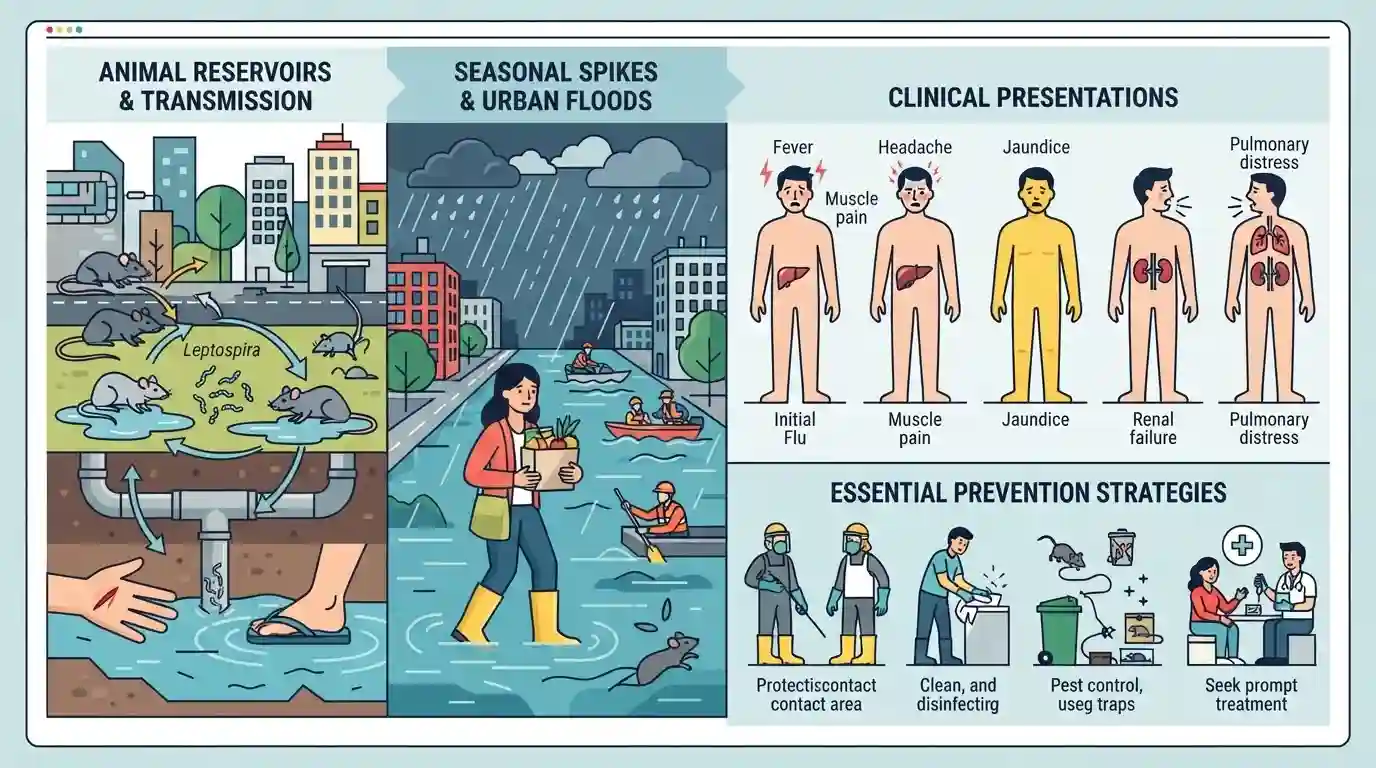
This article provides a comprehensive overview of leptospirosis, a bacterial zoonosis caused by Leptospira species. It highlights modes of transmission (exposure to water/soil contaminated with animal urine), seasonal spikes during monsoons and urban flooding, clinical presentations ranging from mild febrile illness to severe multi-organ failure, and essential prevention strategies.
મુખ્ય મુદ્દા
- Leptospirosis is a zoonotic bacterial disease caused by bacteria of the genus Leptospira, commonly transmitted to humans through water or soil contaminated by the urine of infected animals like rodents, cattle, and dogs.
- The disease is particularly prevalent during the monsoon and post-monsoon seasons, often surging due to urban flooding, waterlogging, and poor sanitation infrastructure.
- Symptoms range from mild flu-like manifestations (fever, chills, headache, muscle aches) to severe, life-threatening complications such as Weil's disease, kidney damage, liver failure, and pulmonary hemorrhage.
- Prevention and control require robust public health measures, safe drinking water, vector and rodent control, personal protective equipment for sanitation/agricultural workers, and public awareness campaigns.
મહત્વપૂર્ણ શબ્દો
Leptospirosis

A widespread bacterial zoonotic disease caused by Leptospira species, transmitted through water or soil contaminated with infected animal urine, and frequently surging during monsoons and urban flooding.
UPSC context
UPSC GS Paper II (Health & Public Health) and GS Paper III (Disaster Management/Disease Outbreaks). Evaluates understanding of zoonotic infections and monsoon health risks.
પ્રિલિમ્સ ટ્રેપ
Leptospirosis is a mosquito-borne viral disease that peaks during the monsoon season due to vector proliferation.
Aspirants often assume leptospirosis is vector-borne like malaria or dengue because of its monsoon surge, but it is actually a bacterial infection spread through contaminated water or soil.
સંલગ્ન સ્થિર ખ્યાલો
What are the key characteristics of zoonotic diseases and the One Health framework in India?
- Definition & Scope: Zoonotic transmission involves infectious diseases spreading between animals and humans, encompassing viral, bacterial, and parasitic pathogens.
- One Health Approach: One Health integrates human health, animal health, and environmental interfaces to prevent and control zoonotic outbreaks holistically.
- Institutional Framework: National Center for Disease Control (NCDC) and ICMR coordinate surveillance and outbreak responses for high-burden zoonoses in India.
આંતર-વિષય પેટર્ન
Urban Flooding + Zoonotic Disease Outbreaks
Monsoonal urban flooding in Mumbai or Chennai regularly triggers leptospirosis outbreaks, intersecting disaster management (NDMA guidelines) with public health infrastructure.
Zoonotic Diseases + One Health Framework
Leptospirosis management requires coordinated surveillance across animal, human, and environmental sectors, aligning directly with the national One Health mission.

Expect a statement-based prelims question distinguishing bacterial zoonoses (leptospirosis) from vector-borne tropical diseases.
સંલગ્ન PYQ · 4
સંલગ્ન PYQ · 4
- 2021PrelimsGS1
In the context of hereditary diseases, consider the following statements : 1. Passing on mitochondrial diseases from parent to child can be prevented by mitochondrial replacement therapy either before or after in vitro fertilization of egg. 2. A child inherits mitochondrial diseases entirely from mother and not from father. Which of the statements given above is/are correct?
- 2019PrelimsGS1
Which one of the following statements is not correct?
- 2023PrelimsGS1
'Wolbachia method' is sometimes talked about with reference to which one of the following?
- 2024MainsGS3
Flooding in urban areas is an emerging climate-induced disaster. Discuss the causes of this disaster. Mention the features of two such major floods in the last two decades in India. Describe the policies and frameworks in India that aim at tackling such floods.
