Huntington Disease Genetic Basis and Neurodegenerative Impacts
Source:The Hindu ↗
Why It Matters
As India expands its genomic research capabilities through initiatives like the GenomeIndia Project, understanding hereditary and neurodegenerative conditions like Huntington's disease is critical for addressing rare genetic disorders, advancing precision medicine, and framing comprehensive health policies for non-communicable and genetic diseases.
Summary
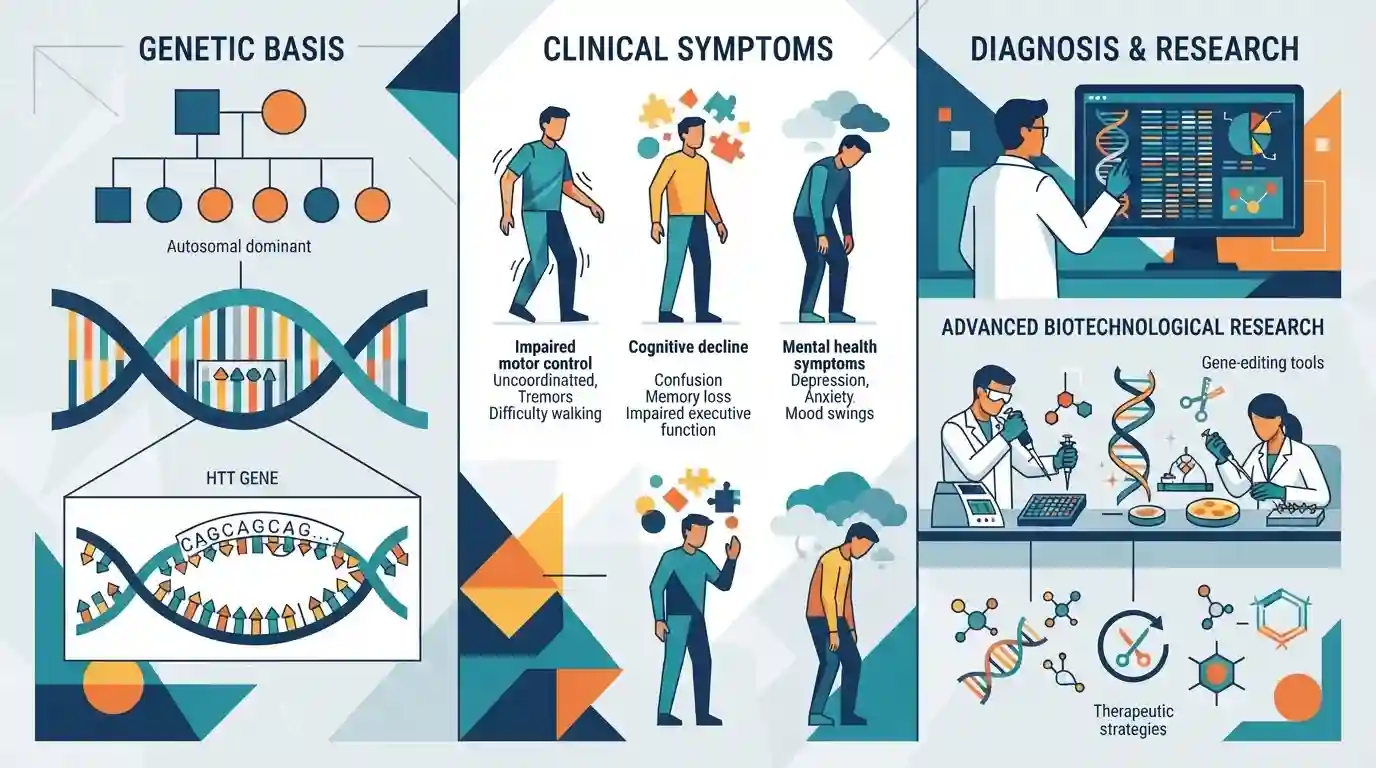
An overview of Huntington's disease, a rare and fatal hereditary neurodegenerative disorder caused by a genetic mutation in the HTT gene. The article highlights its genetic basis involving CAG repeat expansions, clinical symptoms affecting motor control, cognition, and mental health, and the current lack of curative therapies, emphasizing the need for advanced biotechnological research and genetic screening.
Key Points
- Huntington's disease is a fatal inherited neurodegenerative disorder caused by a mutation in the HTT gene on chromosome 4, leading to abnormal expansion of CAG repeats (polyglutamine expansion).
- It manifests as progressive motor dysfunction (chorea, involuntary movements), cognitive decline, and psychiatric disturbances, typically appearing in adulthood (30s to 50s).
- Currently, there is no cure or disease-modifying treatment available; management focuses on palliative care, symptomatic relief, and psychological support.
- Genomic initiatives like the GenomeIndia Project are crucial for mapping unique population-level genetic variations and understanding hereditary diseases in India.
Important Terms
GenomeIndia Project

A landmark pan-India genomics initiative funded by the Department of Biotechnology to sequence 10,000 genomes, establishing a genetic baseline and biobank to study population-specific rare and inherited disorders.
UPSC context
UPSC GS Paper III (Science & Technology - Biotechnology); important for understanding indigenous genetic mapping, rare diseases, and biobanking initiatives in India.
Static Concepts Connected
What are trinucleotide repeat disorders and how do they manifest genetically?
- Repeat Expansion: Genetic mutation involving abnormal expansion of three-nucleotide sequences (e.g., CAG repeats) within specific genes, disrupting normal protein function.
- Inheritance Patterns: Follows various inheritance patterns; Huntington’s disease is autosomal dominant, whereas others like Friedreich's ataxia are autosomal recessive.
- Genetic Anticipation: Characterized by 'anticipation', where disease severity increases and age of onset decreases in successive generations due to expansion instability.
Cross-Topic Patterns
Genomics + National Health Policy Frameworks
Mapping population-specific genetic variants through initiatives like GenomeIndia directly supports precision medicine and rare disease screening frameworks in the national health policy.

Autosomal dominant neurodegenerative disorders and trinucleotide repeat expansions like Huntington's will be tested via match-the-cause questions.
Linked PYQs · 2
Linked PYQs · 2
- 2026PrelimsGS1
Which of the following statements with regard to GenomeIndia Project is/are correct ? 1. It is a part of the Human Genome Project. 2. The project is funded by the Department of Biotechnology (DBT), Government of India. 3. Its primary aim is to build a catalogue of genetic diversity of the Indian population. Select the answer using the code given below :
- 2021MainsGS3
What are the research and developmental achievements in applied biotechnology? How will these achievements help to uplift the poorer sections of the society?
